Process sheet · enquiry to delivery
How ordering works.
Three steps between a valve list and a valve on your dock: drawn once, then explained field by field.
Ordering from NF Teguh takes three steps. Send your valve list by phone, email or WhatsApp. Receive a quotation stating what is from stock and what is on indent. Confirm with a purchase order, and the counter arranges collection or delivery. A complete enquiry states size, pressure class, body material, end connection, operator and quantity. This page explains each field so quotation and delivery stay fast.
Step one: send the valve list
An enquiry reaches the counter three ways: phone +603 5888 9223, email sales@nf-teguh.com.my, or WhatsApp +6012 944 3980. Send the list in whatever form it already exists: a typed message, a spreadsheet, a scanned requisition, a photo of your material take-off. No portal to fill and no account to open first.
What matters is not the format but the fields. Each line should carry enough to price without a call-back: the six fields in DETAIL 04 below. A one-line WhatsApp stating all six beats a formal document that leaves the pressure class to be guessed. If a field is not decided yet, say so; an honest gap is quicker to resolve than a silent one.
Step two: the quotation
The quotation prices your list line by line and says one thing plainly for every line: whether the item is offered from stock or on indent. From stock means the valve is on the racking in Subang Jaya and moves as soon as the order lands. On indent means it is brought in against your order. The quotation states this plainly, because the difference drives your planning more than any other fact on the page.
The quotation also names the documents that travel with the goods. Test reports and material certificates are listed against the lines you asked them for, at the price quoted. Check that list before you confirm. A certificate named on the quotation is part of the order; one remembered afterwards is a fresh request. Validity is stated on the face of the document.
Step three: purchase order and delivery
Confirm with a purchase order that references the quotation: number, line items and the document requirements you are holding the order to. The counter acknowledges it and the goods move by the route the order named: collection from the counter at 24A, Jalan Tiara 2, Taman Perindustrian Sime UEP, Subang Jaya, or delivery to your site or forwarder. If you plan to collect, say so on the order and you will be told when the item is ready.
Certificates and test reports travel with the delivery, referenced to your order lines. Check goods against the delivery order on receipt: size, class and material grade on the nameplate against what you ordered. Raise anything odd while the paperwork is still on the table.
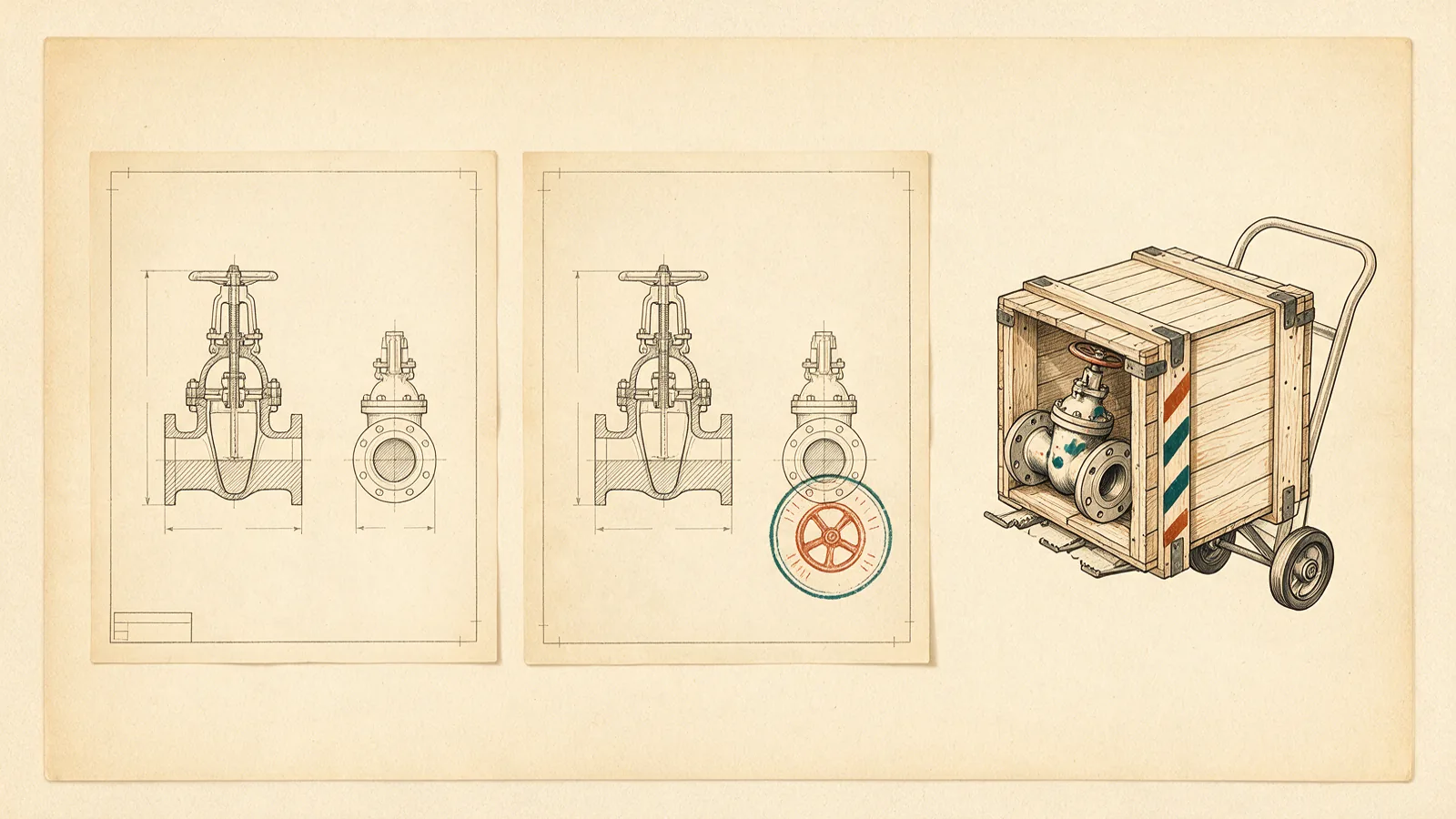
What a complete enquiry states
- Size: nominal bore, per line
- Pressure class or PN rating
- Body material, and trim if your spec names it
- End connection: flanged, butt-weld, threaded
- Operator: handwheel, gear, actuated
- Quantity per line
- Service
- Add the fluid and conditions where the duty is unusual, so the counter can check your selection
- Standards
- Name the design standard your spec works to, if it names one
- Papers
- State certificate and test requirements on the enquiry, not after: see DETAIL 05
- Help
- Unsure of a field? The specifying guide walks every one
Six fields per line is the whole ask. A complete enquiry needs no clarifying round trip. Every field above maps one-to-one onto a line of the quotation you get back, which is how a purchase order stays unambiguous.
Documents you can request
Two families of paper cover most orders. Request both on the enquiry so they can be named on the quotation. EN 10204 material certificates answer what the body and trim are made of: type 3.1 is the routine ask for pressure-retaining parts, 3.2 adds independent countersignature for critical service. API 598 test reports answer whether the finished valve passed its shell and seat tests before despatch.
Which type your project needs, and the wording that puts it beyond argument on a purchase order, is covered in the procurement documentation guide. If your inspector or client documentation list names something more specific, put the list itself on the enquiry.
EN 10204 and API 598 are published standards, named here as reference. Confirm requirements against the current edition; your purchase order governs what is supplied.
Common delays, and how to avoid them
Almost every slow order is slow for one of four reasons, all avoidable at the enquiry stage. A missing field, usually pressure class or body material, turns a same-day quotation into a question-and-answer thread. Papers requested after delivery: a certificate is easy to name on an order and hard to produce afterwards, so ask up front. A flange standard mismatch: an enquiry that never says which flange standard the piping uses invites the wrong drilling. Actuated lines without details: an actuator needs its mounting and signal stated, or the quotation comes back as questions.
The enquiry is the cheapest place to be complete. A minute spent on the six fields is repaid at every later step. If anything on the route is unclear, the FAQ answers the questions buyers actually ask.