Valve family 01 / 06 · multi-turn isolation
The gate valve.
A wedge that lifts clear of the bore. Full flow, or no flow, and nothing in between.
- Motion
- Multi-turn rising wedge
- Duty
- Isolation only, never throttle
- Bore
- Full, unobstructed when open
- K
- ≈ 0.15 fully open, reference only
A gate valve is a linear-motion isolation valve: a wedge or parallel gate lifts clear of the bore so flow passes straight through with very little pressure drop. Plants use gate valves where the duty is fully open or fully shut, not throttling. NF Teguh supplies gate valves for Malaysian power, petrochemical, oil and gas, terminal, offshore and natural gas services, quoted against your size, class and material.
How a gate valve works
Turn the handwheel and the stem draws a wedge-shaped disc up out of the flow path, into the bonnet. Open, the bore is a straight, round passage the same size as the pipe. Fluid passes as if the valve were not there, which is why the gate valve’s resistance coefficient is among the lowest of any pattern. Closed, the wedge is pressed between two machined seats, one each side of the body, and line pressure helps hold it against the downstream seat.
That geometry is also the pattern’s one firm rule: a gate valve is an open-or-shut device. Left partly open, the wedge hangs in the stream, vibrates, and the seating faces erode. The valve loses the tight shutoff that was the reason it was chosen. Where the duty is regulating flow rather than isolating it, the right answer is a globe valve. The trade-offs are set out in gate valve vs globe valve.
Where gate valves fit, and where they do not
Gate valves dominate block-valve duty: pump suction and discharge isolation, header take-offs, battery limits, tank connections. Anywhere a line must be positively shut for maintenance and fully open the rest of its life. The straight-through bore also passes scrapers and pigs, which matters on long product lines. In Malaysian service NF Teguh quotes them across power plant, petrochemical, oil and gas, terminal, offshore and natural gas duties.
They are the wrong choice for throttling and for frequent cycling, since a multi-turn valve is slow to stroke. They are wrong too where a quarter-turn interlock or fast shutoff is the point; there a ball valve earns its place. On dirty or scaling media the wedge guides can pack with solids, which is where a plug valve is often specified instead.
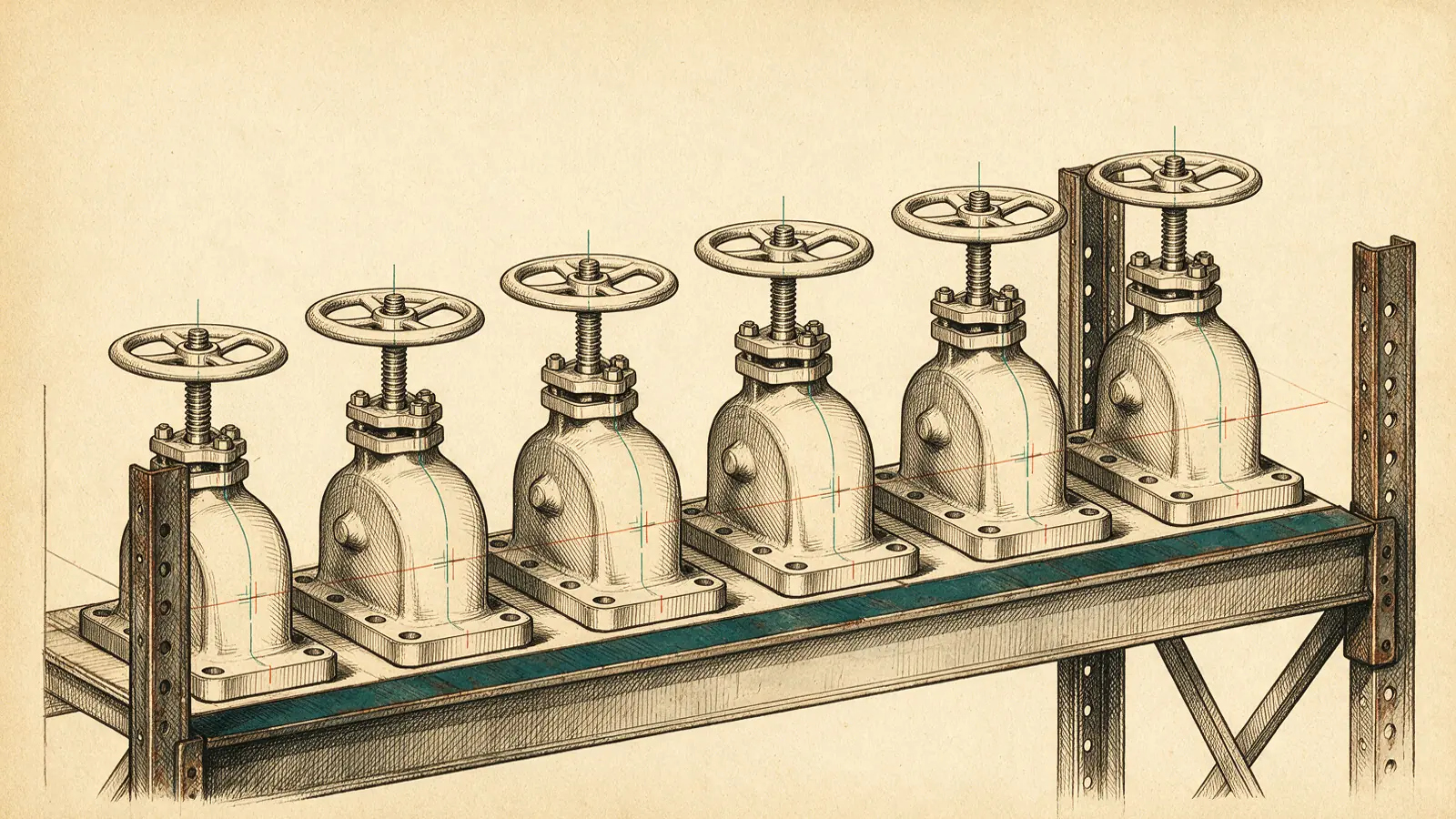
Wedge patterns: solid, flexible, split
The wedge comes in three main patterns, and specifying the right one is mostly about temperature. A solid wedge is the simplest and strongest, the default for smaller sizes and steady conditions. A flexible wedge is cast with a peripheral groove so each face can flex a little against its seat. It forgives the seat distortion that thermal cycling causes, which is why it is the common choice on steam. A split wedge is two halves that self-align, suited to non-condensing services at moderate temperature.
Stem arrangement matters too. Rising-stem outside-screw-and-yoke construction keeps the stem threads out of the process fluid and shows position at a glance. Why that pattern dominates isolation duty is covered in the OS&Y explainer.
Body and trim materials
Carbon steel bodies carry most general hydrocarbon and utility duty. Cast and forged grades cover the standard pressure classes, with low-temperature grades where the service dips below ambient design limits. Stainless and alloy bodies answer corrosive media and higher temperatures. Trim, meaning the seats, wedge facing, stem and back-seat, is specified separately from the body. Hard-faced trim earns its cost wherever the valve will be cycled against differential pressure.
Sour service adds its own layer. Where a line names NACE MR0175, body, trim, bolting and welds all fall under its material limits. See what sour service means for a valve order. State the service fluid honestly on the enquiry and the material question usually answers itself.
Standards a gate valve enquiry usually names
Three designations do most of the work on a gate valve purchase order. API 600 is the design and manufacturing standard for bolted-bonnet steel gate valves in petroleum service. At NPS 4 and below, a compact gate valve may be ordered to API 602 instead; how to tell API 600 from API 602 on a spec line sets out the split. ASME B16.34 tabulates the pressure-temperature ratings behind every class marking. What Class 150 or Class 300 actually permits at your line temperature is set out in the pressure class reference. API 598 governs the shell and seat testing the finished valve must pass before despatch.
Designations are reference data, not a claim about any particular valve. The governing edition is always the one your purchase order names. Confirm ratings against the manufacturer’s own data for the size and trim quoted.
What to state on a gate valve enquiry
- Size & pressure class
- End connection: flanged, butt-weld, threaded
- Body & trim material
- Wedge pattern, if your spec names one
- Operator: handwheel, gear, actuated
- Test & certification required
- Quote
- From stock or on indent. The quotation states which
- Papers
- Test reports and material certificates on request. Ask on the order, not after delivery
- Route
- How ordering works, in three steps
- Counter
- Phone, email or WhatsApp