Comparison sheet · isolation against regulation
Gate valve vs globe valve.
Two multi-turn patterns, one decision: does the line need to be shut, or steered?
Choose a gate valve for open-shut isolation and a globe valve for throttling. A gate valve's straight bore gives minimal pressure drop but poor flow control. A globe valve's seat-and-disc geometry controls flow precisely but costs more head. Block valves on long runs favour gate; control duty near pumps and bypasses favours globe. Geometry, pressure drop, operation and typical services are compared below.
The one-line rule
Isolate with a gate, regulate with a globe. A gate valve is built to be fully open or fully shut, and to stay that way for years. A globe valve is built to hold any position in between and meter the flow. Every other difference follows from that division of labour. Where a specification says “block valve”, it means the gate pattern. Where it says “regulating” or “bypass control”, it means the globe. The rest of this sheet is the reasoning, ending in the table that settles most selections.
Geometry and flow path compared
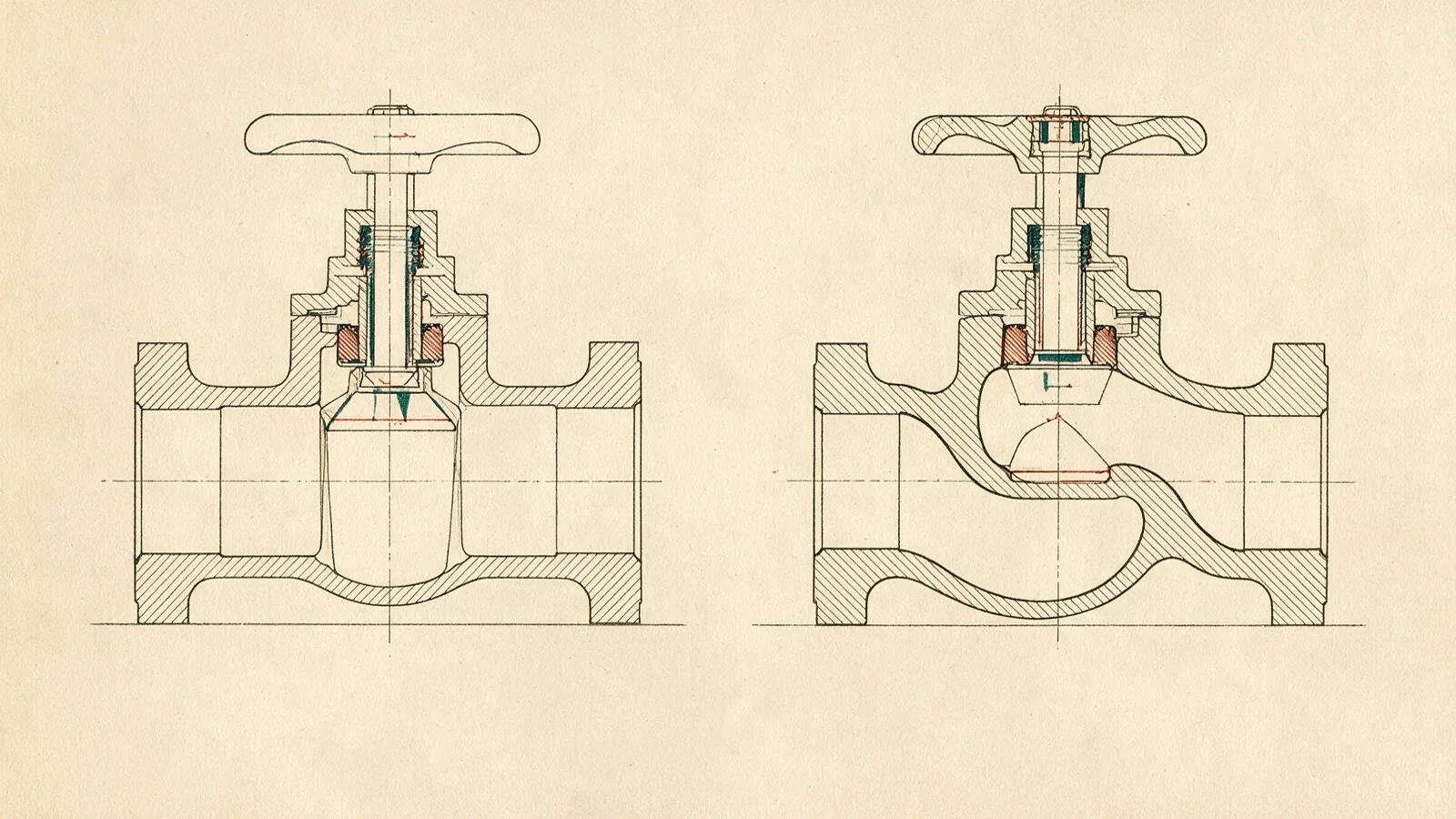
Cut both bodies open and the difference is immediate. The gate valve is a straight tube with a slot: a wedge slides across the bore at right angles to the flow. Lifted into the bonnet, it leaves a round, full-size, unobstructed passage. The globe valve turns the fluid instead. Its body walls the passage into an S: flow enters below the seat, rises through it and turns again to leave. The disc closes onto that seat parallel to the flow, which is what lets it hold intermediate positions without damage.
Pressure drop and energy
Geometry is paid for in head. An open gate valve is nearly invisible to the fluid. Its resistance coefficient sits at the bottom of the published range, which is why long transfer lines and pump suctions are gated. The globe’s two right-angle turns cost roughly an order of magnitude more resistance, even fully open. On a valve that opens twice a year that is trivial. On a large line running around the clock it is a pumping-energy bill. Specify a globe only where its control ability is actually used.
Resistance coefficients are order-of-magnitude reference values. Confirm against the manufacturer’s published data for the size and trim quoted. Your purchase order’s edition governs.
Operation and speed
Both are multi-turn valves: a handwheel and many revolutions from shut to open. Neither is quick, and neither suits duties that cycle constantly. That is quarter-turn territory, compared in ball valve vs butterfly valve. The globe usually strokes in fewer turns, because its disc lifts a short way off the seat rather than clearing the full bore. The globe also throttles without damage: its disc and seat are made for partial opening. Never throttle with a gate valve. Half open, the wedge vibrates in the stream and the seating faces erode first.
Typical services for each
Gate valves take the block positions: pump suction and discharge isolation, header take-offs, battery limits and tank connections. Globe valves take the working positions: bypass and recirculation lines, vent and drain duty, sample points, and anywhere flow is trimmed by hand. Across the industries NF Teguh supplies (power plant, petrochemical, oil and gas, terminal, offshore, natural gas), the two patterns sit side by side in the same piping class. On steam, the globe takes the regulating stations while flexible-wedge gates hold the isolation points either side.
The comparison table
Seven lines settle most selections. Qualitative by design: sizes, classes and trims move the numbers, so the numbers belong on the quotation.
Full comparison: scroll →
| Factor | Gate valve | Globe valve |
|---|---|---|
| Geometry | Wedge slides across a straight bore | Disc closes onto a seat in the body |
| Flow path | Straight through, full bore open | S-shaped: two turns through the seat |
| Pressure drop | Very low when open | High: inherent to the path |
| Operation speed | Slow: many turns, full bore lift | Slow, but a shorter stroke |
| Throttling ability | None: damages the seats | Good: designed for it |
| Typical duty | Block and isolation positions | Regulation, bypass, vent and drain |
| Relative cost basis | Lower for equal size and class | Higher: more machined seating work |
Qualitative comparison for pattern selection only. Ratings, dimensions and trims come from the governing standards and the manufacturer’s data for the valve quoted. Confirm against the current edition; your purchase order governs.
Which to enquire for
Name the duty and the pattern names itself. “Isolation” on the enquiry line means gate; “regulating” means globe. A line that needs both gets one of each, not one compromise valve. State size, pressure class (what a class permits is on the reference sheet), end connection, body and trim material, operator and the certificates required. The counter can then quote either pattern from the same list. The full checklist is on specifying industrial valves, the route from quotation to delivery on how ordering works, and the counter answers by phone, email or WhatsApp.