Valve family 02 / 06 · multi-turn regulation
The globe valve.
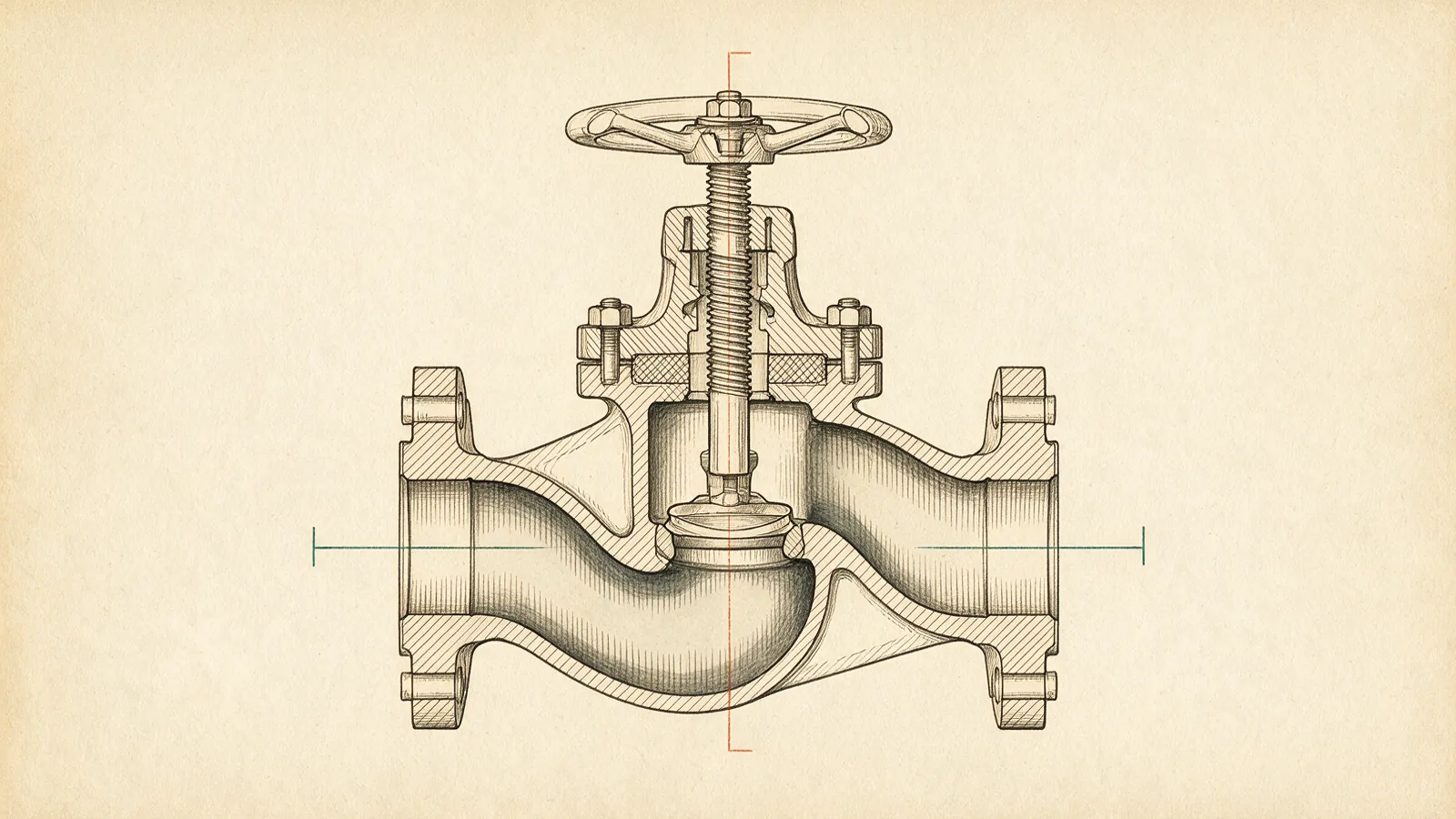
A disc lowered onto a seat across an S-shaped passage. Specify it when flow must be metered, not merely stopped.
- Motion
- Multi-turn disc off a seat
- Duty
- Throttling and regulation
- Cost
- Tortuous path, high pressure loss
- K
- ≈ 6 fully open, reference only
A globe valve regulates flow. Its disc closes onto a seat set in an S-shaped passage, so it can throttle as well as isolate. That gives fine control, at a higher pressure drop than a gate valve. NF Teguh supplies globe valves to Malaysian power plant, petrochemical, oil and gas, terminal, offshore and natural gas services, matched to your purchase order.
How a globe valve works
Fluid enters below the seat, turns upward through the seat ring, then turns again to leave. That is the S-shaped passage the pattern is named for. The disc closes square onto the seat, so each increment of handwheel travel changes the open area by a predictable amount. Stem position and flow stay stable enough to set, hold and repeat.
The same geometry sets the price. Two changes of direction cost energy. Fully open, a globe valve resists flow perhaps forty times as much as an open gate valve of the same size. Where the line can afford that loss, the control is worth it.
Throttling duty: what a gate valve cannot do
Left half-open, a gate valve’s wedge hangs loose in the stream and chatters itself out of a seal. A globe valve’s disc is carried rigidly on the stem and sits happily at any opening. That is why bypass lines, minimum-flow loops, vents, drains and sample points are globe territory.
The rule cuts both ways. On a line that is only ever fully open or fully shut, the globe valve’s pressure loss buys nothing, and block duty goes to the gate valve. The full trade is tabulated in gate valve vs globe valve. Severe throttling erodes the trim, so state honest line conditions and the counter flags it early.
Tee, wye and angle patterns
The tee pattern puts the seat square across the body: most compact, highest loss. The wye pattern leans stem and seat to roughly forty-five degrees, so loss falls sharply and the freer path suits erosive services. The angle pattern turns the flow ninety degrees, so the valve replaces an elbow: one casting, one set of flanges.
Specify by what the line needs: tee where compactness rules, wye where pressure drop or solids matter, angle where the pipe already turns.
Disc and seat trim choices
Trim tunes a globe valve to its duty. A plug-type disc, tapered and parabolic, gives the finest control and is the usual choice for genuine throttling. A flat or conventional disc favours shutoff over control. A needle profile, in small sizes, meters the smallest flows. Renewable seat rings let a worn seat be replaced rather than the body scrapped.
Materials follow the service. Hard-faced trim resists the erosion and wire-drawing that throttling inflicts, and earns its cost on any valve that lives partly open. State the fluid, the temperature and the duty, regulate or isolate, and the trim question usually answers itself. The specifying guide walks the full sequence.
Standards a globe valve enquiry usually names
BS 1873 is the design standard for bolted-bonnet steel globe valves in petroleum and general industrial service. ASME B16.34 carries the pressure-temperature ratings behind the class markings. What a class permits at your line temperature is tabulated in the pressure class reference, and the system is unpacked in what Class 150, 300 and 600 actually mean. API 598 governs the shell and seat tests before despatch.
Designations are published reference data, not a claim about any particular valve. The governing edition is always the one your purchase order names. Confirm ratings against the manufacturer’s data for the size and trim quoted.
What to state on a globe valve enquiry
NF Teguh supplies globe valves from Subang Jaya into Malaysian power plant, petrochemical, oil and gas, terminal, offshore and natural gas services. Six lines make an enquiry quotable first time:
- Size & pressure class
- End connection: flanged, butt-weld, threaded
- Body & trim material
- Pattern (tee, wye or angle) and the duty: regulate or isolate
- Operator: handwheel, gear, actuated
- Test & certification required
- Quote
- From stock or on indent: the quotation states which
- Papers
- Test reports and material certificates on request. Ask on the order, not after delivery.
- Route
- How ordering works, in three steps
- Counter
- Phone, email or WhatsApp