Valve family 05 / 06 · quarter-turn, disc in the stream
The butterfly valve.
A disc turns on its stem in the middle of the bore. It is the lightest, shortest way to close a large line.
- Motion
- Quarter-turn disc in the flow
- Duty
- Large bore, low weight, coarse control
- Note
- Disc stays in the stream when open
- K
- ≈ 0.45 open, reference only
A butterfly valve turns a disc a quarter turn inside the flow path, giving isolation and coarse control from a short, light body. Wafer and lug patterns bolt between existing flanges, which keeps installed weight and cost down on large lines. NF Teguh supplies concentric and offset butterfly valves for Malaysian power, petrochemical, oil and gas, terminal, offshore and natural gas services.
How a butterfly valve works
A circular disc sits in the bore on a stem through its diameter. A quarter turn swings it from flat against a seat, shut, to edge on to the flow, open. The disc never leaves the stream. Even fully open its edge stands in the bore, which costs a modest, permanent pressure loss and rules the pattern out where a pig must pass. It will hold intermediate positions, so coarse flow control is a legitimate duty.
What the geometry buys is size economy. The body is a short ring, not a long casting. The disc weighs a fraction of a wedge or a sphere of the same bore. Both advantages grow with diameter, which is why cooling water, tank farm and utility lines go butterfly once the bore is large. The full trade is tabulated in ball valve vs butterfly valve.
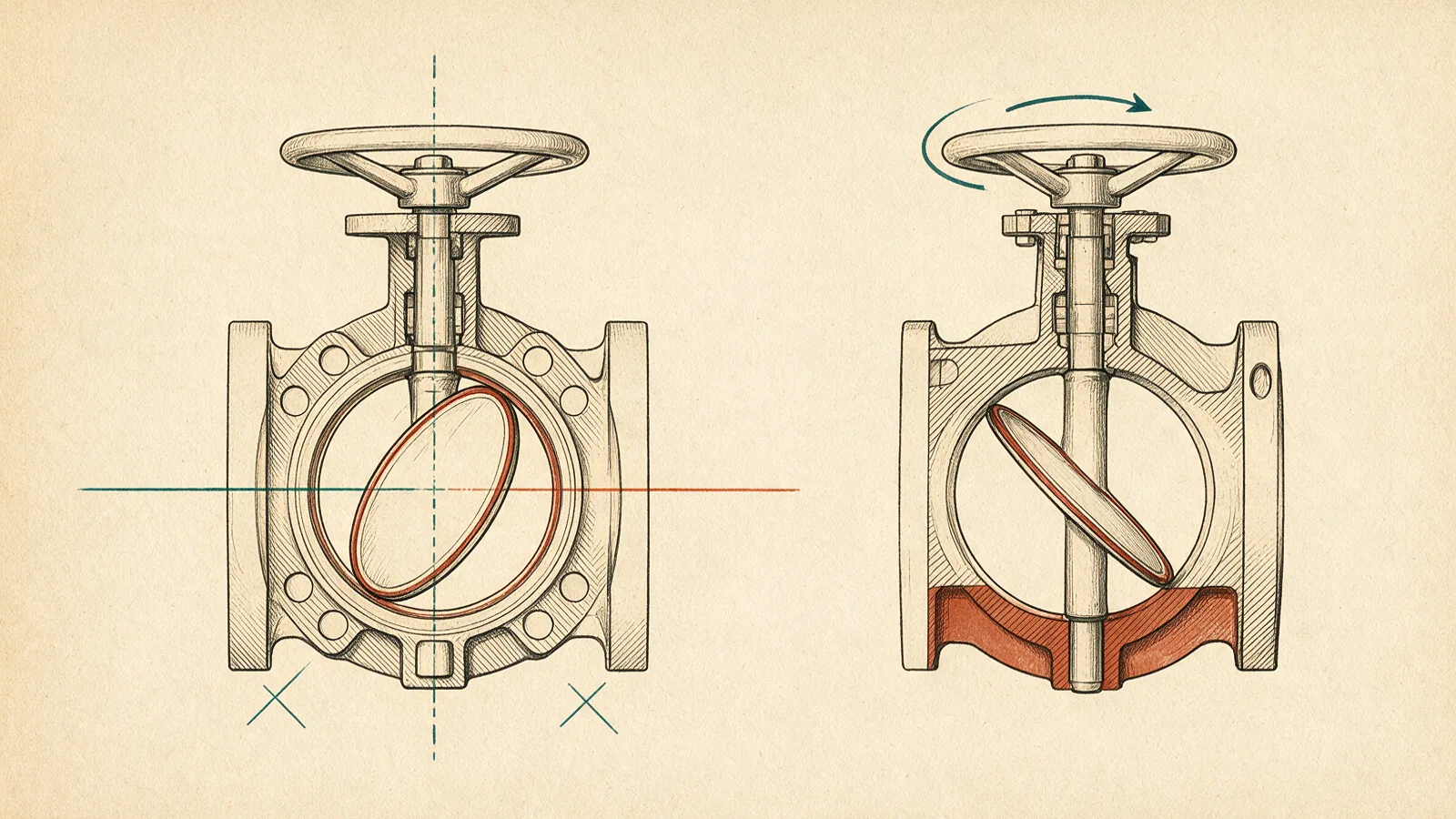
Wafer, lug and double-flanged bodies
A wafer body is a ring clamped between two pipe flanges by the line’s own studs. It is the cheapest and lightest pattern, but it lives only as long as both flanges are made up: break the joint and the valve comes out with it. A lug body carries threaded lugs so each flange bolts to the valve independently. Downstream pipework can then be dropped with the valve still holding the line, within the maker’s dead-end rating. A double-flanged body is a valve like any other, with its own full flanges, and is the choice for large bores and critical positions.
The split is installation, not performance. The same disc and seat live in all three shells. Which body a position justifies is worked through in the body-pattern memo.
Concentric and offset disc geometries
In the concentric pattern the stem passes through the disc’s centre and the disc closes into a resilient liner. Simple, cheap and tight, but the seat is rubbed through the whole stroke, so liner life sets valve life. Utility and water duty live here happily.
Offsetting the stem changes the motion. A double-offset disc cams away from its seat within the first degrees of opening, so seat contact and wear nearly vanish. Pressure and temperature range climb accordingly. The triple-offset pattern adds a conical, torque-seated metal seal: no rubbing at all, and tight shutoff at temperatures no elastomer survives. Process and hydrocarbon specifications name the offset patterns almost exclusively.
Liner and seat materials, and the actuator pad
On a lined valve the liner is the wetted surface. The fluid touches liner and disc, and often never the body at all, so chemistry and temperature limits belong to the liner material, not the shell. Elastomer grades carry water and utility duty. PTFE-lined patterns answer aggressive media. Offset patterns move to laminated or solid metal seats where heat rules soft materials out. State the fluid and temperature honestly and the liner column of the quotation writes itself.
One more line matters at enquiry time. Butterfly valves are actuated more often than any other family, and the ISO 5211 mounting pad standardises how a gearbox or actuator bolts to the stem. If the valve will ever be automated, say so. A pad specified now costs nothing; a retrofit later costs a bracket, a coupling and patience.
Standards a butterfly valve enquiry usually names
API 598 governs the shell and seat testing the finished valve passes before despatch. ISO 5211 defines the actuator mounting interface above. Class-rated patterns carry markings that trace to ASME B16.34. What each class permits at your line temperature is tabulated in the pressure class reference. The certificates a purchase order can call for are covered in the procurement documentation guide.
Designations are published reference data, not a claim about any particular valve. The governing edition is always the one your purchase order names. Confirm ratings against the manufacturer’s data for the size and liner quoted.
What to state on a butterfly valve enquiry
NF Teguh supplies concentric and offset butterfly valves from Subang Jaya into Malaysian power, petrochemical, oil and gas, terminal, offshore and natural gas services. Six lines make the enquiry quotable first time:
- Size & pressure class
- End connection: wafer, lug or double-flanged
- Body, disc & liner material
- Disc geometry: concentric, double or triple offset
- Operator: lever, gear, actuated (ISO 5211 pad)
- Test & certification required
- Quote
- From stock or on indent. The quotation states which
- Papers
- Test reports and material certificates on request. Ask on the order, not after delivery
- Route
- How ordering works, in three steps
- Counter
- Phone, email or WhatsApp