NACE MR0175 and sour service: what it means when a valve line names it
NACE MR0175, now paired with ISO 15156, limits materials for sour service (hydrocarbon streams carrying hydrogen sulphide) because sulphide stress cracking breaks susceptible steels. When a valve line names it, body, trim, bolting and welds must all comply, typically through hardness limits and controlled chemistry. This article explains when the standard applies, what compliance looks like on paper, and what to settle before ordering.
In this memo06 details
What sour service is
Sour service is oil and gas production duty where the stream carries hydrogen sulphide in the presence of water. The threshold is not a smell or a rule of thumb: the standard defines when an environment counts as sour, by the partial pressure of hydrogen sulphide in the system, and the operator's process engineers make that determination line by line. Below the threshold, ordinary materials practice applies; above it, a separate materials law takes over.
That law is NACE MR0175, maintained jointly as ISO 15156. The two designations name the same body of requirements, and specifications cite them singly or together. When a valve line in a datasheet carries the words, every wetted metallic part of that valve has just been given a materials sentence. As throughout this register, the detail below is published reference data: the governing edition is your purchase order's, and the classification of the service belongs to the operator. Where sour lines cluster is sketched in the oil & gas overview.
Why hydrogen sulphide cracks steel
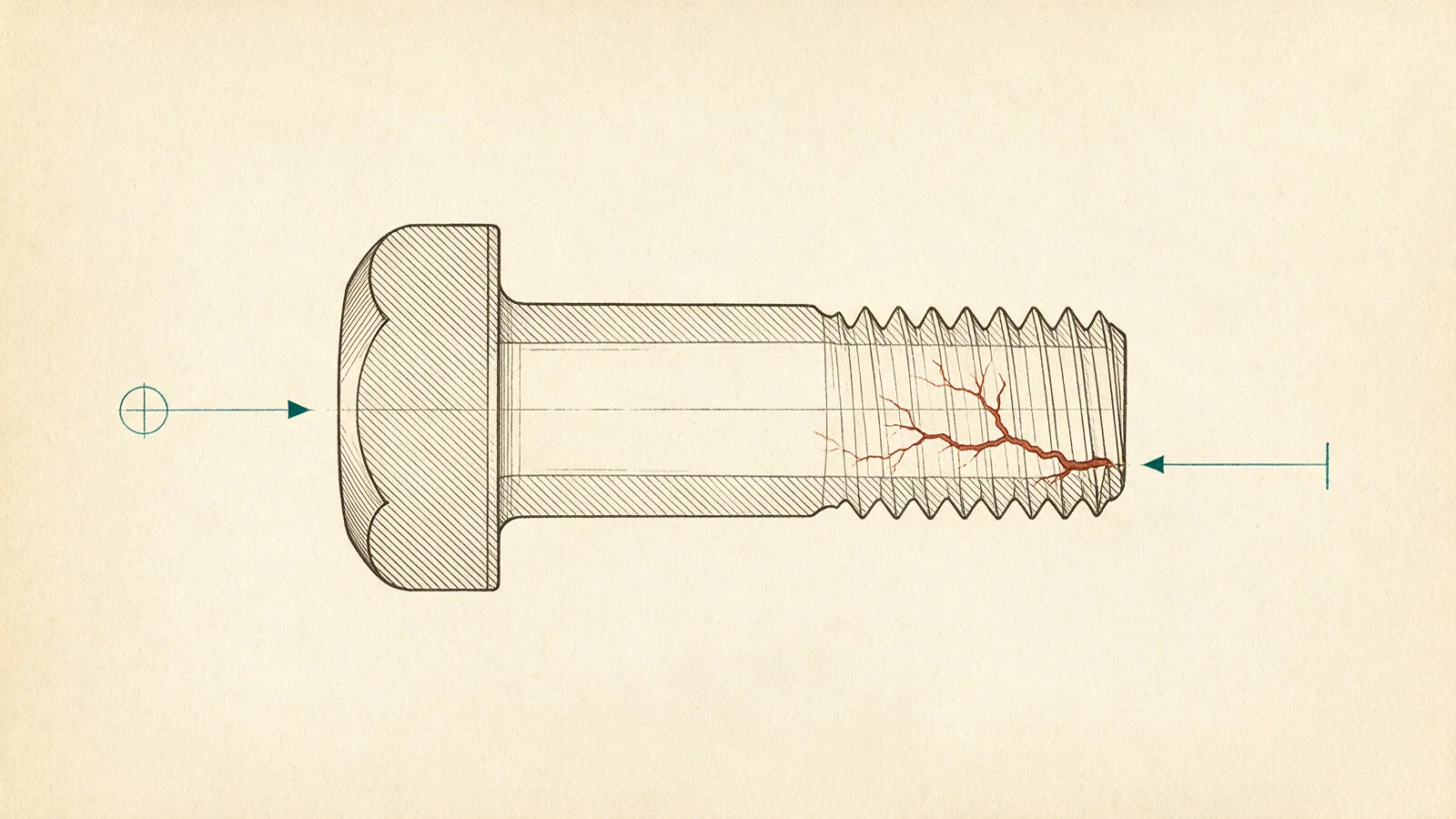
The mechanism is sulphide stress cracking, a form of hydrogen embrittlement. Wet hydrogen sulphide corrodes steel slowly, but the damage that matters is not the corrosion itself: the reaction generates atomic hydrogen, and the sulphide keeps that hydrogen from recombining harmlessly at the surface, so it diffuses into the metal instead. In a hard, highly stressed microstructure the absorbed hydrogen destroys ductility, and a part that would have yielded gracefully instead cracks and fractures, suddenly, at stresses well below its rated strength.
The plate above shows the signature: a branching crack running through the threaded, stressed end of a bolt. Two facts drive everything the standard requires. Harder materials are more susceptible, and higher stress accelerates the attack. That is why the response is written in hardness limits and material condition, not in corrosion allowances. It is also why the failure is so unforgiving of shortcuts: the crack grows quietly inside sound-looking metal, and the first visible symptom of sulphide stress cracking is frequently the fracture itself.
What MR0175 compliance covers
Compliance is a property of every part exposed to the sour environment, not of the valve as a catalogue item. There is no such thing as a NACE valve in the abstract. There is a valve whose named parts are supplied in materials and conditions the standard accepts for the intended environment. That framing matters at enquiry stage, because two suppliers can both write "NACE" against a line while meaning different scopes of parts. On a typical valve it reaches all of this:
| ELEMENT | WHAT THE STANDARD ASKS | WHERE IT BITES |
|---|---|---|
| Body and bonnet | Compliant grades in a compliant heat-treated condition | Castings and forgings forming the wetted envelope |
| Trim | Compliant materials for closure member, seats and stem | Stems: highly stressed and fully wetted |
| Bolting | Compliant bolting wherever the environment reaches it | The classic miss: studs specified as if they were dry |
| Welds and repairs | Qualified procedures, controlled hardness in weld and heat-affected zone | Repairs made outside the qualified procedure |
Hardness limits in plain terms
Hardness is the standard's chosen proxy for susceptibility, because it can be measured on a finished part and correlates with the microstructures that crack. For each material family the standard sets ceilings on measured hardness and conditions on how that state is reached: heat treatment held within defined limits, cold work controlled, welds and their heat-affected zones brought under the same ceiling as the parent metal. The specific values live in the standard's tables and belong there. Quote them from the edition your purchase order names, not from memory or a forwarded datasheet.
One non-compliant stud in a sour line undoes the compliance of everything it holds together.
The discipline this demands is uniformity. A compliant body with an over-hard weld repair, or compliant trim held down by ordinary bolting, is a non-compliant valve wearing compliant paperwork.
Paperwork that evidences compliance
Compliance is claimed on the order and evidenced in the material documents. Expect a supplier's statement that the valve is supplied in accordance with NACE MR0175 / ISO 15156 for the parts the order names, backed by material certificates showing grade, heat-treatment condition and hardness results for the actual heats supplied. That is exactly the territory of EN 10204 certificates. Sour duty is one of the services where specifications routinely escalate the ask from a 3.1 to an independently countersigned 3.2. How the whole document pack hangs together is mapped in the valve procurement documentation guide.
Read the certificates against the claim: the grades, conditions and hardness figures on the paper are the compliance. A cover letter asserting the words, over certificates that show something else, is the discrepancy audits exist to find.
Questions to settle before ordering
Four questions close most gaps. Is the service formally classified sour, and by whom? The standard's applicability is the operator's call, not the supplier's. Which parts must comply: wetted parts only, or bolting and externals too, since specifications differ on where the environment is assumed to reach. What documentation evidences it: statement plus certificates, and of which EN 10204 type. And which edition governs, written on the purchase order rather than assumed.
Settled up front, none of this costs more than a paragraph of wording. It is the same discipline the specifying guide applies to every other line of a valve order. Settled after delivery, it costs a valve. A stockist such as NF Teguh in Subang Jaya would rather see the paragraph; more memos from the counter are in Insights.
Related memos
Standards named above are published reference data. Confirm against the current edition; your purchase order governs. Questions: the counter.