Wafer, lug or double-flanged: choosing a butterfly valve body
Wafer butterfly valves clamp between line flanges and are the lightest and cheapest; lug bodies carry threaded inserts so a line can be dead-ended or dismantled on one side; double-flanged bodies bolt independently to each flange and suit larger sizes and critical or buried service. This article sets out how each installs, what each allows in maintenance, and how to state the choice on an enquiry.
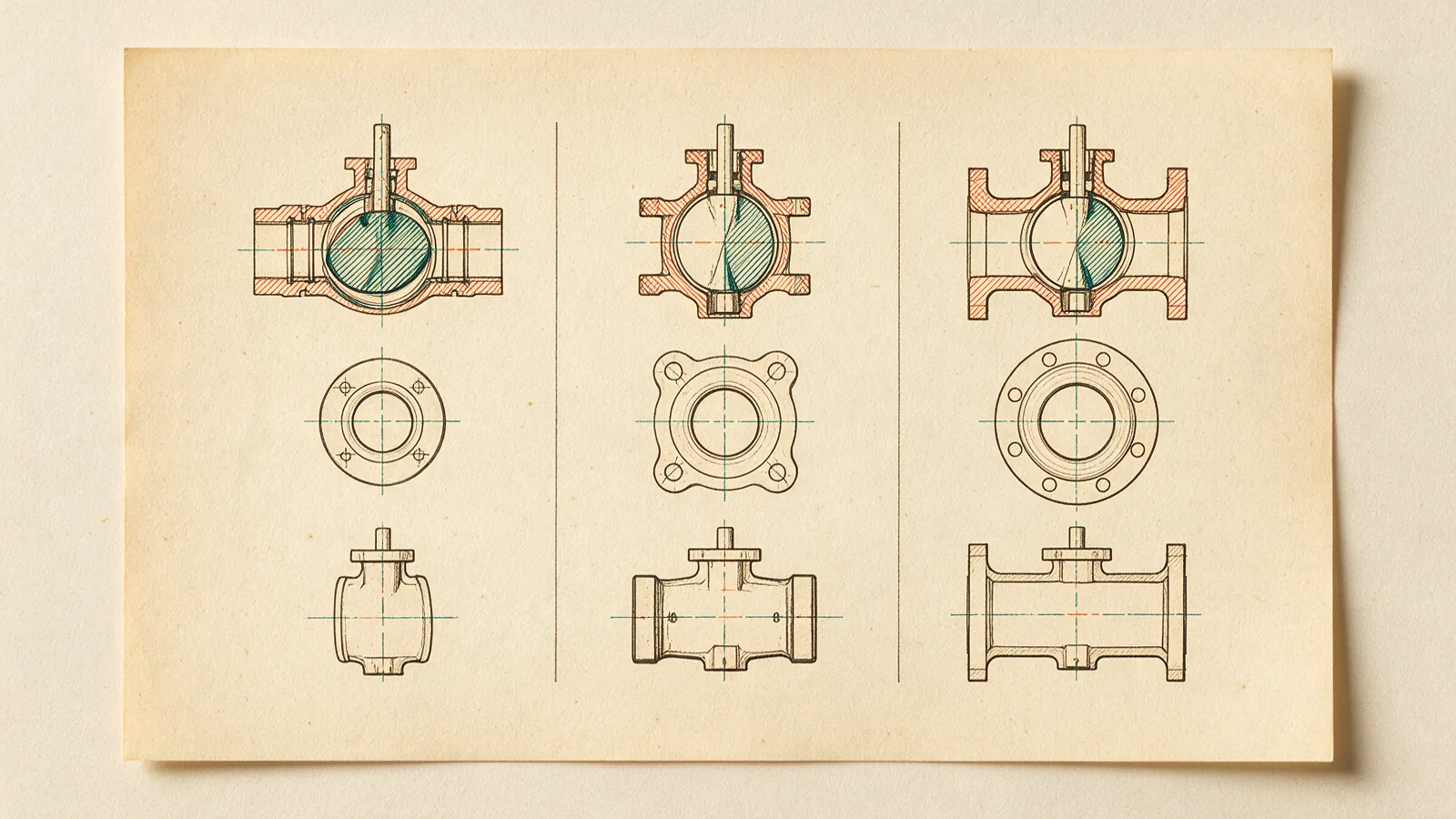
In this memo06 details
The three bodies at a glance
The butterfly valve puts a disc on a shaft in the middle of the flow and turns it a quarter of a turn. Around that one mechanism the industry sells three different bodies, and the choice between them is not about how the valve seals. It is about how the valve meets the pipework, and what the pipework is allowed to do around it afterwards. Wafer bodies clamp between the line flanges; lug bodies carry threaded lugs so bolting can land in the valve itself; double-flanged bodies are full flanged castings bolted independently to each side.
| Body | How it mounts | Dead-end service | Natural ground |
|---|---|---|---|
| Wafer | Clamped between flanges by through-studs | No (needs both flanges made up) | Small and mid sizes, cost-driven duty |
| Lug | Short bolts into threaded lugs, each side separately | Possible, at the manufacturer's stated rating | Lines that must dismantle on one side |
| Double-flanged | Own flanges bolted to each mating flange | Yes, within its rating | Large bores, critical and buried service |
Dead-end capability and its pressure limit are always the manufacturer's rating call: confirm them on the specific valve's data sheet, because your purchase order governs.
Wafer: light and economical
A wafer body is the least metal a butterfly valve can wear. It has no working bolt holes of its own; long studs run from line flange to line flange straight past the body, and the joint's clamping force is what holds the valve in place. That makes it the lightest, shortest and cheapest of the three forms, and for a large share of water, air and general utility duty it is the default answer for exactly those reasons.
The economy has a consequence worth writing down: the valve exists only as part of a made-up joint. Undo either flange and the whole assembly lets go, so a wafer valve can never hold the end of an open line, and any maintenance downstream means draining the section and breaking the full joint. On a cooling loop that can be an accepted nuisance; on a process line it can be a shutdown. That limitation is precisely what the lug body exists to remove, and it is the first question to ask before the price difference settles the choice.
Lug: dead-end and maintenance service
A lug body carries cast lugs drilled and tapped to match the flange pattern, and each side is bolted separately with short cap screws. Nothing passes the body; each flange joint stands on its own. Downstream pipework can then be unbolted for maintenance while the upstream joint keeps holding, and, where the manufacturer rates the body for it, the valve can dead-end an open line. That dead-end rating varies by design and is frequently lower than the valve's normal class rating, so confirm the figure on the data sheet rather than assuming the line's class carries over; your purchase order governs. Lug bodies are the usual answer at pump suctions and discharges, tank connections, and anywhere a line is expected to come apart in service while the rest of the system stays wet.
Double-flanged: large and critical lines
A double-flanged body is a full casting with its own flanges, bolted to the mating flanges like any other flanged valve. It is the heaviest and most expensive of the three, and it is specified where the stakes climb: large bores where centring a wafer accurately between flanges becomes awkward, buried or submerged service where the joint must be permanent and dependable, and critical duty where the valve should behave as a piece of the piping rather than a filling clamped in a sandwich. Face-to-face dimensions for flanged valves are tabulated in ASME B16.10, whose lengths are set out in their own memo: published reference data; confirm against the current edition, since your purchase order governs. At sizes where a gearbox or actuator arrives, the double-flanged body's stiffness also gives the operator a steadier platform than a clamped wafer can offer.
Installation and gasket notes
Wafer and lug valves seal on gaskets or on an integral resilient liner depending on the design, and the difference matters at ordering time: a liner-seated valve wants no gaskets at all, because doubling up distorts the liner and the joint weeps from day one. Centring matters more than it does for most valves; a wafer body sitting low on its studs will catch the disc edge on the pipe bore, and the fault only shows itself when the valve refuses to stroke fully open. Remember too that a butterfly disc swings proud of the body faces as it opens, so the adjacent pipe must be clear of weld beads, linings and fittings at the valve. If an actuator is coming, name the mounting interface on the enquiry: ISO 5211 is the pad standard commonly quoted on data sheets. It is published reference data, to be confirmed against the current edition.
The disc does the sealing; the body only decides what the pipework may do around it. Buy the body for the maintenance you intend.
Wording for the enquiry
State the body style by name (wafer, lug or double-flanged) alongside size, class, disc and seat materials, the flange standard the line uses, and any actuation, the same discipline the specifying guide applies to every family. If the valve must dead-end, say so and at what pressure; that one sentence prevents a wrong body arriving on site. Certificates and test paperwork travel with the order per the procurement documentation guide.
NF Teguh is an industrial valve stockist in Subang Jaya, Selangor. Send the line conditions to the counter through the ordering route; where quarter-turn selection is still open between families, ball vs butterfly sets out that trade, and the rest of the register is on insights.
Related memos
Standards named above are published reference data. Confirm against the current edition; your purchase order governs. Questions: the counter.