Fire-safe valves: API 607 vs API 6FA and when a spec asks for them
Fire-safe means a valve keeps a defined degree of shutoff after a standard fire test, not that it is fireproof. API 607 covers fire testing of quarter-turn soft-seated valves; API 6FA covers fire testing for valves to API 6D. Specifications name one where a hydrocarbon inventory could feed a fire. This article explains what each test demonstrates and what to ask for when a datasheet says fire-safe.
In this memo06 details
What fire-safe actually means
Fire-safe does not mean fireproof, and it does not promise the valve is reusable after the flames are out. It means a representative valve of that design has been through a standard fire test (burned under defined conditions for a defined period) and kept its leakage, internal and external, within the limits the test standard allows, during the burn and after it. It is a demonstrated outcome on a test stand, nothing more and nothing less.
The reason specifications care is isolation. In a plant fire, the valves around the burning inventory are what stand between a contained incident and a fed one. The ordinary soft-seated valve fails that duty early, because its polymer seats soften and go long before the pressure boundary does. A valve that keeps even a degraded shutoff through the burn changes what the fire can reach.
So specifications ask for it wherever a hydrocarbon inventory could feed a fire through a failed valve: process units, tank farms, and the pipeline and terminal services surveyed in the oil & gas overview. Two API standards carry the requirement, and they are not interchangeable. As throughout this register: the test details below are published reference data, and the governing edition is your purchase order's.
API 607 in brief
API 607 is the fire test for quarter-turn valves and valves with nonmetallic seating: in practice, the soft-seated ball, butterfly and plug valves whose polymer seats are precisely the parts a fire destroys first. The test exposes a pressurised valve to an enveloping flame for the period the standard defines, then cools it and measures through-seat and external leakage against the standard's limits, with the valve required to remain operable enough to be cycled as the procedure demands.
The crucial word is representative. A certificate is earned by a test valve and extends to a qualified range of sizes, pressure classes and materials around it, as the standard's qualification rules allow. A datasheet claiming API 607 should therefore be able to name the test report and the qualified range that covers the valve actually offered.
API 6FA in brief
API 6FA is the fire test specification written against the API product standards for pipeline and wellstream valves (valves to API 6D among them). The intent is the same as API 607's: burn a pressurised, representative valve, then hold its during-fire and post-fire leakage within defined limits. The population differs: 6FA speaks to the gate, ball and plug valves of transmission and terminal service, metal-seated constructions included, where the concern is the whole valve's behaviour as a pressure boundary in a fire, not only the survival of a polymer seat.
Which standard a specification cites usually follows the product standard the valve is built to. A pipeline valve ordered to API 6D will see fire-safety demanded as API 6FA; a soft-seated process ball valve will see API 607. Where a datasheet cites the wrong one for the construction offered, treat it as a question to raise at enquiry stage rather than a box to tick. A certificate against the wrong scope protects nobody.
Which applies to which valves
Put side by side, the split is clean enough to card:
| STANDARD | SCOPE | TYPICALLY CITED ON |
|---|---|---|
| API 607 | Quarter-turn valves and valves with nonmetallic seating | Soft-seated ball, butterfly and plug valves in process units |
| API 6FA | Valves built to API 6D and related API product standards | Pipeline, terminal and transmission-class valves |
| Neither | Services with no credible fire case | Utility duties where the demand adds cost, not safety |
The choice of valve family itself (where a ball suits and where a butterfly does) is a separate decision, compared in the ball vs butterfly sheet and, for ball valves specifically, in the trunnion-or-floating memo.
Soft seats, secondary seals and fire behaviour
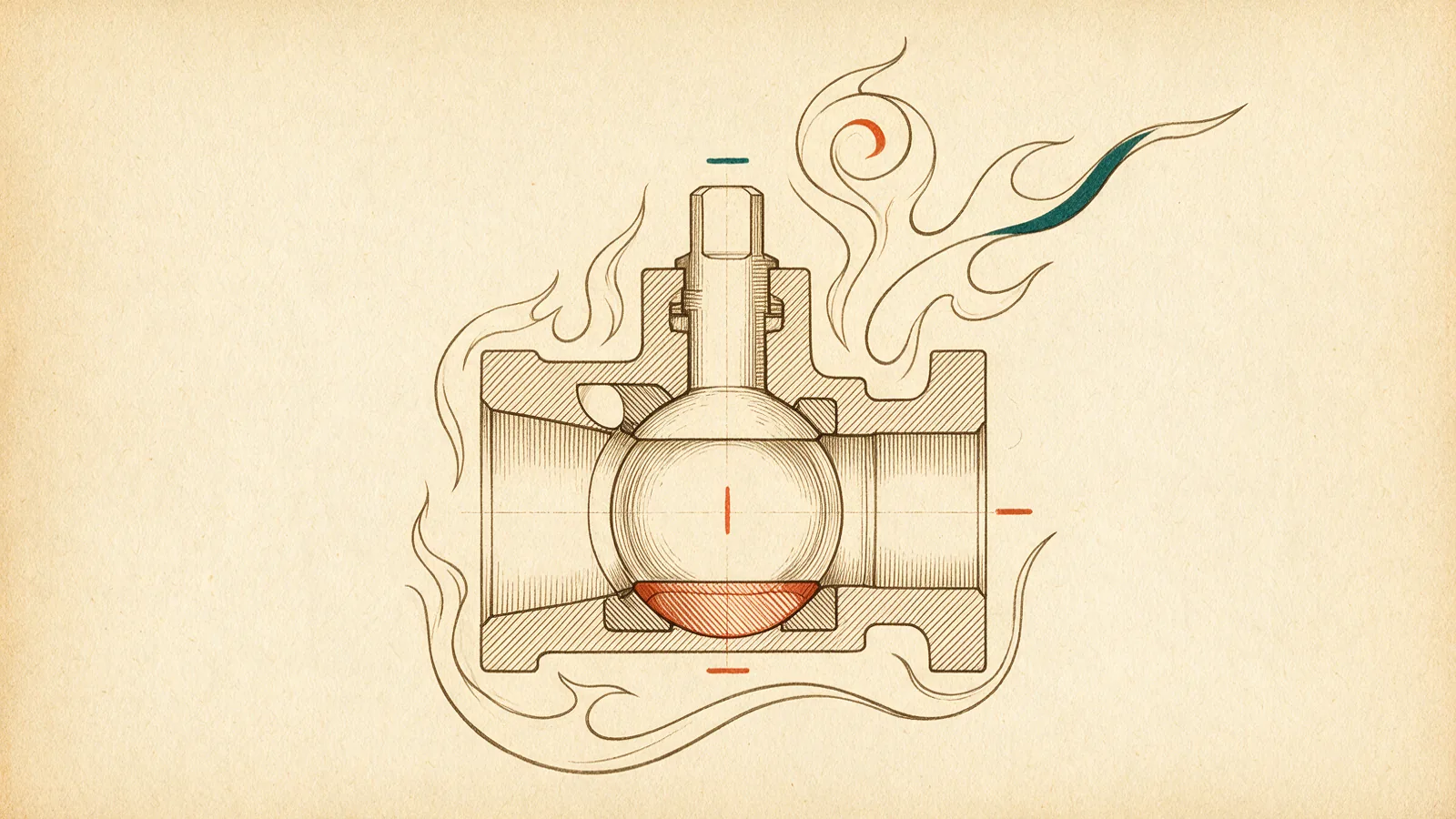
What makes a soft-seated valve pass a fire test is designed-in redundancy. The polymer seat is assumed lost: behind it sits a secondary metal seat the ball settles against once the soft seat has gone. That is the red detail in the plate above. Stem sealing shifts from polymer to graphite, body joints get fire-resistant gaskets, and the aim throughout is a defined, limited leak through a burned valve rather than an open path.
Fire-safe is a test outcome: a defined leak rate through a burned valve, not a promise the valve will look reusable.
That is also why fire-safe design and fire-tested are not the same claim. The first says the drawing office followed the principles; the second says a valve of that design went through the burn and a report exists. A specification that means the second should say so.
Wording for the enquiry
Name the standard rather than the adjective: "fire-tested to API 607" or "fire-tested to API 6FA", not "fire-safe" alone. Ask for the fire test certificate, and check its qualified range covers your size, class and seat material. A certificate for a different trim answers a different question. Editions matter more here than usual, because fire test procedures have been revised over the years and an old certificate may sit against an edition your project specification no longer accepts; state the edition on the enquiry, since the governing edition is your purchase order's. Where the fire demand arrives alongside documentation demands, the paper trail logic of the valve procurement documentation guide applies unchanged.
How a fire-test line fits into the rest of a valve specification (line conditions, class, materials, and only then the certificates) is the subject of the specifying guide. A stockist such as NF Teguh in Subang Jaya can quote against exactly that wording; more memos from the counter are in Insights.
Related memos
Standards named above are published reference data. Confirm against the current edition; your purchase order governs. Questions: the counter.