Trunnion or floating: choosing a ball valve mounting
In a floating ball valve the ball is held only by its seats, and line pressure pushes it onto the downstream seat. This is simple and economical at small sizes and moderate classes. A trunnion-mounted ball turns on fixed bearings while spring-loaded seats ride against it, keeping torque manageable and shutoff reliable at large sizes and high pressure. This article gives the practical crossover points and the specification wording.
In this memo06 details
How a floating ball seals
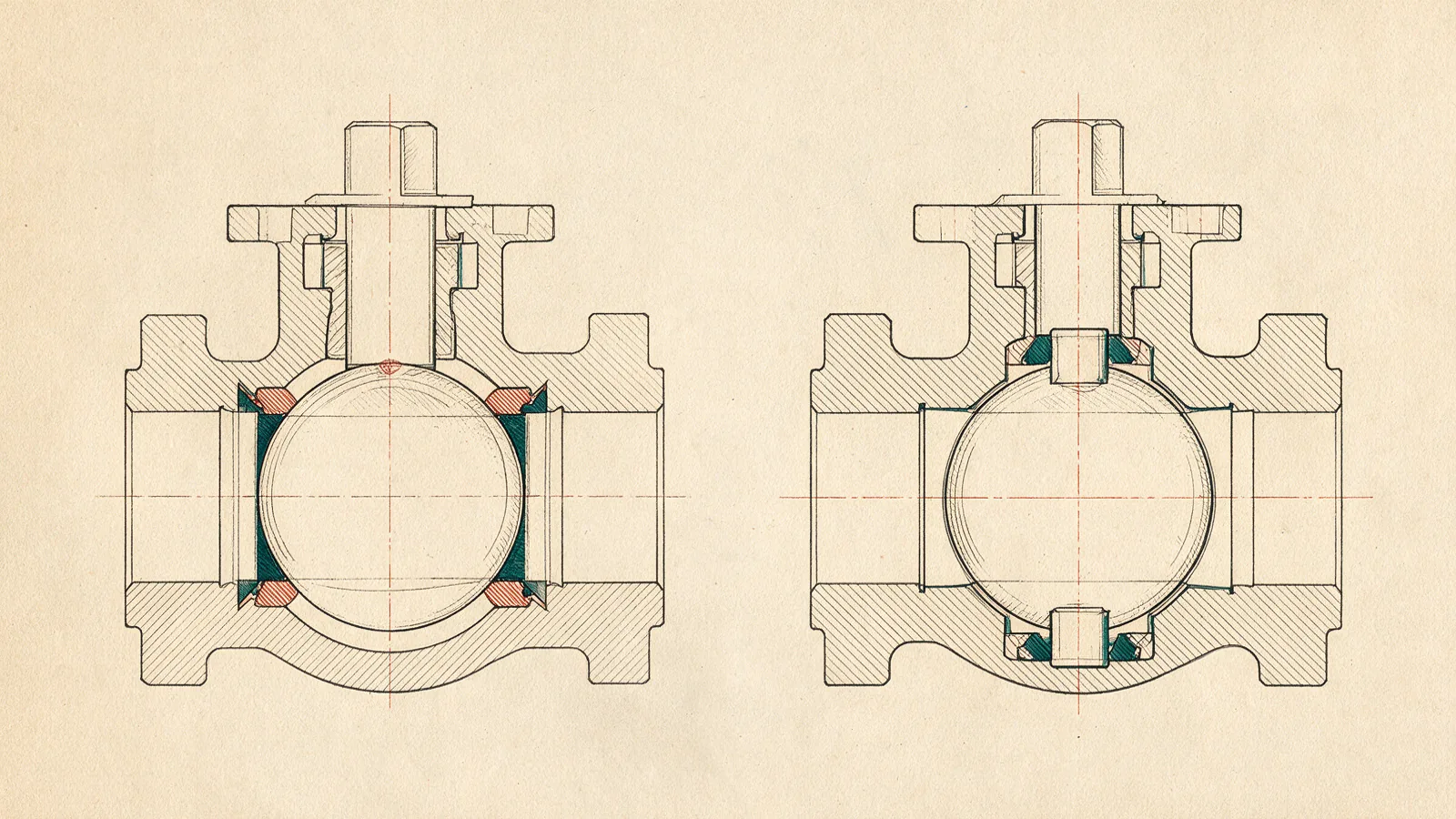
A floating ball valve has no support under the ball. The sphere sits between two seats, and the stem engages it through a slot loose enough to let it shift. Close the valve and let pressure build on one side, and the ball moves a fraction downstream, pressing into the downstream seat. The line's own pressure makes the seal, and the harder the line pushes, the tighter the shutoff gets.
That is the pattern's elegance and its limit in a single mechanism. The arrangement needs nothing beyond the seats themselves, which keeps the part count low and the price with it, and it is why the floating pattern is the everyday ball valve of general industry. But the whole closing force lands on one seat face, so seat loading climbs with pressure and with ball diameter together. At some combination of the two, a soft seat starts to creep, deform, or drag heavily on every stroke, and that combination is where the floating pattern runs out of road.
How a trunnion-mounted ball seals
A trunnion-mounted ball is pinned top and bottom. The stem above and a trunnion post below hold the sphere on a fixed axis, turning in bearings, so line pressure cannot push the ball anywhere. The sealing action inverts: instead of the ball moving onto the seat, spring-loaded seat rings ride forward against the stationary ball, and line pressure acting behind each seat ring adds to the spring's push.
The seal load is now set by seat-ring geometry rather than by the full thrust of the line acting on the ball's whole cross-section. That one change is why the pattern scales: doubling the bore no longer doubles the burden on a seat face. Most trunnion designs also make each seat self-relieving, so pressure trapped in the body cavity vents back to the line instead of locking the valve or over-stressing the seals.
Floating: pressure seats the ball. Trunnion: springs seat the seats. Every other difference between the two follows from that swap.
Torque and actuation consequences
Torque is where the difference is felt on the wrench. A floating ball is dragged across a heavily loaded downstream seat on every stroke, so operating torque climbs steeply with pressure and size; a valve that swings freely on the bench can be a two-hand job on a live line. Trunnion bearings carry the pressure load instead, and torque stays comparatively flat as pressure rises.
This matters twice at the enquiry stage. Gear operators and actuators are sized on torque, so an actuator big enough to turn a floating ball at pressure can cost more than the trunnion valve that would not have needed it. And if the valve will be automated, the actuator interface belongs on the enquiry: ISO 5211 is the mounting-pad standard usually named on data sheets. Treat that designation as published reference data, confirm pad and stem detail against the current edition, and let your purchase order govern.
The size and class crossover
There is no universal line where floating ends and trunnion begins; it moves with seat material, bore and manufacturer. The honest way to hold it: smaller bores at Class 150 and Class 300 are natural floating territory, and large bores or Class 600 and above push quickly toward trunnion mounting. Those class designations are published reference identifiers; what each permits by temperature is the subject of the pressure class memo and the ASME reference sheet, and the valve's own rating plate and your purchase order govern. The comparison below is deliberately qualitative.
| Aspect | Floating | Trunnion-mounted |
|---|---|---|
| Ball support | Seats alone | Stem and trunnion bearings |
| Sealing action | Pressure pushes ball onto downstream seat | Springs and pressure push seats onto ball |
| Operating torque | Climbs with pressure and size | Comparatively flat |
| Natural ground | Smaller bores, lower classes | Larger bores, higher classes |
| Part count and price | Lower | Higher |
| Vented-cavity isolation | Limited | Common, by design |
Double block and bleed
Trunnion valves bring one more capability that specifications name often: double block and bleed. Because each spring-loaded seat can seal against the body cavity independently, a single valve can hold pressure from both sides while the cavity between the seats is vented and watched, which is positive proof that neither seat is passing before anyone breaks containment downstream. Pipeline-class specifications reach for API 6D here, the pipeline valve standard whose vocabulary covers block-and-bleed and isolation configurations; treat the designation as published reference only, confirm the exact configuration wording against the current edition, and have your purchase order state it explicitly. A floating ball can be built to seal in both directions, but vented-cavity isolation is the trunnion pattern's home ground. If maintenance isolation on your line depends on it, that requirement alone usually settles the mounting question before size or class get a vote.
Wording for the enquiry
On the enquiry, the mounting is one line among the usual set: size, class, bore (full or reduced), body and trim materials, end connections, operator. The whole checklist is walked through in the specifying guide; to it, add the word floating or trunnion-mounted, and any double-block-and-bleed requirement stated plainly. Ask for the paperwork in the same breath: test reports and material certificates are the subject of the procurement documentation guide and the API 598 memo.
NF Teguh is an industrial valve stockist in Subang Jaya, Selangor. Send that wording to the counter and the quotation will say what is from stock and what is on indent; the route is on how ordering works. Where quarter-turn selection at size is still open, ball vs butterfly compares the families, and more memos like this one live on the register.
Related memos
Standards named above are published reference data. Confirm against the current edition; your purchase order governs. Questions: the counter.