What OS&Y means and why rising-stem gate valves dominate isolation duty
OS&Y stands for outside screw and yoke: the gate valve's stem threads run in a yoke outside the pressure boundary, so the threads never touch the process fluid and the rising stem shows open or shut at a glance. That is why rising-stem OS&Y gate valves dominate isolation duty in refineries and power plants. This article explains the mechanism, its inspection advantages and its limits.
In this memo06 details
What OS&Y means
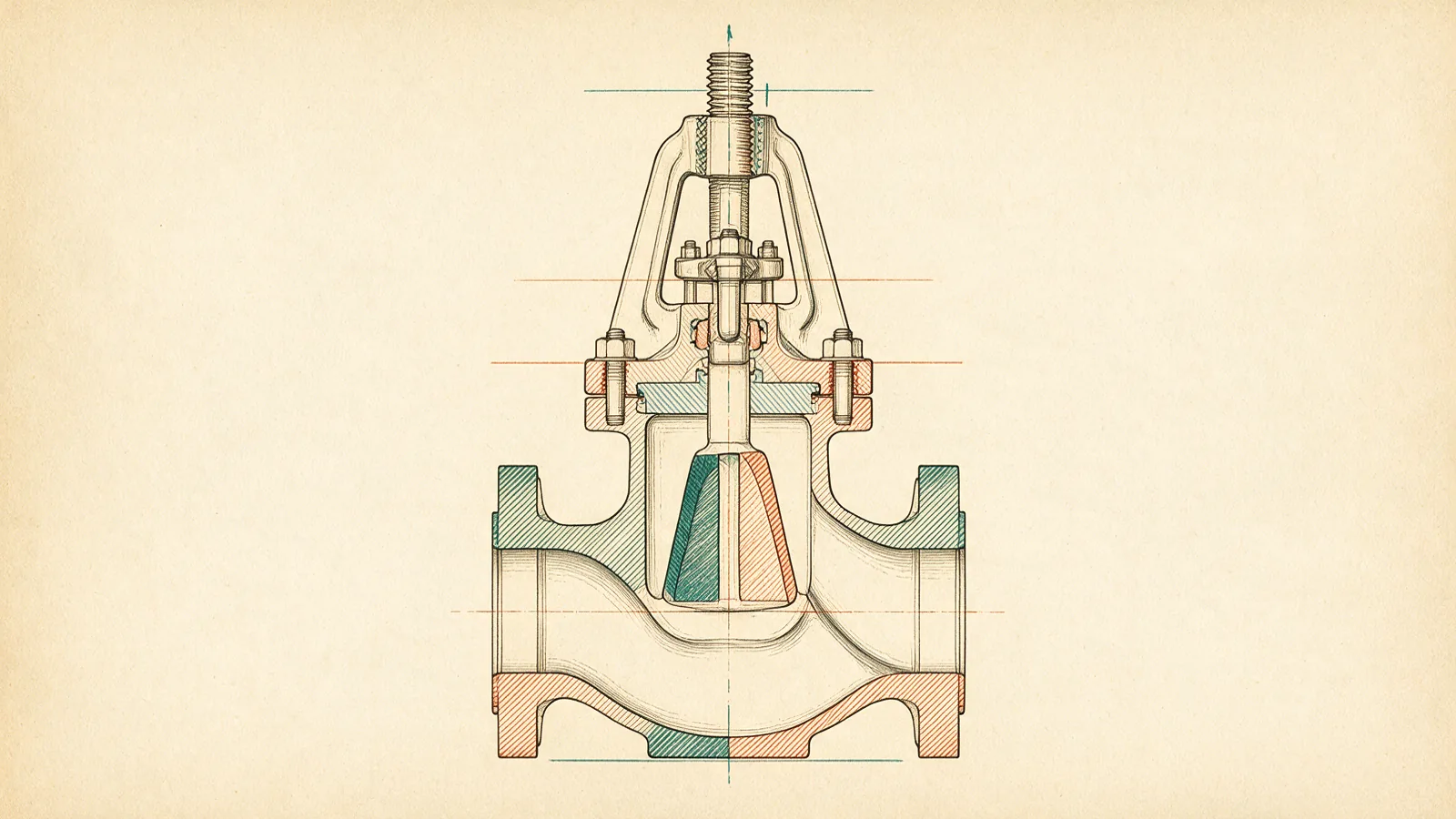
OS&Y is stamped and spoken wherever gate valves are bought: outside screw and yoke. The screw is the stem thread; outside means it lives above the pressure boundary, in the open air. The yoke is the bridge cast across the top of the bonnet, carrying a threaded bushing (the yoke nut) in which the stem thread runs. Turn the handwheel and the yoke nut winds the stem up or down through itself: the stem rises out of the yoke as the gate lifts, and sinks back as it closes. Nothing about the thread ever touches the fluid.
The abbreviation matters because it fixes two separate design choices at once: where the thread lives, and whether the stem rises. A valve can put its thread inside or outside the body, and its stem can climb with the gate or spin in place. OS&Y names the combination that puts the thread outside and lets the stem rise. The arrangement is standard vocabulary in the steel gate valve world; API 600, the bolted-bonnet steel gate valve standard, describes valves built this way. Treat that designation as published reference data and confirm against the current edition, since your purchase order governs.
Rising versus non-rising stems
The alternative is the inside-screw, non-rising stem: the thread is cut where the stem meets the gate, inside the body, and the stem only rotates in place while the gate climbs the thread. The valve gets shorter, because nothing has to rise, which is why the pattern survives in buried service and cramped valve pits where an OS&Y stem would have nowhere to go. The cost is that everything the OS&Y arrangement protects is surrendered: the thread is wetted, the position is hidden, and the mechanism can only be inspected by opening the valve up. The trade between the two is stark enough to tabulate.
| Aspect | OS&Y rising stem | Inside screw, non-rising |
|---|---|---|
| Thread location | Outside, above the bonnet | Inside the body, wetted |
| Position indication | Stem height shows it at a glance | None without an added indicator |
| Thread lubrication | Accessible in service | Not accessible |
| Headroom needed | Full stem travel above the yoke | Compact |
| Natural ground | Plant isolation duty | Buried lines, tight chambers |
Why the threads stay clean
A wetted thread lives in whatever the line carries. Process fluid corrodes it, dissolved solids pack it, temperature cycles work the deposits deeper. In isolation duty, the day the valve is finally needed is precisely the day it has not moved for months. The OS&Y arrangement takes the thread out of that story entirely. It runs dry above the bonnet, where it can be seen, brushed and greased with the line live, and where galling or damage announces itself before it matters. Stem sealing simplifies too: the packing has only to seal a smooth stem surface sliding through it, never a thread form, so a weeping gland can be drawn up or repacked without disturbing the thread at all. For the refinery and power-station isolation duty described on the oil and gas sheet and the power plants sheet (valves that stand still for a year and must then move on demand), that serviceability is most of the argument for the pattern.
Reading valve position at a glance
The rising stem is also an instrument. A stem standing tall above the yoke is an open valve; a stem sunk flush is a shut one. Either is legible from across a pipe rack, through a fence, in a torch beam on a night round. Operators walking a line-up before start-up read stem heights the way drivers read signals, and permit-to-work isolation checks lean on the same glance: the valve declares its own state without anyone touching it. A non-rising stem gives nothing away without a position indicator bolted on, and an indicator is one more mechanism to trust and to maintain. In fire-protection practice the same property is valued for supervision, which is why the OS&Y form is so recognisable there.
The thread stays out of the fluid, and the valve reports its own position from across the rack. OS&Y earns its keep twice.
Where OS&Y is the wrong answer
The pattern buys its virtues with height. The stem needs clear room above the yoke equal to the gate's full travel, so a large OS&Y valve wants headroom that a valve pit, a buried chamber or a low pipe gallery simply does not have. That is exactly the ground where the non-rising stem survives. The exposed thread also asks for basic housekeeping in dirty, dusty or icing environments: grease that binds grit becomes lapping paste, so the thread earns a wipe as part of the round. And OS&Y answers only the stem question, never the family question. A gate valve of any stem pattern is an isolation valve, opened or closed and left there; regulating duty belongs to the globe valve, a split that gate vs globe walks through in full.
Wording for the enquiry
Most steel gate valve data sheets assume OS&Y and say so; the safe enquiry states it anyway. Alongside the usual line (size, class, body and trim materials, ends, operator, the discipline set out in the specifying guide) write "OS&Y, rising stem", or, where headroom rules it out, "non-rising stem" and let the supplier flag the trade-offs back. Certificates and test paperwork ride along per the procurement documentation guide. For small-bore gate valves, API 600 and API 602 compared sets out where the compact standard takes over.
NF Teguh is an industrial valve stockist in Subang Jaya, Selangor. The counter quotes against exactly that wording through the ordering route, and the rest of the register is on insights.
Related memos
Standards named above are published reference data. Confirm against the current edition; your purchase order governs. Questions: the counter.