BS 1873 vs API 623: globe valve standards compared
BS 1873 and API Standard 623 are both steel globe valve design standards, and they do not cover the same valves. BSI puts BS 1873:1975 at 15 mm to 400 mm in Classes 150 to 2500. API Std 623, second edition January 2021, is a heavy-duty refinery series from NPS 2 to 24 in the same class span. Below NPS 2 there is no API 623 valve to quote: API 602 covers the compact sizes.
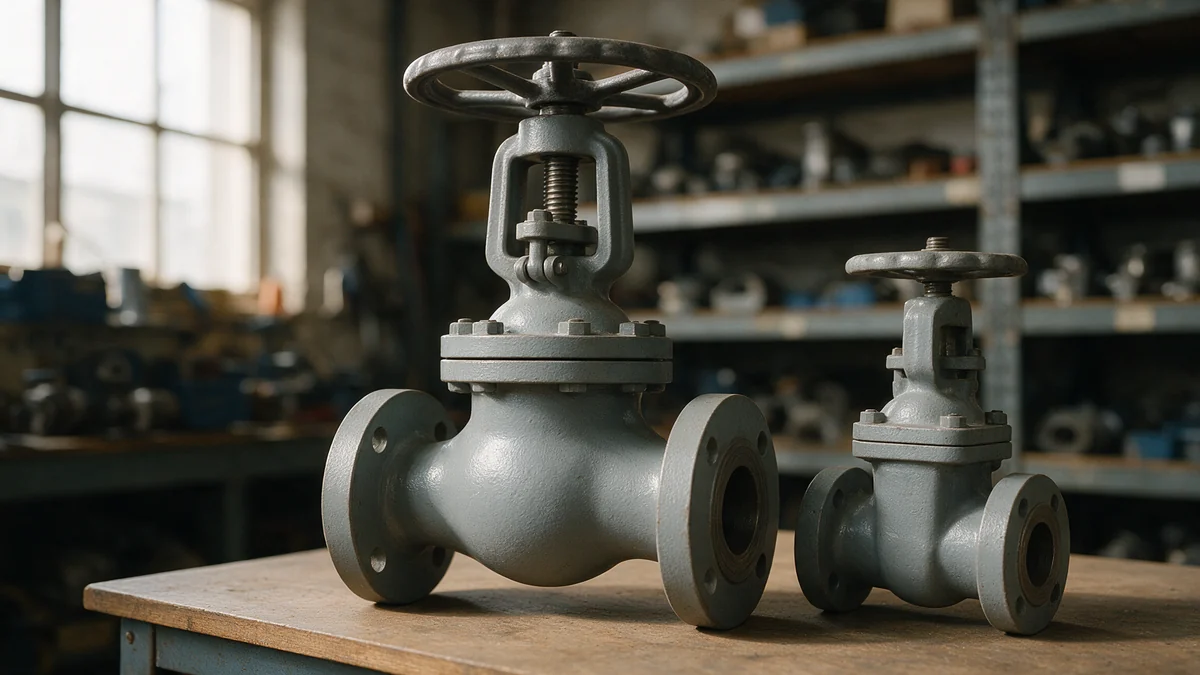
What does BS 1873 cover?
BS 1873 is the British Standard for steel globe valves in petroleum service, and it covers globe stop and check valves in the same document. BSI's published scope puts the envelope at 15 mm to 400 mm and Classes 150 to 2500, in three body patterns, with an outside screw and yoke stem. It is a design standard, so what it settles is construction rather than duty.
BSI's own record for BS 1873:1975 sets the envelope out: cast or forged carbon and alloy steel globe and globe stop and check valves, outside screw and yoke, in straight, angle and oblique Y patterns, with flanged or butt-welding ends.
BSI shows BS 1873:1975 as Current, published 30 April 1975. Its scope also records two extensions worth knowing before a small or awkward line item is written. BSI notes that the standard can serve as a general guide where the material composition falls outside its own materials section, as it does for highly corrosive service or for low temperatures, and that it can be adapted to needle-type seats at 15 mm and 20 mm, with the seat bore reduced and the needlepoint either integral with the stem or loose on it.
That second line matters for a small-bore requisition. BS 1873 reaches 15 mm and carries a stated route to needle seats, while API 623 does not reach that far down at all. The three body patterns BS 1873 names are the same three the globe valve product sheet sets out, which that sheet calls tee, wye and angle for the same bodies, and the outside screw and yoke stem BS 1873 requires works the way the OS&Y memo describes on gate valves.
What does API Standard 623 cover?
API Standard 623 is the heavy-duty steel globe valve standard for petroleum refinery service. Its published scope covers bolted bonnet steel globe valves from NPS 2 to NPS 24, which is DN 50 to DN 600, in Classes 150 to 2500. It ties that series to duty: refinery service where corrosion and erosion call for heavy wall sections and large stem diameters.
A specification that names API 623 is therefore asking for wall thickness and stem section, not only for a globe valve. The same published abstract enumerates the features the standard governs: bolted bonnet and pressure seal bonnet, outside screw and yoke, rotating and non-rotating rising stems, rising and non-rising handwheels, straight, y-pattern and right-angle bodies, stop-check valves, and plug, narrow, conical, ball or guided discs. Where a spec cites API 623, the disc options come from that list rather than from a general catalogue, and the globe valve product sheet covers how trim choice follows duty.
Edition matters on API 623, and not only as a date. The first edition was September 2013. Writing in Valve World, Ron Merrick and Ashley Casteel of Fluor Enterprises record that the first edition required the fully body-guided disc design only in Class 900 and higher. The second edition, dated January 2021 and including Errata 1 from 2024, extended the fully body-guided disc requirement to all ratings of globe valve. A seven-year gap is long enough that an old project specification and a current quotation can be describing valves built to different rules, so the enquiry should name the edition as well as the standard.
What is the difference between BS 1873 and API 623?
The two published scopes differ at both ends of the size range and in what they assume about the service. BS 1873 runs 15 mm to 400 mm, API 623 from NPS 2 to NPS 24, so an NPS 20 globe valve falls outside BS 1873 just as a 15 mm one falls outside API 623. Both stop at Class 2500 and both cover stop-check valves.
The comparison below is drawn from BSI's record for BS 1873:1975 and the API Std 623 scope record published by Accuris.
| Point of comparison | BS 1873:1975 | API Std 623, 2nd edition |
|---|---|---|
| Size range | 15 mm to 400 mm (16 in) | NPS 2 to NPS 24, DN 50 to DN 600 |
| Classes | 150 to 2500 | 150, 300, 600, 900, 1500, 2500 |
| Patterns named | Straight, angle, oblique Y | Straight, y-pattern, right-angle |
| Stem arrangement | Outside screw and yoke | Outside screw and yoke, rotating and non-rotating rising stems |
| Bonnet types named | Not named in the scope abstract | Bolted bonnet and pressure seal bonnet |
| Discs named | Not named in the scope abstract; needle-type seats at 15 mm and 20 mm by adaptation | Plug, narrow, conical, ball or guided |
| What the scope emphasises | Cast or forged carbon and alloy steel, with a general-guide route for other compositions, highly corrosive service and low temperatures | A heavy-wall refinery series, with stem sections sized for corrosive and erosive duty |
| Stop-check valves | Covered, and named in the title | Covered, with a definition printed in the scope |
| Published | 30 April 1975, shown by BSI as Current | January 2021, second edition, with Errata 1 from 2024 |
Two things the scope records do not show are on the record in the trade press. In Valve World, Merrick and Casteel describe API 623's starting point as the structure of API 600 combined with the technical content of BS 1873, which they call the most widely used existing specification for process globe valves, so the two documents are related rather than independent. And in the Valve Manufacturers Association's Valve Magazine, Javier Vergara reported, writing when the standard was new in 2014, that the minimum wall thickness in it mirrors API 600 and is greater than ASME B16.34.
Below NPS 2 there is no API 623 valve to quote, and that is the gap a requisition falls into when the size is written before the standard. The same divide runs through the gate valve side, where API 600 and API 602 split the range between bolted-bonnet and compact designs.
What is a globe stop-check valve, and which standard governs it?
A globe stop-check valve is a non-return valve that the stem can also force shut, and both standards cover it. It is not a variant option on a plain globe valve, because the disc is not fastened to the stem. Ordering one against a plain globe valve line item gives the wrong valve even when size, class and ends are all correct.
API 623's published scope carries the clearest short account of the behaviour: a stop-check valve is a non-return globe valve whose disc the stem can drive onto the seat, but which is otherwise free to lift as a check valve on flow from under the disc. BS 1873's title carries stop and check valves alongside plain globe valves, so either standard can govern one.
A stop-check valve is therefore a globe valve body doing a check valve's job with a manual override. Where the duty is pure non-return with no manual shut, the swing, dual-plate and piston check valve memo covers the alternatives, and the enquiry should say which of the two it wants in plain words.
Does naming a globe valve standard settle the installed length?
Not on its own. The face-to-face figures a pipe fitter works from are tabulated in ASME B16.10, and in the Class 150 table as Wermac reproduces it a globe valve needs a markedly longer gap than the gate valve of the same size. Naming BS 1873 or API 623 settles how the valve is built, not how much pipe it occupies.
Two readings follow for a purchase order. Changing valve type is a piping change, not a like-for-like swap. Either way the length comes from the B16.10 table for that valve type, body pattern, size, class and end connection, so the enquiry has to state the pattern. Gate valve versus globe valve compares the two types on duty rather than on length.
The ASME B16.10 memo covers the tables, the tolerances and the facings.
What does a globe valve enquiry need to state about the standard?
Four lines settle the standards side of a globe valve enquiry, and each one closes a question a published scope alone cannot answer. The rest of the enquiry, the sizing and material detail, is set out on the globe valve product sheet.
- Standard and edition: BS 1873, API 623, or the client specification that governs, and which edition of it.
- Plain globe or stop-check: these are two different valves, not one valve with an option, and both standards cover both.
- Service temperature: whether the duty is high-temperature steam, which decides which side of the disc carries pressure.
- Documentation: the test and certificate package the purchase order will require against that standard.
On documentation, the two memos to read next are the API 598 shell and seat test memo and the EN 10204 3.1 versus 3.2 memo, because those two decide what paperwork travels with the valve. The specifying guide walks the whole sequence from line conditions to purchase order. NF Teguh stocks and quotes globe valves alongside gate, ball, plug, butterfly and check valves from Subang Jaya, Selangor, as a Petronas registered vendor, into power plant, petrochemical, oil and gas, terminal, offshore and natural gas service. Send an enquiry with these four lines in it.
What do buyers ask about BS 1873 and API 623?
The questions that follow are the ones a published scope can answer and a product catalogue usually cannot. They all turn on the same axis: BS 1873 is broader on material scope and reaches down to 15 mm, while API 623 is the heavy-wall refinery series. Two enquiry problems sit there, a size outside one of the two envelopes, or a valve that is not a plain globe valve at all.
Can one globe valve be marked to both BS 1873 and API 623?
Where a valve is offered dual-marked, inside the overlap that is possible: the two envelopes meet between NPS 2 (DN 50) and 400 mm, in Classes 150 to 2500. What an enquiry should pin down is which standard the test certificate and the nameplate will name, and to which edition, because that is what a project specification is checked against at goods-in.
Which standard covers a globe valve below NPS 2?
Not API 623: its published scope starts at NPS 2. BS 1873 reaches down to 15 mm, and BSI records that it can be adapted to needle-type seats at 15 mm and 20 mm with a reduced seat bore. The compact route is API Standard 602, whose published tenth-edition scope covers gate, globe and check valves in eleven sizes from DN 8 to DN 100, or NPS 1/4 to NPS 4.
Which edition of each standard applies?
The edition your purchase order names. BSI shows BS 1873:1975, published 30 April 1975, as Current. API Std 623 is in its second edition of January 2021, including Errata 1 from 2024, and replaced a first edition from September 2013, so an older specification may be describing a different document.
A globe valve enquiry that names the standard, the edition, whether it is a stop-check, and the service temperature can be quoted without a round of questions. Send it through the contact page, and see how ordering works for what follows.
Sources, read 23 September 2026: BSI Knowledge, BS 1873:1975; Accuris, API Std 623 scope and edition history; Wermac, ASME B16.10 Class 150 face-to-face table; Wermac, Globe valves; Valve World, Merrick and Casteel, Changes in the API 623 standard, 28 August 2023; Valve Magazine, Vergara, New API standard for globe valves, 24 June 2014; API Std 602 tenth edition scope, published by API. Both standards are described from their published scope records; neither full standard was read for this memo, and no table, clause or other text from either standard is reproduced here.
Related memos
Standards named above are published reference data. Confirm against the current edition; your purchase order governs. Questions: the counter.