ASME B16.5 vs B16.47: flange standards compared
The published titles divide them by size. ASME B16.5 is titled for pipe flanges and flanged fittings from NPS 1/2 through NPS 24. ASME B16.47 is titled for large diameter steel flanges from NPS 26 through NPS 60. B16.47 is also published in two series, Series A and Series B, which the 2011 edition tabulates separately, so a large diameter line has to name the series too.
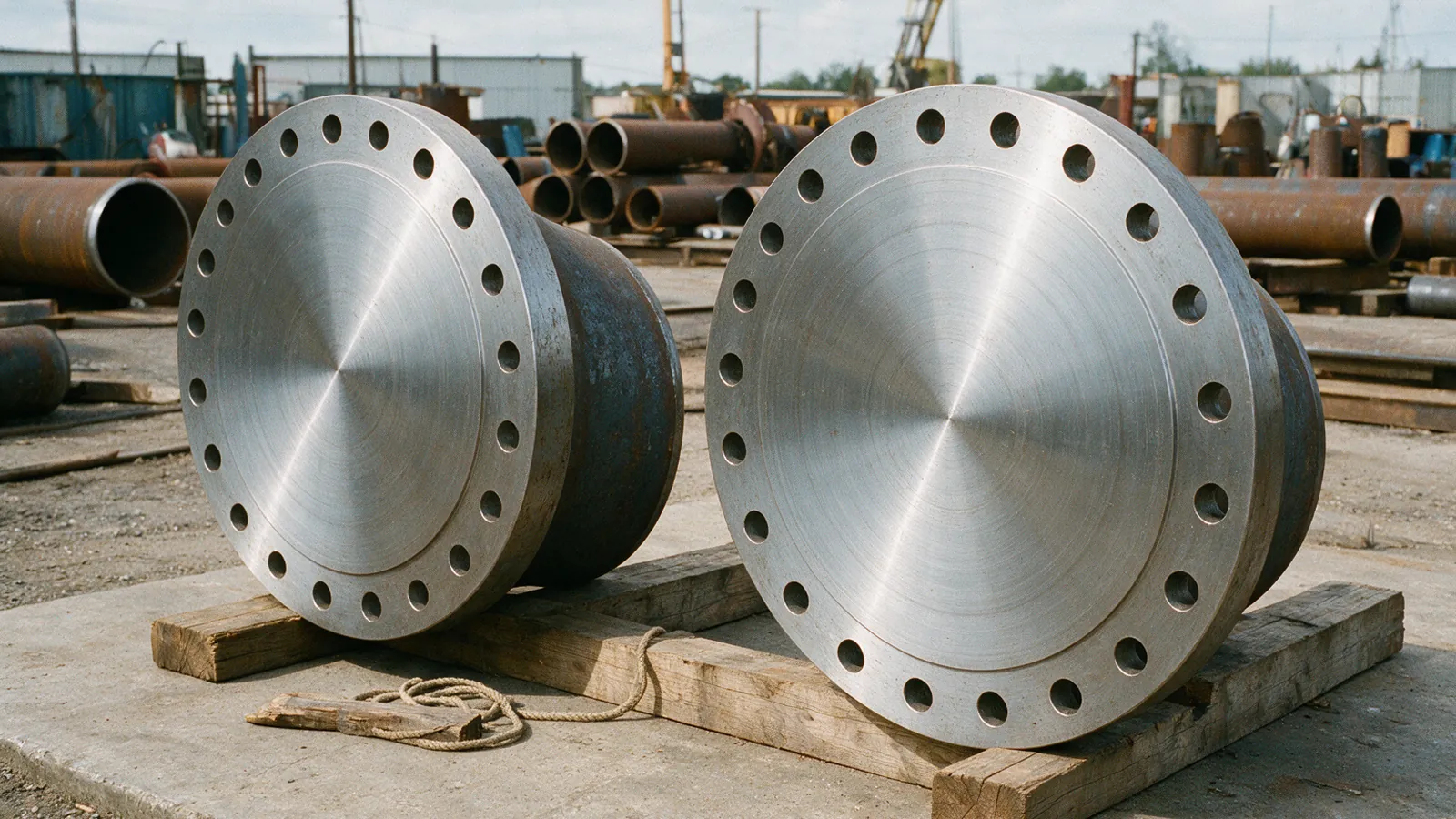
Which standard covers a pipe flange: ASME B16.5 or ASME B16.47?
The published titles answer it by size. ASME's own catalogue lists one standard as B16.5, Pipe Flanges and Flanged Fittings: NPS 1/2 through NPS 24, Metric/Inch Standard, and a second as B16.47, Large Diameter Steel Flanges: NPS 26 through NPS 60, Metric/Inch Standard. Both are shown there at a 2025 edition. So the first question on a flange line is which size band it is in.
The title fixes the band each document is written for. It is not a promise that every size in the band is tabulated in every edition, which is why the edition year matters later on this page.
ASME treats the three main B16 flange and valve standards as one family. Announcing a set of B16 revisions in 2016 it said that B16.5, B16.34 and B16.47 "provide industry with technical guidelines and requirements regarding the use of flanges and valves ranging from nominal pipe sizes (NPS) NPS 1/2 to NPS 60". The split between them is in the titles.
Where the flanges are the ends of a valve, the valve itself is specified somewhere else again. Class 150, 300 and 600 and face-to-face dimensions are each their own question, and the facing is a third.
| Read this | ASME B16.5 | ASME B16.47 |
|---|---|---|
| Size range in the published title | NPS 1/2 through NPS 24 | NPS 26 through NPS 60 |
| What the title covers | Pipe flanges and flanged fittings | Large diameter steel flanges |
| Series | None | Two: Series A and Series B |
| Classes with their own dimension tables, in the contents list of the edition read | Not divided by series | Series A from Class 150; Series B from Class 75 |
| Editions ASME's catalogue page offers | 2003, 2013, 2017, 2020, 2025 | 2006, 2011, 2017, 2020, 2025 |
| Which ASME B16.20 gasket tables apply | The B16.5 flange tables | The Series A or the Series B tables |
| What an enquiry still has to add | Class, facing and finish, material, certificate | All of those, and the series |
What are Series A and Series B in ASME B16.47?
They are two separately tabulated sets of flanges inside one standard. The published contents list of ASME B16.47-2011 lists its dimension tables one series at a time: tables for Class 150, 300, 400, 600 and 900 Series A flanges, and then tables for Class 75, 150, 300, 400, 600 and 900 Series B flanges.
Two things follow from the contents list alone, without opening a single table. The standard keeps the two series apart, and the two lists of classes are not the same: a Class 75 table is listed under Series B, and the Series A tables in that contents list begin at Class 150.
That is why "ASME B16.47 Class 300, NPS 36" is still an incomplete line. It names the standard, the class and the size, and it leaves the series to whoever reads it next.
The rest of the 2011 contents list reads like B16.5's: a scope, pressure-temperature ratings, component size, marking, materials, dimensions, tolerances and pressure testing, with the material and bolting specification lists and the rating tables held by material group.
Why does one standard have two series at all?
Because the two series came from two different documents. The ASME B16 committee's own history file for B16.5 records it directly: "1990 ASME B16.47, Large Diameter Steel Flanges, introduced that extended coverage for construction of flanges in the NPS 26 to NPS 60 size range. Flange dimensions and ratings were based on MSS SP-44 for Series A flanges and based on API 605 for Series B flanges."
MSS SP-44 is still current. The standards distributor Nimonik's record for MSS SP-44, Steel Pipeline Flanges lists MSS SP-44-2026, dated 1 February 2026, as the current revision at 70 pages, and gives its scope as covering "pressure-temperature ratings, materials, dimensions, tolerances, marking, and testing for steel pipeline flanges". We have no record on file for the status of API 605, so this page says nothing about it beyond the history entry quoted above.
Two details in Nimonik's record matter to a buyer. MSS SP-44's welding neck flanges "shall be forged steel", and its blind flanges "may be made from either forged steel or from steel plate". And for the small end of its own range it hands the job back: "Dimensional and tolerance requirements for NPS 10 and smaller are provided by reference to ASME B16.5."
The record also notes that SP-44 "covers two Product Specification Levels (PSL)", and that where none is specified the material is supplied as PSL1. A pipeline flange line that names SP-44 and stops has accepted PSL1 by default.
Does the answer change anything beyond the flange?
It changes the gasket. The published contents list of ASME B16.20-2023, Metallic Gaskets for Pipe Flanges tabulates gaskets separately for ASME B16.5 flanges, for ASME B16.47 Series A flanges and for ASME B16.47 Series B flanges. That is the practical reason the series belongs on the purchase order rather than in a site conversation later, because the flange order and the gasket order are usually placed by different people. What each facing then needs is covered in RF, FF and RTJ flange faces.
Does the edition year change which sizes are in the standard?
Yes, and that is why the year belongs on the purchase order. A titled size range is not the same thing as the list of sizes tabulated inside it. ASME's history file for B16.5 records that the 2017 edition was "published with the addition of NPS 22 and clarifications", so NPS 22 sits inside the current edition and outside older ones that a specification may still name. The titled seam between the two standards has not moved: B16.5 stops at NPS 24 and B16.47 starts at NPS 26.
The same history file shows how much else has moved in that document over the years. Permission for dual marking arrived in the 1996 edition, and the 2003 edition was published "with metric units as primary and allowing US customary units as alternate", along with revised ratings and "altered flange thickness dimensional reference planes for Class 150 and 300 flanges".
None of that is academic on a purchase order. ASME's catalogue page for B16.5 offers the 2003, 2013, 2017, 2020 and 2025 editions, and the page for B16.47 offers 2006, 2011, 2017, 2020 and 2025. An old edition is not an unavailable edition, so "to ASME B16.5" without a year is a line two readers can satisfy differently.
What these records do not settle
The published records used in this memo do not answer three questions that come up on every large-diameter enquiry. Saying which three is cheaper than guessing at any of them, because each one ends in a different place: the current edition of the standard, the piping class, or the supplier's own paperwork.
Whether a Series A and a Series B flange of the same size and class will bolt together. The contents lists show that the standard tabulates the two series separately and that their class lists differ. They do not show what the dimensions are, so nothing here decides what will or will not mate. That is a question for the tables in the current edition and for the maker's drawing.
Which series a given project should use. That is the piping designer's call, written into the piping class, and neither ASME catalogue page expresses a preference.
What any flange in anyone's stock actually is. Every designation on this page is a published identifier. None of it is a statement about what NF Teguh holds, can supply or can certify.
What should a flanged enquiry actually say?
Six lines remove most of the back and forth on a flanged valve or a flange enquiry: the size, the class, the standard with its edition year, the series on anything NPS 26 and above, the facing and its finish, and the material with the certificate type. Each of the six is a question a supplier would otherwise have to come back and ask, and each has an answer the piping class already holds.
- Size, as NPS or DN. This is what decides whether B16.5 or B16.47 is even in scope.
- Class. Class 150, 300, 400, 600 and upward, and for a Series B large-diameter line, Class 75 if that is what the piping class says.
- Standard and edition. Name the year. "ASME B16.47-2025" is a different instruction from "ASME B16.47".
- Series, on anything NPS 26 and above. Series A or Series B, in those words.
- Facing and facing finish. Raised face, flat face or ring-type joint, and the finish called for.
- Material and documentation. The body or forging specification and grade, and the certificate type: EN 10204 3.1 or 3.2 are not the same document.
NF Teguh is a Petronas registered vendor and an industrial valve supplier and stockist in Subang Jaya, Selangor, carrying gate, globe, ball, plug, butterfly and check valves. Send those six lines to the counter and the standard is settled at enquiry rather than at goods inwards. The counter takes them by telephone or email from the contact page, which lists WhatsApp separately as the fastest first line.
Where the flanges are valve ends, the fuller sequence is in specifying industrial valves from line conditions to purchase order, and how ordering works covers what happens after the enquiry. The other memos are collected in insights.
What else do buyers ask about the two flange standards?
These are the questions left over once the size band and the series are separated. Each is answered from the same published records used above, and none of them is settled by the words "to ASME" alone. Where a question turns on a value rather than on a record, the answer says so and sends you to the standard.
Our drawing says NPS 30. Which standard is that?
NPS 30 sits inside the size range in the published title of ASME B16.47, Large Diameter Steel Flanges: NPS 26 through NPS 60, and outside the range in the title of ASME B16.5, which reads NPS 1/2 through NPS 24. The line still needs the series, because the published contents list of ASME B16.47-2011 tabulates Series A and Series B separately. Confirm that in the edition your specification names.
The requisition names ASME B16.47 but not a series. What should we do?
Ask, before the order rather than after it. Nothing in ASME's published contents list makes one series the default, and the two class lists are not identical. The same question has to be answered again for the gasket, because ASME B16.20-2023 tabulates gaskets by series as well.
If a pipeline specification names MSS SP-44, has it named ASME B16.47?
No. They are separate documents from separate publishers. ASME's history file records that B16.47 took its Series A dimensions and ratings from MSS SP-44, which is an origin, not an equivalence. SP-44's own current record also sends NPS 10 and smaller back to ASME B16.5 for dimensions and tolerances, so a line that names only SP-44 has left part of its own range to another standard.
What is a Product Specification Level on an SP-44 flange?
SP-44's record states that the standard practice covers two Product Specification Levels, and that if none is specified the material is supplied as PSL1 with the standard requirements. If a project wants the other level, the requisition has to say so; silence is an answer, and the answer is PSL1.
Does the edition year really need to be on the purchase order?
It changes what is inside the document. ASME's own history file for B16.5 records that NPS 22 was added in the 2017 edition, that dual marking became permissible in 1996 and that metric became the primary unit in 2003. ASME's catalogue page still offers several older editions of both standards, so two suppliers reading the same unyeared line can both be right.
Where these figures come from
Each record below was read on 10 October 2026 and saved with this memo's working papers.
- ASME's own catalogue page for ASME B16.5: the published title, the 2025 edition shown, and the 2003, 2013, 2017, 2020 and 2025 editions offered.
- ASME's own catalogue page for ASME B16.47: the published title, the 2025 edition shown, and the 2006, 2011, 2017, 2020 and 2025 editions offered.
- ASME's published front matter for ASME B16.47-2011, date of issuance 20 October 2011: the section list, and the separate dimension tables for Series A at Classes 150, 300, 400, 600 and 900 and for Series B at Classes 75, 150, 300, 400, 600 and 900.
- ASME's published front matter for ASME B16.5-2013, date of issuance 29 April 2013: that edition's contents list.
- ASME's published table of contents for ASME B16.20-2023: the gasket tables held separately for ASME B16.5 flanges, ASME B16.47 Series A flanges and ASME B16.47 Series B flanges.
- The ASME B16 committee file ASME B16.5 History, revision 2018-1-4: the 1990 introduction of B16.47 with the MSS SP-44 and API 605 origins of its two series, and the 1996, 2003 and 2017 edition entries quoted above.
- ASME's own news item ASME to Publish ASME B16 Standards Revisions This Year, 17 June 2016: the NPS 1/2 to NPS 60 coverage sentence.
- The standards distributor Nimonik's record for MSS SP-44, listing MSS SP-44-2026 dated 1 February 2026 as the current revision: the title, the scope sentence, the forged and plate wording, the reference of NPS 10 and smaller to ASME B16.5, and the two Product Specification Levels.
Where a quotation shows a one-half fraction character in the source, it is written here as 1/2. No dimension, bolt count, rating, tolerance or test value from any standard is reproduced, and the comparison table in this memo is our own wording. These designations are identifiers and publisher record facts only. No NF Teguh stock, capability, material range or certification claim attaches to any of them. Buy the current editions from ASME and MSS for the requirements themselves, confirm every line against the maker's own drawing, and your purchase order governs.
Related memos
Standards named above are published reference data. Confirm against the current edition; your purchase order governs. Questions: the counter.