RF, FF or RTJ: what a valve's flange face means
RF is a raised face, FF is a flat face and RTJ is a ring type joint. The facing is the machined surface the gasket seals against, so it decides which gasket the joint takes. ASME B16.5 and ASME B16.20 both keep the ring joint case in tables of its own, which is why an enquiry has to name the facing and not only the size and class.
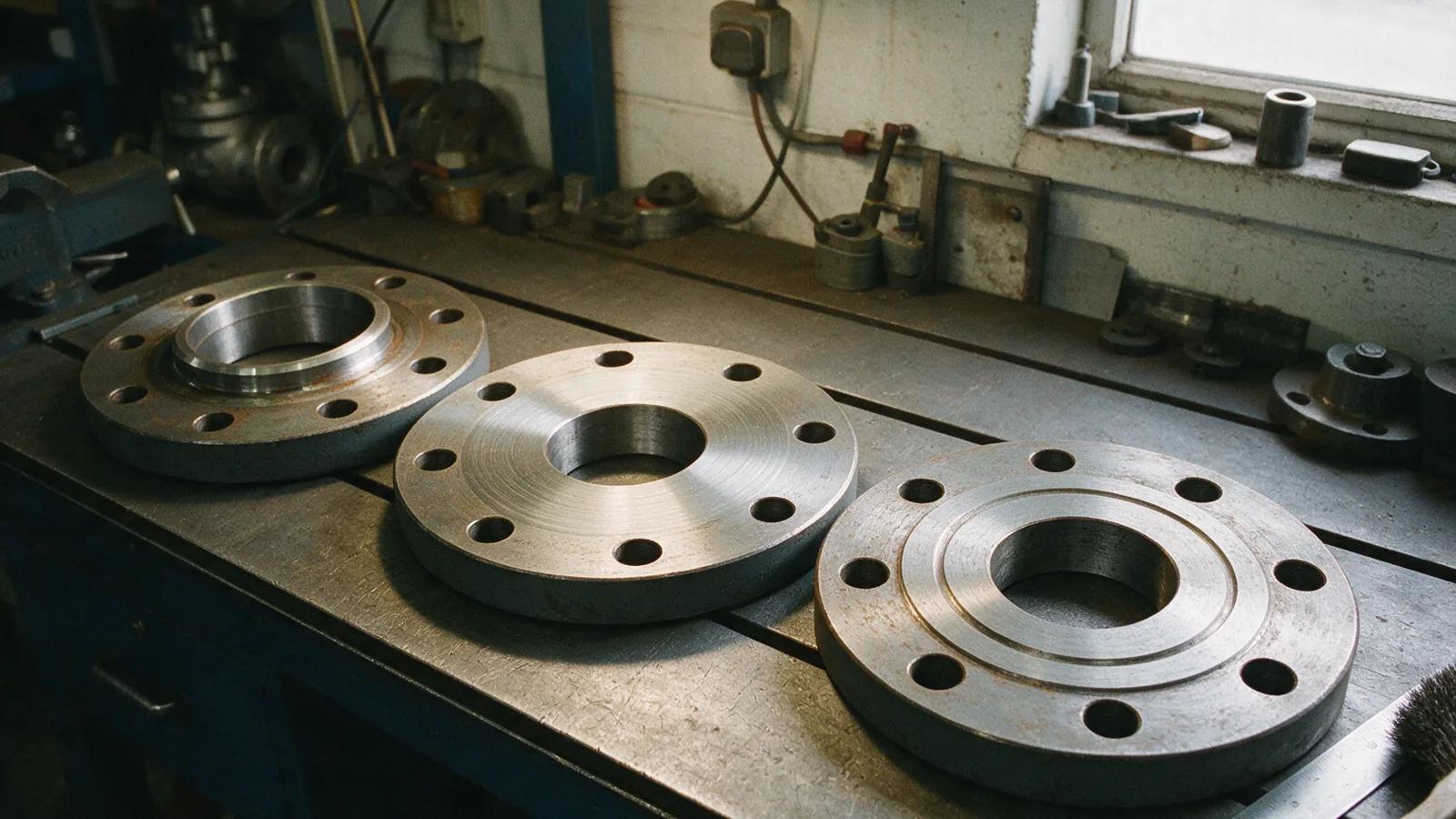
What does RF, FF or RTJ mean on a valve flange?
RF is a raised face, FF is a flat face and RTJ is a ring type joint. Each is a shape machined on the mating surface of the flange, and it decides how the joint seals. The facing is independent of the pressure class: a Class 300 valve can be supplied raised face or ring type joint, and both are Class 300 valves.
The standard behind the flange itself is ASME B16.5. Its published title states its own size boundary in full: Pipe Flanges and Flanged Fittings, NPS 1/2 Through NPS 24, Metric/Inch Standard. ASME lists the 2025 edition as current and records that the standard has been placed on stabilized maintenance.
ASME B16.5 settles construction rather than duty. What it does not do is tell you which facing your service needs; that comes from the piping specification and the gasket the joint is designed around. Which class the valve is, separately, is what Class 150, 300 and 600 actually mean, and the whole route from line conditions to a purchase order is in specifying industrial valves.
What is the difference between a raised face and a flat face?
Both seal against a gasket laid on the flange face, and the difference is where that face sits. Wermac's flange faces reference calls the raised face the most common type in process plant applications, with the gasket surfaces raised above the bolting circle face to concentrate more pressure on a smaller gasket area. On a flat face the gasket surface is in the same plane as the bolting circle face.
Wermac states one rule about the pair with no conditions attached: "Flat face flanges are never to be bolted to a raised face flange." Where a flat face cast iron flange does have to meet a carbon steel flange, Wermac cites ASME B31.1 for the remedy: the raised face on the carbon steel flange must be removed, and a full face gasket is required. The reason Wermac gives is to keep the thin, brittle cast iron flange from being sprung into the gap the raised face leaves.
The facing finish is part of the specification, not a workshop detail. ASME B16.5 devotes a table to permissible imperfections in flange facing finish for raised face and large male and female flanges, which means a facing on those flanges can be dimensionally correct and still be rejectable on its finish.
Why is a ring type joint facing treated as its own case?
Both standards treat the ring type joint that way. ASME B16.5 carries a table of dimensions of ring joint facings covering all pressure rating classes, held separately from its table of dimensions of facings other than ring joints. Wermac describes the ring type joint as sealing when the tightened bolts compress the gasket into the grooves, deforming it into intimate contact and creating a metal to metal seal.
ASME B16.20 splits the same way. ASME B16.20, Metallic Gaskets for Pipe Flanges, is organised into parts, and ring joint gaskets have a part of their own, separate from spiral wound gaskets and from grooved metal gaskets with covering layers. Its ring joint part covers types, size, materials and marking as a self-contained set.
Ring joint gaskets are also not one type. ASME B16.20's ring joint part tabulates dimensions and pipe sizes separately for Type R, Type RX and Type BX ring gaskets, so a ring type joint enquiry that does not name the ring type has left a real variable open. B16.20-2023 is a revision of the 2017 edition, issued on 22 December 2023, with the next edition scheduled for 2028.
| Facing | Where the gasket sits | How it seals | What the enquiry must add |
|---|---|---|---|
| RF, raised face | On a face raised above the bolting circle | Bolt load focused on a narrower gasket seat | The gasket the joint is designed around |
| FF, flat face | In the same plane as the bolting circle | Gasket across the full face | A full face gasket, and confirmation the mating flange is not raised face |
| RTJ, ring type joint | In a machined groove | Metal ring deformed into the grooves, metal to metal | The ring type: R, RX or BX |
Does the facing change the installed dimensions?
The facing can change the installed dimensions, and for valves a separate standard governs it. ASME B16.10 valve face-to-face dimensions records that ring joint, female and groove facings are measured end to end rather than face to face, so ASME B16.10 gives a ring joint valve its own end-to-end length, separate from the raised face figure for the same size and class.
ASME B16.5 carries the same relationship for flanges and flanged fittings. It contains a figure titled End Flange Facings and Their Relationship to Flange Thickness and Center-To-End and End-To-End Dimensions. A facing substitution agreed verbally at the quotation stage is therefore a dimensional question, and it can arrive as a valve that does not drop into the gap the drawing left for it.
Bolting is worth re-checking after any flange-end change. ASME B16.5 treats bolt length as a calculated dimension, with a nonmandatory appendix giving a method for calculating bolt lengths and a separate table of flange bolting dimensional recommendations. A bolt list written against one facing should not be assumed to carry over to another.
Why does a flanged valve enquiry have to name the flange standard and series?
The gasket standard tabulates the series separately, so the series decides which gaskets are tabulated for the joint. ASME B16.20 lists its spiral wound gasket dimensions in three separate tables: one for use with ASME B16.5 flanges, one for ASME B16.47 Series A flanges and one for ASME B16.47 Series B flanges. A flange described only by class and size has not yet told the supplier which of the three applies.
ASME B16.20 repeats that three-way split three times over. It does the same for the inside diameters of inner rings for spiral wound gaskets, for the maximum flange bore permitted with a spiral wound gasket, and for grooved metal gaskets with covering layers. Four independent tabulations of the same distinction are the clearest published evidence that the gaskets for the two series are tabulated separately.
For a stockist that turns into an ordering habit rather than a technical argument. Our reading of those tables is that the flange standard and, where ASME B16.47 applies, the series should be stated alongside the size, class and facing, because that is what decides which gasket table a supplier is working from.
What should a flanged valve enquiry state?
Five lines settle the flange end of a valve enquiry: the size and class, the facing, the ring type where the facing is RTJ, the gasket, and the standards and editions. Each one closes a variable a supplier would otherwise have to assume, and together they remove the two failure modes that cost the most later.
- Size and pressure class, and the flange standard, including the ASME B16.47 series where that standard applies.
- The facing, written out: RF raised face, FF flat face or RTJ ring type joint.
- For a ring type joint, the ring type: R, RX or BX, since ASME B16.20 tabulates the three separately.
- The gasket the joint is designed around, or a statement that the supplier is to propose one.
- The standards and editions the flange and gasket are to comply with.
State the edition, not only the number. ASME lists B16.5-2025 as the current edition, and the 2017 edition's own front matter recorded its successor as scheduled for publication in 2020, so a drawing that has been in a project file for a few years may be naming a superseded document.
NF Teguh supplies gate, globe, ball, plug, butterfly and check valves from Subang Jaya, Selangor, Malaysia, as a Petronas registered vendor, into power plant, petrochemical, oil and gas, oil terminal, offshore and natural gas service. The flange end of a butterfly valve is a body choice as well as a facing choice, covered in wafer, lug or double flanged. Send an enquiry with those five lines in it, and see how ordering works for what follows.
What do buyers ask about flange facings?
Buyers asking about flange facings are usually holding a drawing that names a facing and a quotation that does not. The questions below all turn on the same axis: the facing is a joint decision, so it governs the gasket, the bolting and sometimes the installed length, and none of those are settled by naming a pressure class alone.
Can a raised face valve be swapped for a ring type joint one of the same class?
Not as a like-for-like substitution. The gasket changes, because ASME B16.20 keeps ring joint gaskets in a part of their own with their own R, RX and BX types. The installed length can change too: ASME B16.10 gives a ring joint valve its own end-to-end length. Treat it as a design change and re-check the bolting.
Can a flat face valve be bolted to a raised face flange?
Wermac's answer is unconditional: "Flat face flanges are never to be bolted to a raised face flange." Where a flat face cast iron flange must meet a carbon steel one, Wermac cites ASME B31.1: remove the raised face on the carbon steel flange and use a full face gasket, so the thin, brittle cast iron flange is not sprung into the gap. Treat FF against RF as a change to design, not a substitution.
Should the gasket or the facing be specified first?
They are one decision, and the facing is the constraint. ASME B16.20 dimensions its metallic gaskets against the flange standard and its series, which means the flange determines which gaskets are even tabulated. An enquiry naming a gasket without the facing, or a facing without the flange standard and series, leaves the other half open. Terms used here are set out in the glossary.
Which editions of these standards apply?
The editions the purchase order names. ASME lists B16.5-2025 as current and the standard as on stabilized maintenance; ASME's front matter records B16.20-2023 as a revision of B16.20-2017, issued 22 December 2023, with the next edition scheduled for 2028. Confirm both with ASME before an enquiry is issued.
Sources, read 30 September 2026: ASME's own catalogue page for ASME B16.5-2025 (current edition and stabilized maintenance status); ASME's published front matter for ASME B16.5-2017 (title, date of issuance, scheduled successor, and the titles of its facing, bolting and figure entries) and for ASME B16.20-2023, Metallic Gaskets for Pipe Flanges (title, date of issuance, parts and table titles, including its separate ASME B16.5, B16.47 Series A and B16.47 Series B tables and its R, RX and BX ring gasket tables); and Wermac, Flange faces for how each facing seals and for the flat face to raised face rule and its ASME B31.1 remedy. The ASME standards are described from the publisher's own records of their title, date of issuance, contents and table titles; no table data, clause or other substantive text from either standard is reproduced here, and the comparison table above is our own wording. Buy the current edition from ASME for dimensions.
Related memos
Standards named above are published reference data. Confirm against the current edition; your purchase order governs. Questions: the counter.