ASME B16.10 valve face-to-face dimensions explained
ASME B16.10 sets how long a valve is between its flange faces or its welding ends, so that a replacement fits the gap its predecessor left. It promises that fit only between valves that share material, valve type, size, rating class and end connection. Facing and pattern matter too. A ring-joint valve is measured end to end, and some ball and plug valves come in short and long patterns.
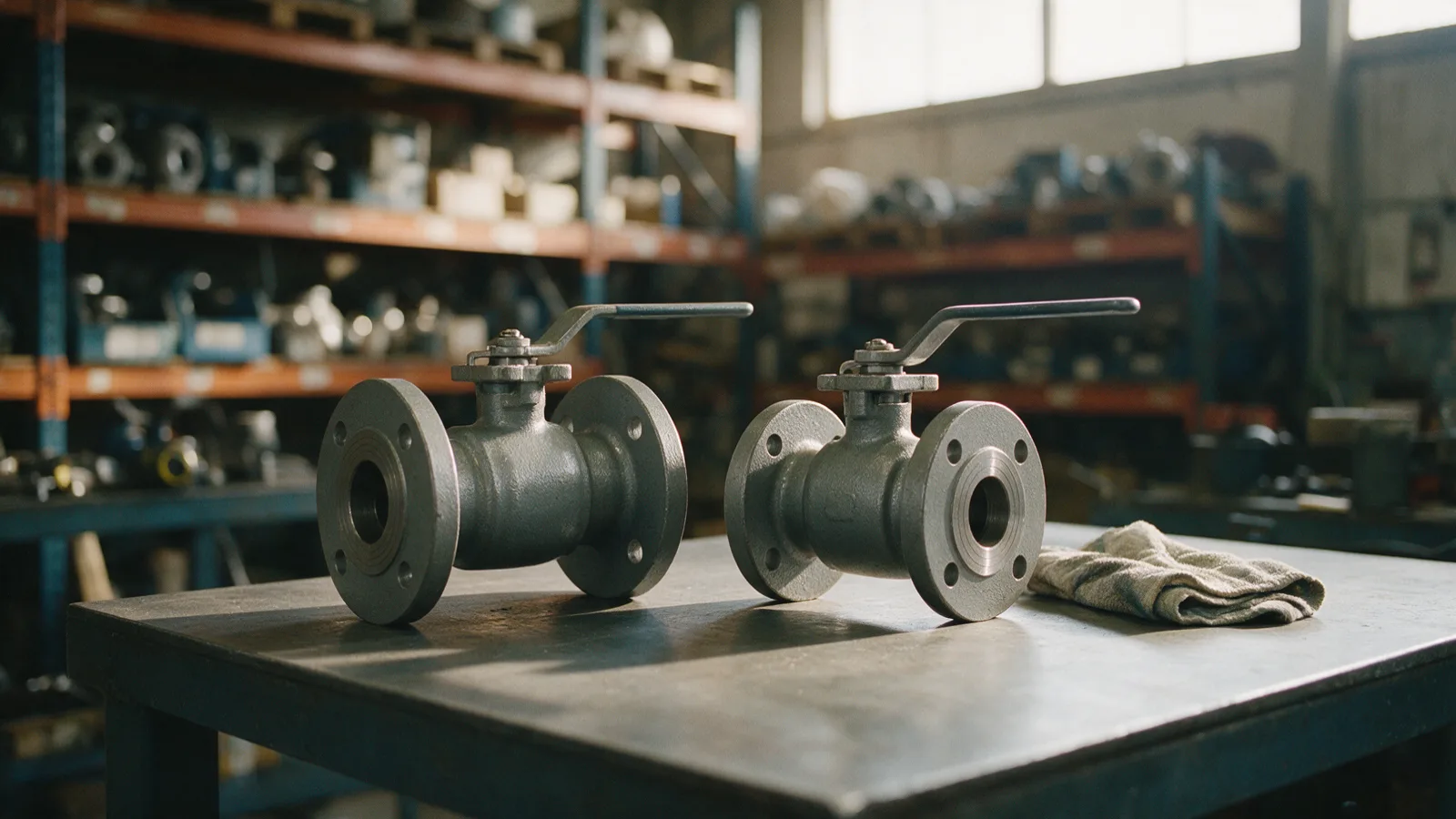
What does ASME B16.10 cover?
ASME B16.10 is the ASME standard for the installed length of a valve. ASME's own page for B16.10 says it covers face-to-face and end-to-end dimensions of straightway valves, and centre-to-face and centre-to-end dimensions of angle valves. Project Materials' summary of ASME B16.10 lists gate, globe, plug, ball, check and butterfly valves among the types it covers.
QRC Valves adds butterfly valves of Class 150, 300 and 600, whose face-to-face may include allowances for gasket or resilient-facing compression. The wafer, lug or double-flanged memo covers the butterfly body choice itself.
ASME B16.10 is a dimensional standard. The same summary notes that it works with ASME B16.34 for pressure ratings and ASME B16.5 for flange connections. The reason it exists is written into its purpose statement:
"Its purpose is to assure installation interchangeability for valves of a given material, type, size, rating class, and end connection." ASME B16.10, scope and purpose, asme.org
Read the other way round, ASME B16.10 promises interchangeability only between valves that share all five. A Class 300 valve is not built to fit a Class 150 gap. A globe valve is not built to fit a gate valve's gap.
What is the difference between face-to-face and end-to-end?
Face-to-face and end-to-end are two ways of measuring a valve's length, and ASME B16.10 uses each for different ends. Face-to-face runs between the gasket contact surfaces of a flanged valve. End-to-end runs between the extreme ends of the valve, and it applies where those extreme ends are not the gasket surfaces. The scope text that Relia Valve reproduces sets out which applies where:
- Face-to-face and centre-to-face: flanged end valves.
- End-to-end: grooved end, butt-welding end and flanged end valves.
- Centre-to-end: butt-welding end and flanged end valves.
- Flanged mating dimensions and facings: ASME B16.5, among others, for steel valves.
A ring-joint flanged valve is the usual trap. QRC Valves' summary of ASME B16.10 lists the facings measured face to face: flat, 1.5 mm raised, 6.4 mm raised, male and tongue. Ring joint, female and groove facings are measured end to end instead. ASME B16.10 therefore gives a ring-joint valve its own end-to-end length, separate from the raised-face figure for the same size and class. The Class 150 lengths in this memo are 1.5 mm raised-face figures. QRC's reproduced B16.10 table heads that column "Flanged End [1.5 mm (0.06 in.) Raised Face] and Welding End", and its NPS 2 Class 150 gate valve reads 178 mm, as Wermac's does. For a ring-joint valve, ask the supplier to quote from the end-to-end column.
How much do face-to-face dimensions differ by valve type?
Face-to-face dimensions differ by valve type, even at one size and class. In the Class 150 tables as reproduced by Wermac, an NPS 6 (6-inch) raised-face gate valve is 267 mm face to face. A globe valve of the same size and class is 406 mm, so the globe is 139 mm longer. Gate valve versus globe valve covers why the two bodies differ.
Class moves the numbers too. At NPS 4, a flanged gate valve is 229 mm in Class 150 and 305 mm in Class 300. Moving up one class on the same size added 76 mm. The table sets out seven common sizes. Every figure is a flanged face-to-face length in millimetres, as the sources print it. It stops at Class 300. Class 600 and above have their own tables, such as Wermac's Class 600 reproduction. What Class 150, 300 and 600 actually permit explains the class step itself.
| Valve, class | NPS 2 | NPS 3 | NPS 4 | NPS 6 | NPS 8 | NPS 10 | NPS 12 |
|---|---|---|---|---|---|---|---|
| Gate, solid wedge, Class 150 | 178 | 203 | 229 | 267 | 292 | 330 | 356 |
| Globe or lift check, Class 150 | 203 | 241 | 292 | 406 | 495 | 622 | 698 |
| Swing check, Class 150 | 203 | 241 | 292 | 356 | 495 | 622 | 698 |
| Ball, long pattern, Class 150 | 178 | 203 | 229 | 394 | 457 | 533 | 610 |
| Ball, short pattern, Class 150 | 178 | 203 | 229 | 267 | 292 | 330 | 356 |
| Gate, solid wedge, Class 300 | 216 | 282 | 305 | 403 | 419 | 457 | 502 |
| Globe or lift check, Class 300 | 267 | 318 | 356 | 444 | 559 | 622 | 711 |
| Swing check, Class 300 | 267 | 318 | 356 | 444 | 533 | 622 | 711 |
| Ball, long pattern, Class 300 | 216 | 282 | 305 | 403 | 502 | 568 | 648 |
| Ball, short pattern, Class 300 | 216 | 282 | 305 | 403 | 419 | 457 | 502 |
ASME sells ASME B16.10 itself, so these lengths are read from free reproductions of its tables. Wermac, Class 150 and Wermac, Class 300 supply every figure. Project Materials agrees on every row in both classes except one: at NPS 6 in Class 150 it prints no swing check split, while Wermac's note gives 406 mm for globe and horizontal lift check valves and 356 mm for a swing check. In Class 300, Wermac prints swing check in its own column, which parts from globe and lift check at NPS 8.
Scope wording is from asme.org, which lists the 2022 edition as current. Published reference data only: confirm every length against the current edition, and your purchase order governs.
Short pattern or long pattern: why can one valve type have two lengths?
One valve type can have two lengths because ASME B16.10 tabulates short-pattern and long-pattern bodies separately for some types. Ball and plug valves are the common cases. In Class 150, the two ball valve patterns share a length up to NPS 4. From NPS 6 they part: 267 mm short against 394 mm long at NPS 6, a gap of 127 mm.
In both classes, a short-pattern ball valve matches the solid-wedge gate valve's length at every size in the table. A long-pattern one does not, from NPS 6 in Class 150. The same Wermac table lists a venturi-pattern plug valve at NPS 6 in Class 150 at 394 mm, the long ball valve's length.
Class 300 holds the two ball valve patterns together for longer. Long and short ball valves share the gate valve's length from NPS 2 to NPS 6, then part at NPS 8: 419 mm short, 502 mm long. Project Materials states the consequence plainly:
"The critical point: you cannot substitute a short-pattern valve into a space designed for a long-pattern valve (or vice versa) without modifying the pipe spool." Project Materials, ASME B16.10 valve face-to-face
Where the two patterns share a length, stating the pattern costs nothing. Where they part, its absence decides whether the valve fits. How a ball valve compares with a butterfly valve covers the choice of type, and the ball valve product sheet lists what a ball valve enquiry should state.
How do you order a replacement valve that fits the existing gap?
A replacement valve fits the existing gap when its tabulated length matches the old valve's, within tolerance. ASME B16.10 ties that length to five things: material, type, size, rating class and end connection. Add the facing and the pattern, and the enquiry pins the length before anyone quotes.
- Read the old valve first. Size, class and material are usually on its body markings or plate. How to read an MSS SP-25 valve nameplate explains the fields.
- Measure the old valve itself, across its own flange faces, or end to end if it is ring joint. An in-line gap between the pipe flanges also holds two gaskets, so subtract both gasket thicknesses before comparing it with the table.
- Compare within tolerance. QRC Valves gives ASME B16.10's straightway tolerance as plus or minus 1.5 mm up to NPS 10 and plus or minus 3.0 mm from NPS 12. Angle valves take half those figures.
- State the facing (raised face or ring joint) and, for a ball or plug valve, the pattern: short, long or venturi.
- Write "face-to-face to ASME B16.10" on the line, so the supplier quotes a valve built to the tabulated length.
A compact socket-welded or threaded valve is outside this exercise. Those end connections are not among the ones ASME B16.10's scope names. API 600 and API 602 compared covers the compact small-bore valves where those ends are common.
What does ASME B16.10 not settle?
ASME B16.10 settles only the length a valve occupies in the line. The pressure and temperature a valve body may carry is a separate question, answered by its rating class. What Class 150, 300 and 600 actually permit covers that side.
The flange itself belongs elsewhere. The ASME B16.10 scope text that Relia Valve reproduces sends the mating dimensions and facings of steel flanged ends to ASME B16.5, among others. Whether a particular valve held pressure is a test record, set out in what an API 598 test report shows.
A matching length is therefore necessary and not sufficient. The replacement must also meet the rating, material and documents the line was specified to. Specifying a valve from line conditions to purchase order walks the whole line item in order.
What do buyers ask about ASME B16.10?
Four questions come up when a flanged valve is replaced against ASME B16.10. Each short answer below is drawn from the tables and sources above, and the figures behind them are in the DETAIL 03 table, where the edition caveat applies.
Is a Class 300 valve longer than a Class 150 valve?
Usually, at the same size and type, but not always. In Wermac's reproductions of the ASME B16.10 tables, an NPS 4 flanged gate valve is 229 mm face to face in Class 150 and 305 mm in Class 300. At NPS 8 the same gate valve is 292 mm and 419 mm. A globe valve at NPS 10 is 622 mm in both classes.
Is a ring-joint valve measured face to face?
No. ASME B16.10 measures flat, raised, male and tongue facings face to face, between the gasket contact surfaces. Ring-joint, female and groove facings are measured end to end, because their gasket surfaces are not at the extreme ends of the valve. A ring-joint valve therefore has its own tabulated length, so quote it from the end-to-end column.
Does ASME B16.10 cover threaded or socket-weld valves?
No. The ASME B16.10 scope names flanged, butt-welding and grooved ends, plus valves made to sit between flat-face or raised-face flanges. Threaded and socket-weld ends are not among them. Those ends are common on compact small-bore valves, which API 602 covers, and the API 600 vs API 602 memo sets out where that standard applies.
How close must a replacement's length be?
Within the ASME B16.10 tolerance. QRC Valves gives plus or minus 1.5 mm for straightway valves up to NPS 10 and plus or minus 3.0 mm from NPS 12, with angle valves taking half those figures. Compare against the old valve itself, or against the in-line gap minus both gasket thicknesses, never the raw gap.
NF Teguh is a Petronas registered vendor and valve stockist in Subang Jaya, Selangor. A replacement enquiry is quickest to price when it arrives with the measured length, material, valve type, size, class, end connection, facing and pattern. Send those to the counter, and read the ordering route for what follows. The rest of the register sits in Insights.
Sources, read 19 September 2026: ASME, B16.10 standard page; Relia Valve, ASME B16.10 scope text; Wermac, Class 150 face-to-face table; Wermac, Class 300 face-to-face table; Project Materials, ASME B16.10 valve face-to-face; QRC Valves, ASME B16.10. Published reference data: confirm against the current edition, and your purchase order governs.
Related memos
Standards named above are published reference data. Confirm against the current edition; your purchase order governs. Questions: the counter.