Check valve types: swing, dual-plate and piston, where each fits
Swing, dual-plate and piston check valves all stop reverse flow but behave differently. Swing checks give low pressure drop in a long body; dual-plate wafer checks close fast in a short, light body; piston checks suit pulsating flow and, with the right spring, vertical lines. Slam risk, pressure drop and installed length decide the pattern. This article maps each type to the services that suit it.
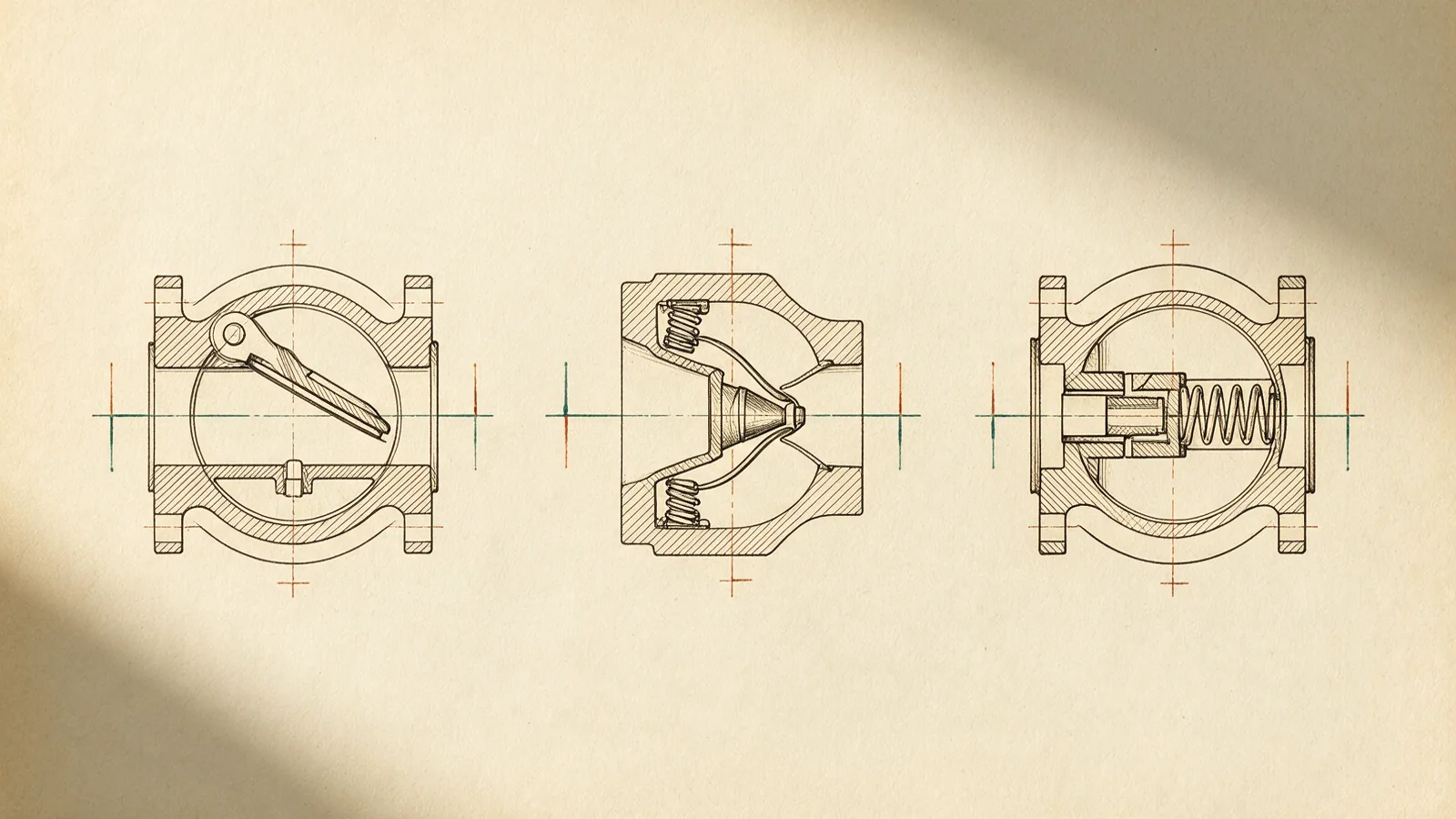
In this memo08 details
Why do check valve types differ?
A check valve is the one valve nobody operates: flow opens it, reversal shuts it, and everything about its behaviour is set by what the moving element weighs, how far it travels, and what pushes it home. Those three variables produce genuinely different machines.
A pump discharge guarding against runback, a compressor line full of pulsation, and a vertical riser make different demands, and the pattern that is perfect on one can hammer itself to pieces on another.
Selection is a matter of matching closing behaviour to the way the flow actually dies in your system, and the three patterns below cover most of the industrial ground between them.
Where does a swing check fit?
On long, clean pump and process lines, where the lowest pressure drop matters. The swing check is the traditional pattern: a disc hung from a hinge at the top of the bore swings clear of the stream when flow establishes and swings back onto its seat when it stops. Fully open, the disc parks out of the flow path, so pressure drop is the lowest of the three: the reason long pump and process lines default to it.
The price is travel. The disc has a long arc to cover before it reaches the seat, and it closes on gravity and reverse flow rather than any spring, so in a system that decelerates slowly it lands gently, while in one that reverses hard it arrives late and slams.
Swing checks come in long flanged bodies and are happiest horizontal, or in upward vertical flow where the disc's own weight still works toward the seat.
Where does a dual-plate check fit?
Wherever space, weight or structural load matters: the pattern is a fraction of the weight and installed length of a swing check at the same bore, which is why it dominates there.
The dual-plate check folds the disc in half. Two spring-loaded half-plates hinge on a central post inside a short wafer body clamped between line flanges; flow holds both plates open against their springs, and the moment forward flow decays the springs start driving them home. They do not wait for reversal.
Pressure drop sits higher than a swing check's, and the plates, springs and hinge post live in the stream, so heavily fouling media argue against it. Being a wafer unit, it also exists only as part of a made-up flange joint: the same body logic covered in the butterfly body memo.
Where do piston and lift checks fit?
On the pulsating flow of reciprocating pumps and compressors. Piston and lift checks guide the moving element along the flow axis instead of swinging it. A piston or ball rises in a guide as flow establishes and is pushed back onto its seat by a spring, by gravity, or both.
Travel is short and controlled, so closure is prompt, and the guided element tolerates the rapid open-close cycling of pulsating flow far better than a swinging disc, which that duty hammers. The costs are a smaller natural size range and the highest pressure drop of the three, since flow must turn through the seat.
Orientation is part of the pattern: a gravity-closed lift check is a horizontal-line valve, while a spring-closed piston check can be rated by its maker for vertical or any-position installation. That is a data-sheet fact to confirm, never an assumption.
What causes check valve slam?
Check valve slam is not the valve failing to shut; it is the valve succeeding too late. If reverse flow is already moving when the element finally lands, the flowing column arrests in an instant and the resulting pressure spike bangs through the pipework: heard as a hammer, felt in the supports, and paid for in gaskets and instrument fittings.
The cure is closing before reversal ever develops, which is exactly what spring assistance buys: dual-plate and spring-loaded piston checks begin closing on dying forward flow, so by the time the flow crosses zero the element is already at or near its seat.
Where a system is known to reverse hard (a tall riser draining back, parallel pumps trading duty), closing character belongs on the enquiry alongside size and class.
A check valve should close on dying forward flow, not on established reverse flow. Every pattern choice is a bet on which it will get.
Which way can a check valve be installed?
Every check valve has an orientation story, because something must push the element home when flow stops. Gravity-closed patterns (the plain swing, the unsprung lift) want horizontal runs, or upward vertical flow where the maker allows it, and none of them can be trusted pointing downward.
Spring-closed patterns are freer, and a dual-plate or sprung piston check is often rated for any position, but that rating is the manufacturer's to give: the same pattern from two makers can carry different orientation limits.
State the line orientation on the enquiry and let the data sheet answer; your purchase order governs what arrives.
Which check valve suits which service?
Laid side by side, the selection compresses into a short table: qualitative leanings, not rules, because bore, medium and the maker's own design all move the answer.
| Duty | Leaning | Why |
|---|---|---|
| Long, clean pump and process lines | Swing | Lowest pressure drop |
| Space- or weight-limited installations | Dual-plate | Short, light wafer body |
| Systems that reverse hard | Dual-plate or sprung piston | Springs close before reversal |
| Pulsating reciprocating flow | Piston | Guided, short travel |
| Vertical lines | Spring-closed patterns, per maker | Gravity closure unreliable |
Whatever the pattern, seat tightness is proven the same way: pressure testing to API 598, the valve inspection and test standard, whose report is unpacked in the API 598 memo; treat the designation as published reference and confirm against the current edition, since your purchase order governs.
The wider paperwork question lives in the procurement documentation guide, and the specification discipline itself in the specifying guide. NF Teguh is an industrial valve stockist in Subang Jaya, Selangor. Put pattern, orientation and closing character on the enquiry to the counter, and find the rest of the register on insights.
What do buyers ask about check valves?
Which check valve has the lowest pressure drop?
The swing check. Fully open, its disc parks out of the flow path, which is why long pump and process lines default to it.
How do you stop check valve slam?
Close before reversal develops. Dual-plate and spring-loaded piston checks begin closing on dying forward flow. Where a system is known to reverse hard, put closing character on the enquiry alongside size and class.
Can a check valve go in a vertical line?
Gravity-closed patterns want horizontal runs, or upward vertical flow where the maker allows it, and none can be trusted pointing downward. A dual-plate or sprung piston check is often rated for any position, but that rating is the manufacturer's to give.
Is a dual-plate check right for fouling service?
Usually not. Its plates, springs and hinge post live in the stream, so heavily fouling media argue against it.
How is a check valve's seat tightness proven?
The same way whatever the pattern: pressure testing to API 598, the valve inspection and test standard. Treat the designation as published reference and confirm against the current edition; your purchase order governs.
Related memos
Standards named above are published reference data. Confirm against the current edition; your purchase order governs. Questions: the counter.