API 600 vs API 602: gate valve standards compared
API 600 and API 602 do not compete. The difference is scope, not rank. API 600 covers bolted-bonnet steel gate valves in 25 enumerated sizes, NPS 1 to NPS 42. API 602 covers compact gate, globe and check valves at NPS 4 and smaller. Seven sizes appear in both. For a gate valve between NPS 1 and NPS 4, the purchase order must name the standard that governs.
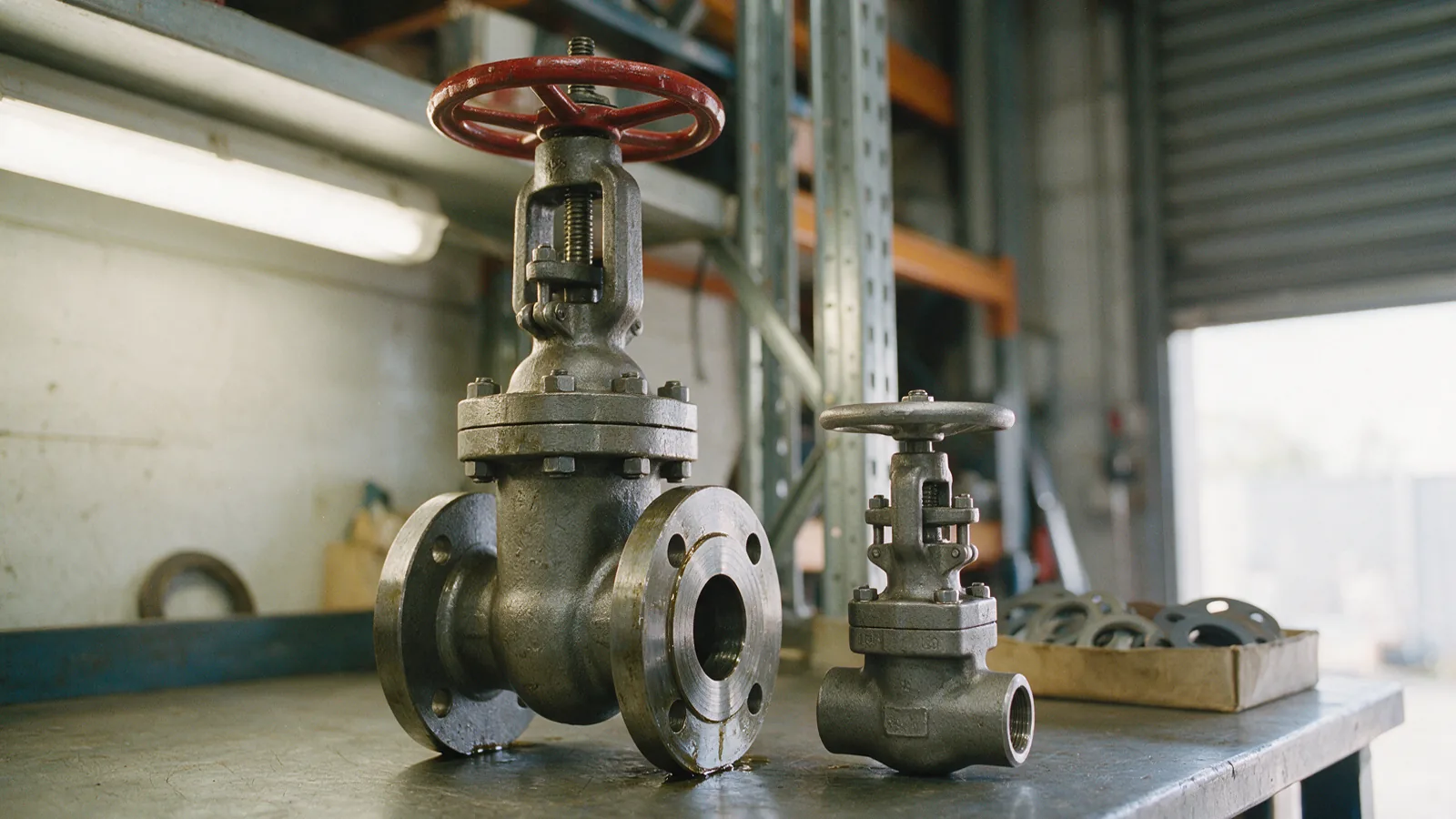
What is the difference between API 600 and API 602?
The difference between API 600 and API 602 starts with scope. API 600 covers one valve type, the bolted-bonnet steel gate valve, and reaches NPS 42. API 602 covers three valve types, gate, globe and check, but stops at NPS 4. The seven sizes they share are where gate valve specifications are most easily misread.
The common shortcut is a clean size boundary: big valves to API 600, small valves to API 602. It is close enough to be useful and wrong enough to cause arguments. Neither standard covers a continuous range. Each names a discrete list: 25 sizes for API 600 and 11 for API 602. NPS 5 is in neither list.
A second shortcut reads API 600 as cast and API 602 as forged. The published scopes do not draw that line. API 602's material tables carry forging and casting descriptions side by side. Body construction therefore belongs on the purchase order as its own statement. Reading the whole line is the discipline of specifying a valve from line conditions to purchase order.
What does API 600 specify?
Per API 600's thirteenth-edition scope, API 600 specifies a heavy-duty series of bolted-bonnet steel gate valves. It is written for petroleum refinery and related applications. The scope gives the reason: corrosion, erosion and other service conditions can indicate a need for full port openings, heavy wall sections and large stem diameters. API 600 enumerates 25 sizes, DN 25 to DN 1050. Its class designations are 150, 300, 600, 900, 1500 and 2500.
API 600 tabulates its own minimum wall thickness for body and bonnet, and its own trim numbers. The scope names a bolted bonnet, outside screw and yoke, and rising stems with non-rising handwheels. How OS&Y rising-stem construction works has its own memo. The scope also names single or double gate, wedge or parallel seating, and metallic seating surfaces. End connections are flanged or butt-welding. Gate valve patterns and trim options are set out on the product sheet.
What does API 602 specify?
Per API 602's tenth-edition scope, API 602 specifies compact gate, globe and check valves. It is written for petroleum and natural gas industry applications. Because it covers three valve types, one specification can cite it for gate, globe and check valves alike. API 602 covers 11 sizes, DN 8 to DN 100, or NPS 1/4 to NPS 4. Its pressure designations are Classes 150, 300, 600, 800 and 1500.
Compact does not mean simplified. Outside screw with rising stems runs the full DN 8 to DN 100 span. Inside screw is narrower: DN 8 to DN 65, at Class 800 and below. Extended bodies and bellows stem seals carry their own size and class bounds. API 602 also provides for standard-bore and full-bore body seat openings. A compact valve line should therefore state the bore. The end-connection and bonnet-joint limits sit in the table below. A purchase order naming only the standard has not said enough.
| READ THIS | API 600 | API 602 |
|---|---|---|
| Valve types in scope | Gate valves only | Gate, globe and check valves |
| Sizes covered | 25 enumerated sizes, NPS 1 to NPS 42 (DN 25 to DN 1050). Not a continuous range: NPS 5 and NPS 22 are absent | 11 enumerated sizes, NPS 1/4 to NPS 4 (DN 8 to DN 100) |
| Pressure designations | Class 150, 300, 600, 900, 1500, 2500 | Class 150, 300, 600, 800, 1500 |
| Bonnet joint | Bolted bonnet | Bolted, welded, or threaded with seal weld, to Class 1500; union nut to Class 800 |
| End connections | Flanged or butt-welding | Socket-welding or threaded, DN 8 to DN 65 (NPS 1/4 to NPS 2-1/2), at Class 800 and Class 1500. Flanged or butt-welding, DN 15 to DN 100 (NPS 1/2 to NPS 4), Class 150 through Class 1500, excluding flanged end Class 800 |
| Body seat opening | Full port openings, cited in the scope as a service need | Standard-bore or full-bore |
| Wall thickness | Own minimum wall thickness table for body and bonnet | Own minimum wall thickness table for bodies, bonnets and check valve covers |
| Trim | Tabulated trim numbers and alternative trim numbers | Tabulated trim materials |
| Written for | Petroleum refinery and related applications | Petroleum and natural gas industry applications |
Every scope figure on this page is read from API's own published previews of the two standards: the scope page and the contents list. API Standard 600, thirteenth edition, January 2015: scope, the 25 enumerated sizes and the pressure class designations. API Standard 602, tenth edition, May 2015: scope, the 11 enumerated sizes, the pressure designations, the bore options, the per-variant size and class bounds, the table titles and the Class 800 statement quoted below. API 600 has since been revised: IOGP S-611 cites its fourteenth edition, May 2021. API 602 has been revised too: Intertek Inform lists API STD 602:2022, published 17 May 2022, as current. Confirm every figure against the current edition.
What does Class 800 mean on a valve?
On a valve, Class 800 is an intermediate pressure class, widely used on compact socket-welding and threaded end valves. It sits outside the listed class series. API 602 names it among its pressure designations and tabulates its own Class 800 pressure and temperature ratings. A Class 800 rating is therefore read from API 602's own tables, not from a listed class table. API 602's scope puts it this way:
"Class 800 is not a listed class designation, but is an intermediate class number widely used for socket welding and threaded end compact valves." API Standard 602, tenth edition, scope
Three practical points follow for a buyer reading API 602. First, API 602's scope excludes Class 800 only for flanged ends. Socket-welding and threaded ends carry it up to NPS 2-1/2. Butt-welding ends carry it from NPS 1/2 to NPS 4. A flanged Class 800 line is therefore worth querying before anyone quotes it. Second, the ratings sit in API 602's own six Class 800 rating tables, given in SI and USC units. Third, the scope points to ASME B16.5 for flanged ends and ASME B16.11 for socket-weld ends, and its material tables follow ASME B16.34 material groups. What Class 150, 300 and 600 actually permit explains how class numbers behave in general.
How do you tell which standard your spec line means?
Which standard a spec line means is decided by four checks: size, end connection, pressure class and valve type. API 600 covers gate valves alone. API 602 covers gate, globe and check valves, and stops at NPS 4. Where the two size sets overlap, the other three checks often break the tie, but not always.
- Size: above NPS 4, only API 600, which is a gate valve standard. Below NPS 1, only API 602, down to NPS 1/4. NPS 5 is in neither set.
- End connection: socket-welding and threaded ends point at API 602, at NPS 2-1/2 and below. Flanged and butt-welding ends sit in both standards from NPS 1 to NPS 4. Above NPS 4, they point at API 600 alone.
- Class: Class 800 appears only among API 602's designations. Class 900 and Class 2500 appear only among API 600's. A Class 900 gate valve at NPS 2 therefore points to API 600.
- Valve type: a globe or a check valve was never API 600's business. Gate valves are all it covers.
Of these two standards, a bolted-bonnet flanged gate valve at an API 600 size above NPS 4 can only be API 600. A compact socket-welded valve on a drain line, at NPS 2-1/2 or below, reads API 602. Where the two still overlap, the governing standard is a decision, not a deduction.
The enquiry line itself should then state the standard, valve type, size, class, end connection and body construction. For an API 602 line, add the bore. Add the bonnet and stem arrangement when the service is particular. A line reading only "API 602 gate valve" leaves those choices to the supplier.
What do the two standards not settle?
Neither API 600 nor API 602 proves anything about a particular valve. Both require pressure testing and both specify permitted materials. A product standard describes what a valve must be. It does not record what the valve in front of you was measured to do. The test record and the material certificate are separate documents. Both standards also set marking requirements, and API 602 includes identification plate marking.
Each of those has its own memo. What an API 598 shell and seat test report shows covers whether the valve held pressure and shut off. Which EN 10204 certificate procurement needs covers what its metal is certified to be. How to read an MSS SP-25 nameplate covers identification.
What the two standards do settle is the family a specification asks for. In the overlap, the enquiry line has to name the standard. NF Teguh is a Petronas registered vendor and valve stockist in Subang Jaya, Selangor. The counter would rather settle the standard at enquiry than at goods inwards. Send the standard, valve type, size, class, end connection and body construction, plus the bore for an API 602 line, to the counter. The line can then be priced as read. The ordering route sets out what follows, and the rest of the register sits in Insights.
Related memos
Standards named above are published reference data. Confirm against the current edition; your purchase order governs. Questions: the counter.