Double block and bleed or double isolation and bleed: which one a spec means
Double block and bleed and double isolation and bleed are different things. Valve Magazine's report of API's entries records that a double block and bleed valve seals against pressure from both sides, while a double isolation and bleed valve adds a seal against pressure from only one side, and that API notes a double block and bleed valve does not give positive double isolation when only one side is under pressure. API describes one valve; OSHA's definition is a procedure using two in-line valves and a bleed.
What does double block and bleed (DBB) mean?
Double block and bleed has more than one published definition. Valve Magazine records that two entities in the United States define it: the American Petroleum Institute, as an industry body, and the Occupational Safety and Health Administration, as the regulator enforcing health and safety law.
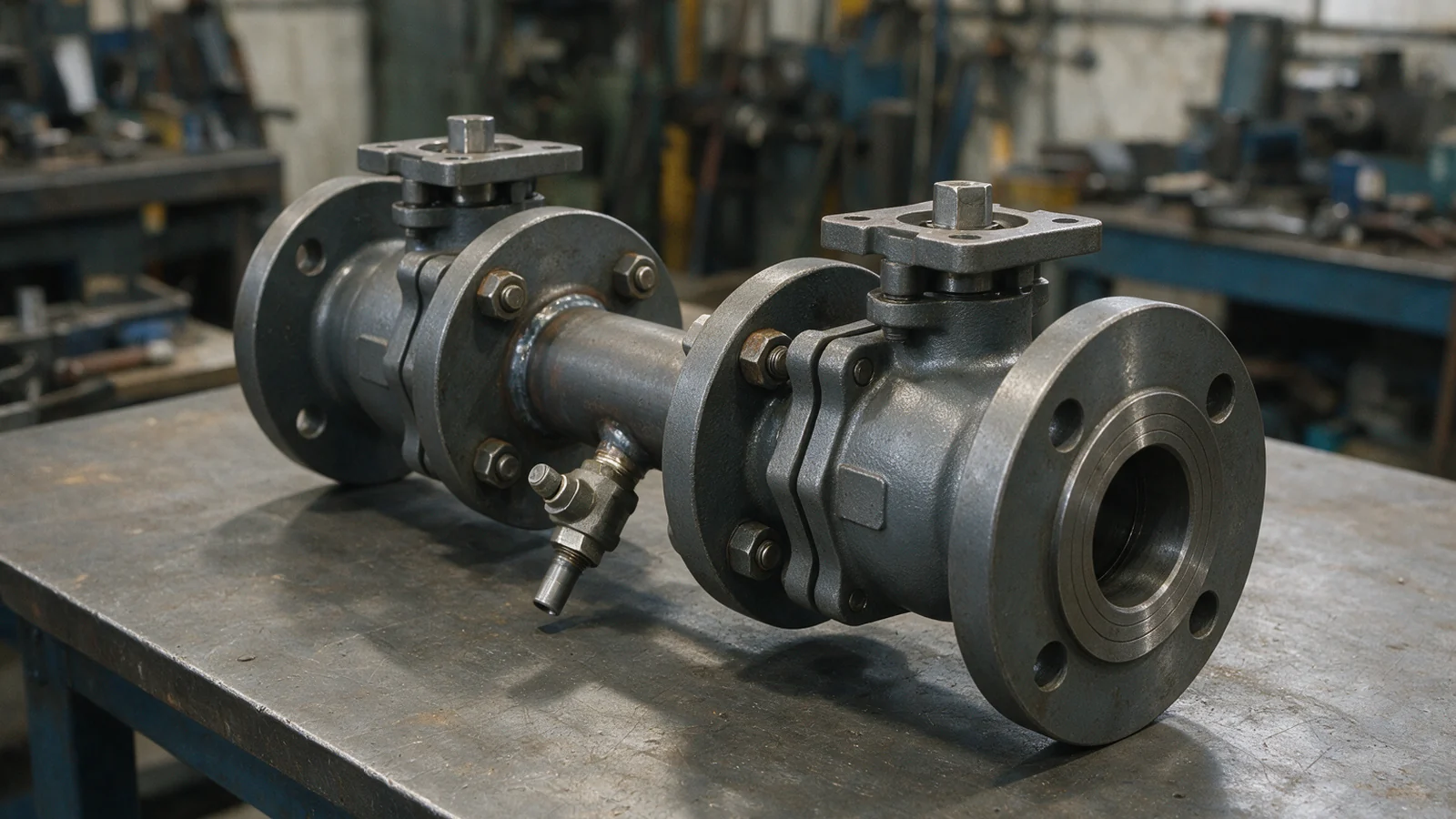
API's is a description of hardware. As Valve Magazine reports it, API's entry covers one valve rather than an arrangement of several: a valve carrying two seating surfaces, able when shut to hold against pressure reaching it from either end, and fitted with a way of draining or venting the space trapped between those two seats. Valve Magazine also records the qualifier API attaches to that definition, and it is the most important sentence on this page: the valve "does not provide positive double isolation when only one side is under pressure."
OSHA's is a description of a procedure. The same report quotes it as "the closure of a line, duct or pipe by closing and locking, or tagging, two in-line valves and by opening and locking, or tagging, a drain or vent valve in the line between the two closed valves." A third definition is in circulation too: Valve Magazine records that the British Valve and Actuator Association defines double block and bleed as a manifold combining one or more isolation valves, usually ball valves, with one or more bleed or vent valves, usually needle-style globe valves, into a single assembly for interfacing with instruments such as pressure transmitters, gauges and switches.
So one phrase can mean a valve, a locked-and-tagged procedure or an instrument manifold. Valve Magazine notes that BVAA, like API, holds that only one valve is required for double block and bleed capability rather than a system.
What is the difference between double block and bleed and double isolation and bleed (DBB vs DIB)?
The difference between double block and bleed and double isolation and bleed is which pressure each seat is proved against. Valve Magazine states the contrast in one line: "a double block-and-bleed valve seals against pressures from both sides of the valve, while a double isolation-and-bleed valve provides an additional seal against pressure from only one side."
API's double isolation and bleed entry, as that report quotes it, also covers one valve with two seats, but asks more of each seat on its own: each has to hold against pressure from a single source, with the same drain or vent on the space between them. The qualifier buyers most often miss follows immediately: that feature, the report records, "can be provided in one direction or in both directions." A valve described as double isolation and bleed may therefore be unidirectional in that respect, which is why the enquiry has to say which directions matter.
Valve Magazine is direct about when the choice matters: "For applications that require an additional pressure barrier that seals separately from the main pressure barrier, it is important to use a DIB valve instead of a DBB to fulfill operational safety requirements." Each arrangement still carries its own trade-off. Valve Magazine records that a double block and bleed valve usually has two unidirectional self-relieving seats, which do not depend on an outside mechanism to relieve pressure, whereas a double isolation and bleed valve uses one or two bidirectional seats and cannot relieve body cavity pressure past them. Its seats are not self-relieving, so the same report states that an external relief system is needed to relieve pressure build-up.
| Point | Double block and bleed | Double isolation and bleed |
|---|---|---|
| What each seat is proved against | The valve holds against pressure reaching it from either end | Each seat seals against pressure from a single source |
| Directions | Seats usually described as unidirectional | One or two bidirectional seats; the feature may be one direction or both |
| Cavity relief | Seats usually self-relieving, needing no outside mechanism | Not self-relieving; an external relief system is needed |
| What the enquiry must add | Which sides carry pressure when shut, and the bleed arrangement | Which directions the feature must cover, and the external relief |
Both terms, in API's usage, describe one valve rather than an arrangement of two. Where a specification pairs either term with a seat tightness expectation, the test evidence is a separate document again, covered in what an API 598 shell and seat test report shows.
Does a double block and bleed requirement mean one valve or two?
A double block and bleed requirement can mean either, and the published definitions are the reason. API's description is of one valve with two seating surfaces. OSHA's is of two in-line valves, closed and locked or tagged, with a drain or vent valve between them opened and locked or tagged. An enquiry naming only the phrase has not said which of those it wants.
Valve Magazine's description of double isolation and bleed sets out why it is reassuring: with both in-line valves closed and the bleeder open, anything leaking past the first valve is drained off before it can pressurise the space between them, and the open bleeder acts as a tell-tale that the leakage exists. If the bleeder itself plugs, the second in-line valve still stops the fluid.
The commercial consequences of choosing between them are real. Valve Magazine records that a single valve unit reduces the installation footprint, saves extra piping and reduces weight in critical areas, saving space, time and cost. Where the installed length of a replacement matters, that is governed separately by ASME B16.10 face-to-face dimensions.
How can a double block and bleed valve still pass fluid?
A double block and bleed valve can pass fluid through its downstream seat when nothing is holding that seat shut. The worked example in Valve Magazine's report of Rudy Garza's presentation to the VMA Technical Seminar is a trunnion-mounted ball valve with self-relieving seats, which API 6D classed, in the edition reported there, as double block and bleed rather than double isolation and bleed.
Closed with line pressure on one side only, that valve's upstream seal is energised by the line pressure along with an internal spring, while the only thing energising the downstream seal is a spring. The report notes that "it is not uncommon for a valve that has been in service for a while to leak a bit" past the upstream seal, which on its own is carried away by the open bleeder.
The failure needs both conditions together. If the upstream seal is leaking and the bleeder is not working, because one or both bleeder valves is closed or the bleed line is clogged, the leakage has nowhere to go. The report states that cavity pressure can then possibly reach as high as 200 psi in that illustrative case, which in the report's own words "overcomes the spring on the downstream seal and forces it off its seat, discharging fluid downstream to where people may be working."
Garza's own classification table marks this valve type with a caveat worth repeating: it denotes potential for exceptions based on the configuration of the valve or the manufacturer. The same table lists trunnion ball valves with double piston effect seats as a separate line from those with self-relieving seats, so a quotation naming double piston effect seats is describing a different arrangement and needs its own confirmation. How a trunnion mounting carries its seats at all is set out in how a trunnion-mounted ball carries its seats.
The report also gives the service where that valve type does what its label suggests: closed with pressure on both sides, as in a bypass loop for proving a flowmeter, both seals stay fully energised. That, it notes, is the configuration API 6D's reference to two sealing surfaces had in mind, and it adds that as far as ExxonMobil Upstream is concerned this is still not true double positive isolation, and in certain services it should not be used to isolate a section for maintenance.
Which edition of API 6D applies to a double block and bleed requirement?
The edition of API 6D that applies is the one the purchase order names. The reporting that spread this DBB and DIB distinction describes a 2010 presentation and refers to API 6D under the older title Specification for Pipeline Valves, so statements quoted from it describe an edition that has since been superseded and retitled.
A United States Federal Register notice of 1 July 2025 records the edition the US pipeline safety regulator, the Pipeline and Hazardous Materials Safety Administration, incorporates by reference: API Specification 6D, Specification for Valves, 25th edition, 1 November 2021, with Errata 1 of December 2021, Errata 2 of April 2022, Errata 3 of October 2023 and Addenda 1, 2 and 3 of April 2023, September 2024 and March 2025. It replaces the 24th edition of August 2014, which the same notice titles Specification for Pipeline and Piping Valves.
That gives three titles across the editions a drawing might name, which is the practical point. The same notice states the specification's scope in the regulator's words: requirements for the design, manufacturing, materials, welding, quality control, assembly, testing, marking, documentation and process controls of axial, ball, check, gate and plug valves for application in the natural gas industry.
This is a United States regulation, not a Malaysian one. It is cited here only because it is a public record of the specification's edition history; it does not govern a Malaysian project. Confirm the current edition with API before an enquiry is issued, and name it with its errata and addenda rather than the number alone. The whole route from line conditions to a purchase order is in specifying industrial valves, and pressure class is in what Class 150, 300 and 600 actually mean.
How do operators decide which valve is enough for isolation?
Operators decide by writing down an isolation philosophy and classifying valves against it, rather than by reading a label. Valve Magazine's report sets out one operator's scheme as an illustration: ExxonMobil Upstream sorts valves into categories by what they physically block, then gives guidance on the minimum isolation required for an application, such as long-term against short-term isolation or segregation for meter proving.
In that scheme the lowest category is a single block valve with one mechanically energised seal and no body bleed required. The next is the double block and bleed, which the report qualifies as "defined in API 6D, but not always by industry", and which it says "requires pressure on upstream and downstream sides simultaneously to energize the respective seals".
Above that sits a true double isolation and bleed per API 6D: a single body with one closure member and dual positively energised seals, with a cavity bleed port between them, and the report records that it "requires a cavity overpressure protection device in expansive fluid services". The highest category is two independent closure members with two separate stems, in the same or separate bodies, and the report states that it must have a bleeder in the middle.
That scheme is one company's, and it does not map onto the standard. The report states that those category designations "are not aligned with the API 6D classifications or those of other industry standards" and are simply practices ExxonMobil Upstream has adopted for its own use. It adds that the presentation should not be taken as holy writ, that other companies and industries may do things differently, that users must determine the safety and suitability of any practice for their own application, and that a valve's design can vary from one manufacturer to another.
The conclusion the report draws is the one a buyer can act on: look at the design of the actual valve and establish what the manufacturer means by the term it has used.
What should an isolation valve enquiry state?
An isolation valve enquiry should state five things: what the isolation is for, which directions carry pressure when the valve is shut, whether one valve or two is wanted, whether the downstream seal must be positively energised and how cavity pressure is relieved, and the standard with its edition. Each closes a variable that the phrase alone leaves open.
- What the isolation is for: isolating a section for maintenance with people working on it, or segregating a line for something like meter proving. The two do not need the same valve.
- Which directions carry pressure when the valve is shut, and whether the far side can be depressurised. Where double isolation and bleed is specified, say whether the feature must cover one direction or both.
- One valve or two: a single valve with two seats and a body bleed, or two in-line valves with a bleeder between them, locked or tagged if a procedural rule applies.
- Whether a positively energised downstream seal is required rather than one held by a spring, and how body cavity pressure is relieved, since a double isolation and bleed valve needs an external relief system.
- The standard and edition, with errata and addenda, plus the size, class and ends.
NF Teguh supplies gate, globe, ball, plug, butterfly and check valves from Subang Jaya, Selangor, Malaysia, as a Petronas registered vendor, into power plant, petrochemical, oil and gas, oil terminal, offshore and natural gas service. The families most often named on an isolation line are gate valves, ball valves and plug valves. Isolation duty is also a stem and bonnet question, covered in what OS&Y means. Send an enquiry with those five lines in it, and see how ordering works for what follows.
What else do buyers ask about double block and bleed?
The questions below are the ones left over once the two terms are separated: the sub-variants a datasheet names, the seat types behind them, and the manifold that shares the name. Each is answered from the same published descriptions used above.
What does it mean when a double isolation and bleed valve is offered in one direction?
It means the second seal is proved in that direction only. Valve Magazine records that the double isolation and bleed feature "can be provided in one direction or in both directions", which is the distinction behind the variants a datasheet may offer. A valve bought for bidirectional duty on the strength of the term alone may be the single-direction build, so the enquiry has to state which directions the feature must cover.
Are double piston effect seats the same as self-relieving seats?
No. Garza's classification table, as published with the report, lists trunnion ball valves with self-relieving seats and trunnion ball valves with double piston effect seats on separate lines, and marks both as admitting exceptions depending on the valve configuration or the manufacturer. A quotation naming one is not describing the other.
Is a double block and bleed manifold the same as a double block and bleed valve?
Not under the definitions above. Valve Magazine records BVAA defining double block and bleed as a manifold combining isolation valves, usually ball valves, with bleed or vent valves, usually needle-style globe valves, in one assembly for instruments such as transmitters, gauges and switches. API's description is of a single valve. An instrument hook-up and a pipeline isolation valve are different purchases that share a phrase.
Do all double block and bleed valves need line pressure to seal?
No, and this is where the generalisation breaks. Valve Magazine records that "the mechanical wedge action of a double block-and-bleed plug valve compresses both the upstream and the downstream seals firmly against the valve body, which means no help is needed from the line pressure to affect a positive seal." The simultaneous-pressure requirement belongs to particular seat arrangements, not to the term.
Sources, read 3 October 2026: Valve Magazine, "DBB and DIB: Which is which?" by Ron Manson and Tashika Varma, 13 May 2014, both of whom the article identifies as working for the valve manufacturer Cameron, for the API and OSHA definitions, the BVAA manifold definition it attributes to the British Valve and Actuator Association's users' manual, the one-line DBB and DIB contrast, the one-direction or both-directions qualifier, the self-relieving and bidirectional seat descriptions and the external relief requirement, the single-unit footprint and piping savings, the meter calibration point and the plug valve wedge action; and Valve Magazine, "The true meaning of double block and bleed", 10 May 2015, reporting Rudy Garza of ExxonMobil Development Company's "Isolation Philosophies" presentation to the VMA Technical Seminar, also republished by Wermac where the figures and classification table are readable, for the trunnion-mounted ball valve example and its possible 200 psi cavity figure, the bleeder failure path, the flowmeter-proving case, the valve categories and their caveats; and the United States Federal Register notice of 1 July 2025, a direct final rule effective 1 January 2026, for the edition of API Specification 6D incorporated by the US pipeline safety regulator, its title history and the scope wording quoted by that regulator. Statements about what API 6D says are reported from those trade-press accounts of the edition current when they were written, not read from the standard; the ExxonMobil Upstream categories are that company's own and the report states they are not aligned with API 6D's classifications. No table or dimensional data from API 6D is reproduced here, its defined terms are given in our own words, every quoted run of a source is marked as a quotation, and the comparison table above is our own wording. Buy the current edition from API for requirements.
Related memos
Standards named above are published reference data. Confirm against the current edition; your purchase order governs. Questions: the counter.