Handwheel, gearbox or actuator: choosing a valve operator
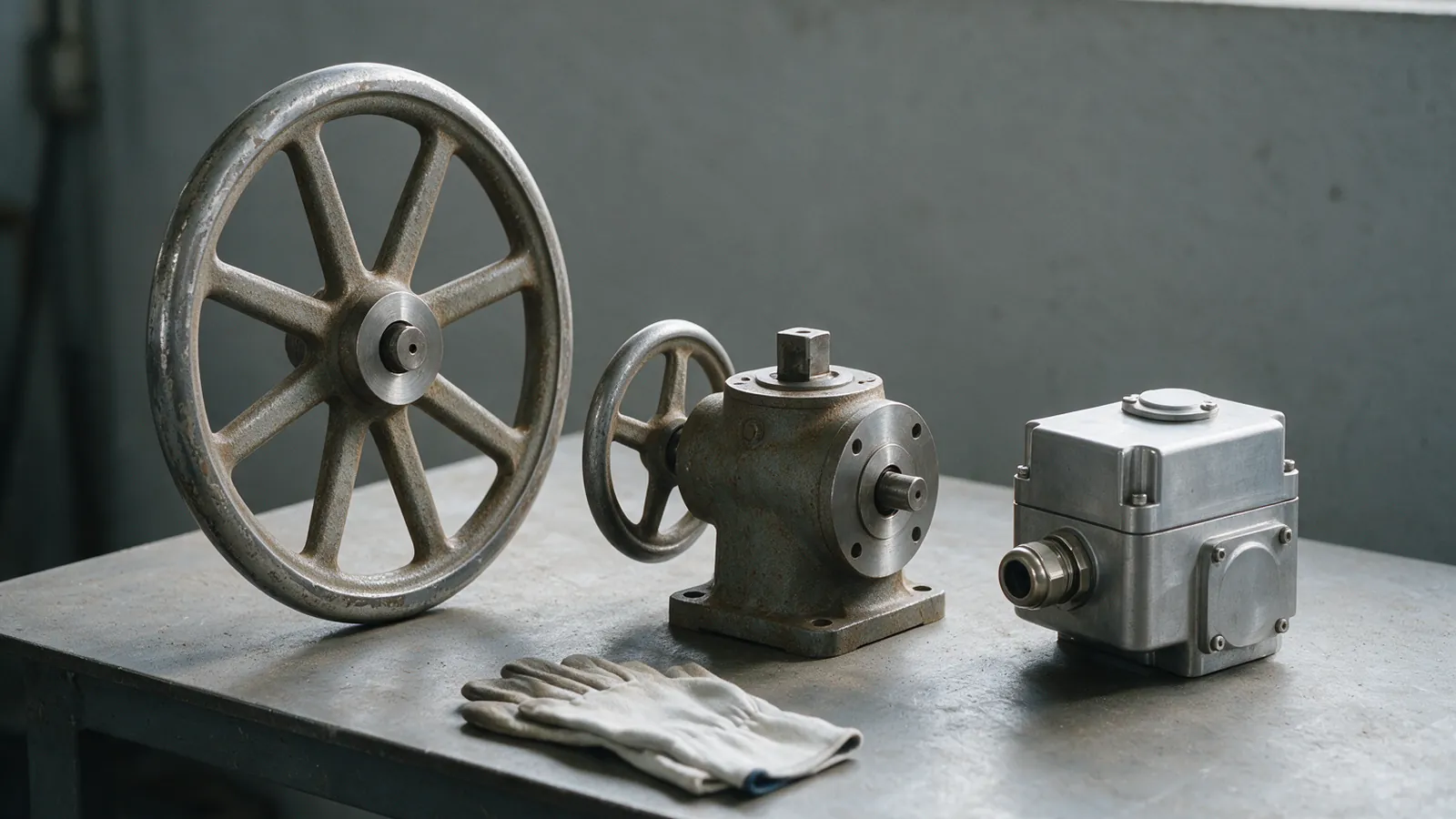
The operator is the part that turns the valve, and a valve order states it on a line of its own. A handwheel or lever fits a valve a person can turn within the plant's own limits on effort and turns. A gearbox fits one that needs more torque than that. An actuator fits a valve that must move on a signal, from a distance, or faster than a person can turn it.
In this memo08 details
What does the operator line on an enquiry cover?
The operator is whatever turns the valve: a lever, a handwheel, a gearbox or a powered actuator. On an enquiry it is a line of its own, separate from the valve, because one valve body can be supplied with any of them. Our glossary lists it the same way, and adds that an actuated valve needs the mounting and the signal stated too.
An order that names a size, a class, a material and a test but no operator has described the valve and not the job. The other five lines are in our memo on specifying industrial valves.
Send the line conditions and the operator you want to the counter on +6012 944 3980.
Torque or thrust: which force does the valve need?
Torque and thrust are the two kinds of force a valve needs, and which one applies follows from how the valve closes. A quarter-turn valve is rotated, so it needs torque. A rising-stem valve is driven along its stem, so it needs thrust. Nothing else about the operator can be settled until that is clear.
Keith Pierrotti, Plant Manager of Cameron's Distributed Valves Division, wrote in Valve Magazine in 2012 that "The first consideration in selecting an actuator is the type of force required", and framed the application engineer's opening question as "Torque or thrust?" He defines torque as "that rotational or twisting force necessary to position ball valves, plug valves, butterfly valves, etc."
So the valve family settles the question before any sizing does: ball, plug and butterfly valves take torque, the rising-stem gate valve takes thrust. On a multi-turn valve the operator still applies torque, at the stem nut, and the stem thread turns it into thrust, so say which quantity your figure is. The figure itself is the valve maker's to state against the line conditions on the enquiry, because the force rises with differential pressure, seat type and what the fluid carries.
Is a handwheel enough, or does it need a gearbox?
A lever or handwheel is enough when a person can work the valve inside the limits that apply to operating effort and to turns. A gear operator, also called a gearbox, is the answer when the valve needs more force at the stem than that, and nothing in the duty requires power. Both answers are still manual operation.
Pierrotti's case for manual is that there is nothing to supply or maintain: "Manual operators have no power requirements, no hydraulic or pneumatic pressure unit to maintain and can be used in the most remote locations." Kevin Swicegood, an engineering manager at Cameron Valves & Measurement, writing in Valve Magazine in 2011, names the two concerns in selecting a manual operator as "the effort required to operate the valve and the number of turns some valves require", and warns that "A lot of effort and a high number of turns can result in personnel fatigue, safety concerns, excessive time for operation and the need for multiple personnel." Those limits come in two tiers. Industry specifications set a ceiling: Swicegood writes that the highest values personnel should exert on levers or handwheels "are defined in the industry", that in 2011 "current API specifications limit[ed] pull to 360 newtons (80 pounds-force)", and that "the maximum lever length or handwheel diameter is also limited by industry specifications". Treat that figure as what he published in 2011, and confirm it against the specification your own order names. Inside that ceiling a company sets its own, tighter limits, and those are the figures only the buyer holds.
A gearbox multiplies the effort put into it and pays for it in turns. Swicegood is blunt about the trade: "With significant gear reduction, the number of turns required for full cycle can number in the hundreds." So a gearbox solves an effort problem and can create a time problem, which is why the enquiry should say how quickly the valve must travel from open to shut. Where it is the right answer it is the economical one: Swicegood writes that high-efficiency worm gears "remain significantly less expensive than automating the valve".
MSS SP-91, "Guidelines for Manual Operation of Valves", is the other standard practice written for this judgement. The current edition is SP-91-2025, and it "provides guidelines for the operation of manually actuated valves by the valve operator's input". No clause or figure from it is reproduced here.
When does the valve have to be actuated?
A valve has to be actuated when it must move without a person at it. Those are duties rather than effort problems, so no gear operator answers them. Four duties call for an actuator:
- It must move on a signal from the control system.
- It must be operated from a safe distance.
- It must travel open to shut at a set speed.
- It must go to a defined position when power or signal is lost.
Swicegood marks the other boundary, the one reached by arithmetic rather than by duty: "Once established limits are exceeded for turns, the valve is generally required to be automated."
Electric, pneumatic or hydraulic?
Powered actuators come in three kinds, and what the plant can supply to the valve decides which:
- Electric. Needs a supply of the right voltage and phase at the valve.
- Pneumatic. Needs instrument air at pressure, which Pierrotti counts as a thing to maintain when he says manual operators have "no hydraulic or pneumatic pressure unit to maintain".
- Hydraulic. Needs a power unit of its own.
The same three appear in the scope of ASTM F1030-86(2023), "Standard Practice for Selection of Valve Operators", whose criteria for power-actuated operators "apply to stem nut and handwheel driven valve operators of the electric, pneumatic, and hydraulic types". Read it for what it is: a three-page practice from ASTM's ships and marine technology committee, subcommittee F25.11, so it is a useful checklist rather than the authority a process plant specification will name. State which of the three the plant can feed before asking for a price, because the answer rules out the other two.
An actuated valve is a longer order line. It states the power available, the fail position, whether the duty is on-off or modulating, the actuator attachment it sits on, which for a quarter-turn valve is the part-turn flange of ISO 5211 and for a rising-stem valve is the multi-turn attachment of ISO 5210, and the control signal and position feedback expected back. Those are choices made at ordering, and they get specific. One maker's published range shows it: Rotork describes its Noah SR actuators "with the safety of a mechanical failsafe built into the actuator", lists wiring diagrams headed "FAIL CLOSE" and "FAIL OPEN" for different models, and states that "these actuators are watertight to IP67 (with optional IP68)". Fail direction and enclosure rating are selected per model, so the enquiry has to say which.
What does a hazardous area add to the order?
In a hazardous area the actuator becomes certified equipment, and the order has to name the certification it must carry and the enclosure rating it must meet. This is the part of the operator line that cannot be settled after delivery, because it is a property of the unit supplied.
IECEx describes itself as the "IEC System for Certification to Standards Relating to Equipment for Use in Explosive Atmospheres". Its certificates are public: issued certificates, licenses and reports are accessible through the IECEx On-Line Certification System, so a certificate named on a quotation can be looked up rather than taken on trust.
EU law reaches the same equipment through Directive 2014/34/EU of 26 February 2014, known as ATEX. Its Article 1 covers equipment and protective systems intended for use in potentially explosive atmospheres, and also devices used outside such atmospheres that the safe functioning of that equipment depends on. The enclosure rating is a separate question, classified under IEC 60529, "Degrees of protection provided by enclosures (IP Code)", whose consolidated version is edition 2.2.
The actuator and its certificates come from the actuator maker; what the enquiry carries is your requirement. Name the scheme and rating your specification calls for, and it goes on the enquiry as written. NF Teguh supplies valves into power plant, petrochemical, oil and gas, oil terminal, offshore and natural gas work, and is a Petronas registered vendor.
What should the operator line actually say?
A complete operator line names four things: the operator type, the force basis it works to, the limits it has to respect, and anything the unit itself must be certified for. Those four hold whether the answer is a lever, a handwheel, a gear operator or an actuator. The table below gives what each choice adds, and a sample line follows it.
| Operator | What the enquiry states | What the maker confirms back |
|---|---|---|
| Lever | Quarter-turn duty, and the clearance to swing it | Torque at the stated line conditions |
| Handwheel | The limits on operating effort and on turns | Effort at the rim, turns to full travel |
| Gear operator (gearbox) | Those limits, plus the time allowed open to shut | Gear ratio, turns, effort left at the rim |
| Actuator | Power, fail position, on-off or modulating, signal and feedback, hazardous-area scheme and enclosure rating | Model, certificate references, rating, mounting |
Written out, with your own figures in the gaps, an actuated line reads: Operator: electric actuator, on-off duty, <voltage/phase> supply, fail closed on loss of power, actuator attachment to be stated (ISO 5211 part-turn, or ISO 5210 multi-turn), <scheme> certification and <IP> enclosure rating, position feedback required. A manual line is shorter: Operator: gear operator with handwheel, rim pull not to exceed <your limit>, turns to full travel to be stated, open to shut within <your time>.
State the duty before the part number: the operator that suits a valve opened twice a year is not the one that suits the same valve cycled every shift, and only the buyer knows which it is. The full set of memos is in the insights register.
NF Teguh is an industrial valve supplier and stockist in Subang Jaya, Selangor, and a Petronas registered vendor. Send an operator line to +6012 944 3980, email sales@nf-teguh.com.my, or use contact us.
What else do buyers ask about valve operators?
Four questions decide the rest of the operator line. Whether an actuated valve still needs a handwheel for manual override; whether the operator can be changed after the valve has been delivered; whether fitting a gear operator or actuator alters the valve's pressure class or face-to-face dimension; and what to write while the choice between manual and actuated is still open.
Does an actuated valve still need a handwheel?
A manual override is an option on the actuator, not something an actuated valve carries by default, so it is a line on the order. Decide it from what the plant must be able to do with the valve when power or signal is gone; an override added later means going back to the actuator, not to the valve.
Can the operator be changed after the valve is delivered?
Sometimes, and the answer turns on the mounting and the stem coupling rather than on the valve body. Ask before ordering whether the valve comes with a stated actuator attachment that takes the operator you may want later, and get the designation in writing on the quotation. For a quarter-turn valve that is an ISO 5211 part-turn flange; for a rising-stem valve it is the multi-turn attachment covered by ISO 5210.
Does fitting a gearbox or an actuator change the valve's class or face-to-face dimension?
No. The pressure class is a property of the valve, as set out in our memo on pressure class, and the face-to-face dimension is a body dimension governed by ASME B16.10. What the operator changes is overall height, weight and the access a fitter needs around the valve.
What if the plant has not decided between manual and actuated?
State the torque or thrust requirement and ask for the actuator attachment designation to be stated on the quotation, ISO 5211 for a quarter-turn valve or ISO 5210 for a rising-stem one. That keeps the valve capable of taking an actuator later without committing the budget now, and it puts the one dimension that governs a later change on paper while the order is still open.
Sources
Read 18 October 2026.
- Valve Magazine, "The Human Factor in Valve Operation", 27 June 2011, by Kevin Swicegood, engineering manager (contractor) at Cameron Valves & Measurement: every Swicegood quotation above, including the industry ceiling on rim pull and handwheel diameter as he reported it in 2011.
- Valve Magazine, "A Primer On Worm Gear Operators", 20 August 2012, by Keith Pierrotti, Plant Manager, Distributed Valves Division, Cameron: every Pierrotti quotation above, and the definition of torque.
- Valve World Americas, 7 May 2025: that SP-91-2025, "Guidelines for Manual Operation of Valves", has been published, and its scope sentence.
- The DIN Media publisher record for MSS SP-91:2025: title, year, pages, ICS and status current.
- The ASTM store record for ASTM F1030-86(2023), "Standard Practice for Selection of Valve Operators", corroborated by the Nimonik standards record: the designation, status, published scope sentences, and the catalogue details showing it as a three-page practice of subcommittee F25.11 in Book of Standards Volume 01.07.
- The ISO catalogue records for ISO 5211, "Industrial valves - Part-turn actuator attachments", and ISO 5210, "Industrial valves - Multi-turn actuator attachments", both edition 4 of February 2026, with the part-turn scope wording taken from the EVS-EN ISO 5211:2026 record: which of the two attachment standards applies to which kind of valve. No flange code, dimension or torque value from either is reproduced here.
- IECEx, official site: the system's own description, and the public certificate system.
- Directive 2014/34/EU of 26 February 2014 (ATEX), Article 1, on EUR-Lex: the products the directive applies to.
- The IEC Webstore record for IEC 60529: its title.
- Rotork, Noah SR actuators product page: cited only as one manufacturer's published evidence that a mechanical failsafe, a fail direction and an enclosure rating are per-model choices made at ordering.
No clause, table or selection criterion from MSS SP-91, ASTM F1030, IEC 60529 or any other standard is reproduced here, and no torque or thrust value for any valve is stated. The one operating-force figure quoted above is what a named author published in 2011, carried with its date, and is not stated as any standard's current requirement. These designations are identifiers and publisher record facts only, and no NF Teguh stock, capability, actuation service or certification claim attaches to any of them. A manufacturer named here is named as a source, not as a carried brand. Confirm every line against the maker's own documentation and the current edition. Your purchase order governs.
Related memos
Standards named above are published reference data. Confirm against the current edition; your purchase order governs. Questions: the counter.