Soft seat vs metal seat ball valve: what a spec means
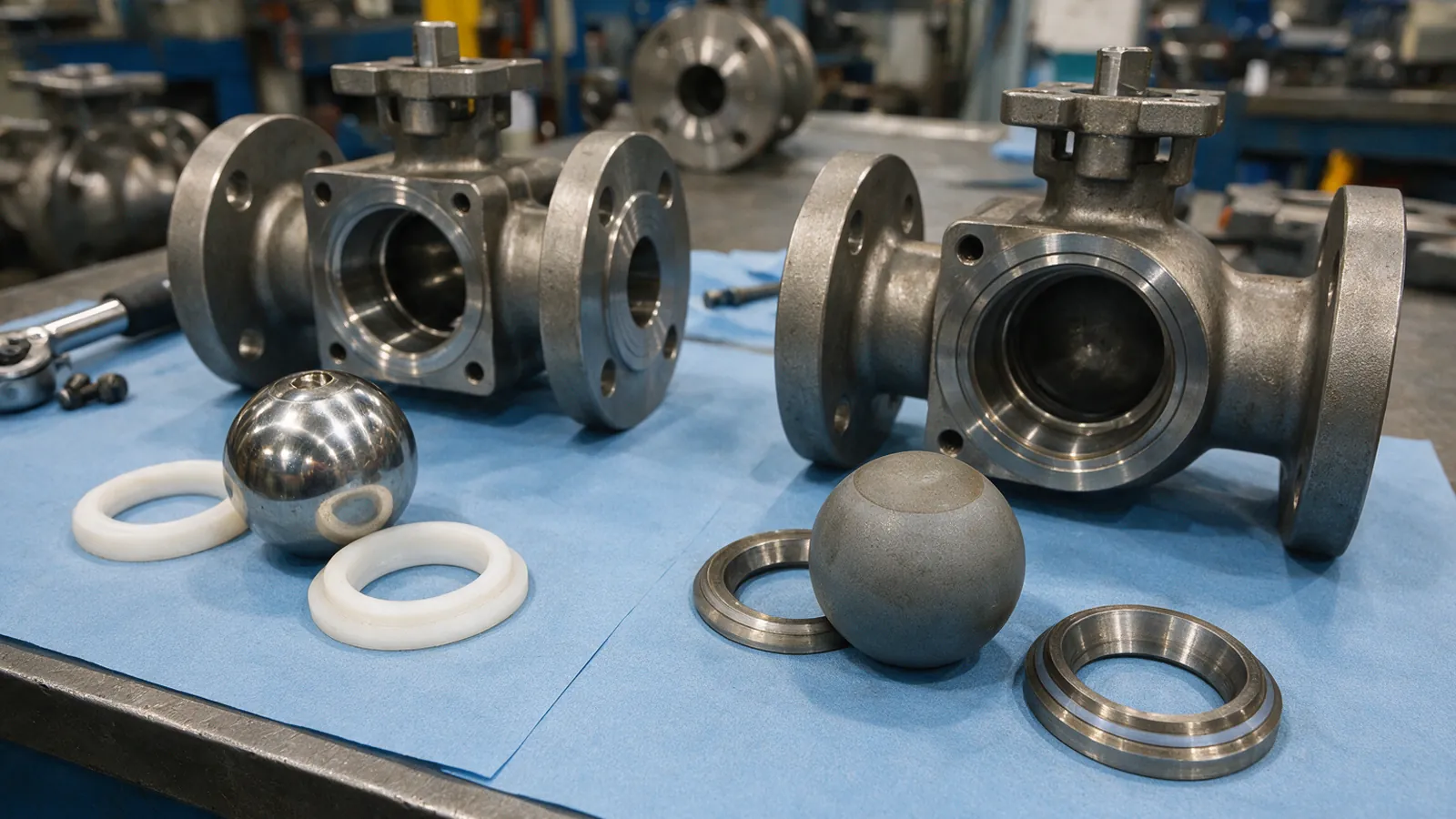
A soft seated ball valve seals against polymer rings such as PTFE and suits clean fluids at moderate temperature, where it gives a tight shut-off. A metal seated ball valve seals hard-coated metal against metal and suits high temperature, abrasive or severe duty. The seat also changes the seat test acceptance under API 598.
In this memo09 details
What is the difference between a soft seat and a metal seat ball valve?
The difference is what the ball seals against. A soft seated ball valve seals against rings of a polymer such as PTFE, which flex around the ball; a metal seated ball valve seals metal against metal, with both faces hard-coated and lapped together.
ValvTechnologies, a maker of metal seated valves, describes soft seats as non-metallic materials like PTFE or other thermoplastics
, and metal seats as a hard metal-to-metal interface whose sealing surfaces are coated with materials such as tungsten carbide or chromium carbide.
Writing for Valve World Americas in 2019, Jeff Roseneder and Matt Steggeman of Emerson describe the usual soft option as reinforced PTFE, PTFE with reinforcing additives such as glass and carbon
, and the metal option as a hard-coated metal seat and ball
. Ball valve types themselves are on our ball valve product page. The Emerson article itself argues for a third option for steam and high temperature isolation, a carbon seat infused with graphite; if neither standard seat fits the duty, ask whether such a seat does.
When is a soft seat the right choice?
A soft seat ball valve is the right choice for clean fluids at moderate temperature and pressure, where tight shut-off matters most: the polymer seat makes full contact with the ball, but it deforms as the temperature rises and wears in dirty or abrasive fluid. ValvTechnologies calls soft seats suitable for clean, light-duty service where chemical compatibility and tight sealing are important
, puts their working temperature below 500 degrees F (260 degrees C), and says they typically operate best in medium/low-pressure environments
. How a soft seat's load on the ball changes with the mounting is in our memo on trunnion and floating ball valves.
The Emerson authors explain why the seal is tight: a soft seated valve typically makes full contact between ball and seat, allowing for positive sealing
. They also give the two limits. Soft seats wear prematurely with harsh or contaminated processing fluids
, and as temperatures increase, PTFE based materials deform and the ability to seal is diminished
.
So a soft seat line should state the maximum temperature, not just the fluid.
When does a line need a metal seat?
A line needs a metal seat when the temperature is above what a polymer seat can hold, or when the fluid carries solids that would cut a soft seat. ValvTechnologies says metal seated valves can handle severe flashing, hydraulic shock, and abrasive process fluids
, with operating temperatures up to and above 1,500 degrees F (about 815 degrees C).
The hard faces come from coatings and hardening: ValvTechnologies names thermal spray coating, stellite hard facing, chromium carbide and tungsten carbide. What a hard-faced seat means on other valve types is in our memo on valve trim and hard-faced seats. The Emerson authors add how the parts are made to work hot: hard metal seat inserts, stainless steel seat retainers and coatings chosen with the body material so the valve tolerates thermal expansion, with the seat lapped to the coated ball.
Metal seats are not free of wear. The same Emerson article says that over time the flow degrades the seat to ball interface, resulting in increased valve seat leakage
, and that repair means extracting the assembly, recoating and lapping again.
How do the two seats compare?
Soft seats seal tight and cost less at the start, but are limited by temperature, pressure and solids. Metal seats survive heat, pressure and abrasion and cost more at the start, but wear and need lapping to repair. The table puts the two sources' published points side by side, each row with its source.
| Point | Soft seat | Metal seat |
|---|---|---|
| Seat material (both sources) | PTFE or another thermoplastic, often reinforced with glass or carbon | Hard-coated metal, lapped to a coated ball |
| Temperature (ValvTechnologies) | Below 500 degrees F (260 degrees C) | Up to and above 1,500 degrees F (about 815 degrees C) |
| Pressure (ValvTechnologies) | Moderate pressure capacity | Suitable for high-pressure systems |
| Dirty or abrasive fluid (ValvTechnologies) | Not recommended | Suited to abrasive service |
| How it seals (Emerson authors) | Full contact between ball and seat | Line contact between ball and seat |
| Cost (ValvTechnologies) | Lower initial, higher lifetime | Higher initial, lower lifetime |
| Repair (Emerson authors) | Not described | Extract, recoat and lap again |
The cost row is a metal seat maker's own view, so weigh it against the actual duty. A clean, cool line gains nothing from a metal seat.
Does the seat change the leakage test?
Yes. As summarised in our API 598 memo, the standard judges seat leakage by seat type: a resilient (soft) seated valve must show no visible leakage during the seat test, while a metal seated valve may show a small counted rate of drops or bubbles that rises with valve size.
That is why a test report for a metal seated valve can show a number other than zero and still be a pass. How to read the acceptance column is in our memo on API 598 shell and seat test reports.
Some metal seat makers publish their own tighter shut-off claims; ValvTechnologies, for example, says its metal seated ball valves are designed for zero leakage. If a line needs a tighter seat test than the standard's default, write the acceptance on the line so it is quoted and tested against.
Can a soft seated ball valve be fire-safe?
Whether a valve is fire-safe is proven by a fire test, not by its seat material alone, so write the fire test the specification names, such as API 607 or API 6FA, on the line together with the seat type and ask for the fire test certificate. The Emerson authors note that PTFE seats deform as the temperature rises.
What each fire test covers, and when a specification asks for one, is in our memo on API 607 and API 6FA fire-safe valves.
What should a ball valve seat line on an enquiry state?
A ball valve enquiry should state the seat type, plus the fluid, the maximum operating temperature, the pressure and any solids, because those decide whether a soft seat will last or a metal seat is needed. A complete line reads:
- Soft seat (and the seat material, if specified) or metal seat (and the coating, if specified).
- The fluid, and whether it carries sand, scale, catalyst fines or other solids.
- The maximum and minimum operating temperatures.
- Size, pressure class and end connection.
- The seat test acceptance, if tighter than the standard's default.
- Any fire test the specification names, such as API 607.
Send the line to sales@nf-teguh.com.my or on WhatsApp. How a full valve line is built, from line conditions to purchase order, is in our guide to specifying industrial valves.
What do buyers ask about ball valve seats?
Is a soft seat ever used on steam?
Only within the seat's temperature limit. The Emerson authors describe a refinery team that ruled out soft seated ball valves for a steam injection header because they were not usable at its high temperature. Check the saturated steam temperature at the line's pressure against the seat material's limit before choosing a soft seat.
Does a metal seat mean the valve will leak?
Not necessarily. Its factory seat test may allow a small counted rate where a soft seat must show none, and the Emerson authors note that a metal seat can leak more as it wears. Read the test report against the acceptance for a metal seated valve, and write a tighter acceptance on the line if the duty needs one.
Can a soft seated valve be converted to a metal seat later?
Do not assume so. The Emerson authors describe the metal seat insert as lapped to the coated ball, so the seat and ball work as a matched pair. Our advice from the counter: treat a change of seat type as a new valve selection and ask the supplier.
What does repairing a metal seated ball valve involve?
The Emerson article says repairing a worn metal seat and ball assembly means extracting it, recoating and lapping again, which requires significant time and planning. Ask the supplier what a seat repair involves for the soft seated valve on your line.
Sources
Read 31 October 2026.
- ValvTechnologies, Which is better: metal seat or soft seat ball valve?: seat materials, temperatures, abrasive service, coatings and the maker's comparison.
- Jeff Roseneder and Matt Steggeman, Emerson, Consider a graphite infused carbon seat for isolation in steam and high temperature applications, Valve World Americas, 2 December 2019: soft and metal seat behaviour, wear and repair.
No clause, table, test value or requirement text from API 598, API 607 or API 6FA is reproduced here; the acceptance principle is summarised from our own API 598 memo. These designations are identifiers only, and no NF Teguh stock, capability or certification claim attaches to any of them. Confirm every line against the current edition. Your purchase order governs.
Related memos
Standards named above are published reference data. Confirm against the current edition; your purchase order governs. Questions: the counter.