Plug valve vs ball valve: which to specify
For isolation duty, NF Teguh's own product pages put clean fluids with the ball valve and dirty media with the plug valve. Neither standard ranks them: API STD 599 covers metal plug valves, API STD 608 covers metal ball valves, and the two stop at different sizes, ends and classes. Name the family, then the size, class, ends, bore or ports, test and certificates.
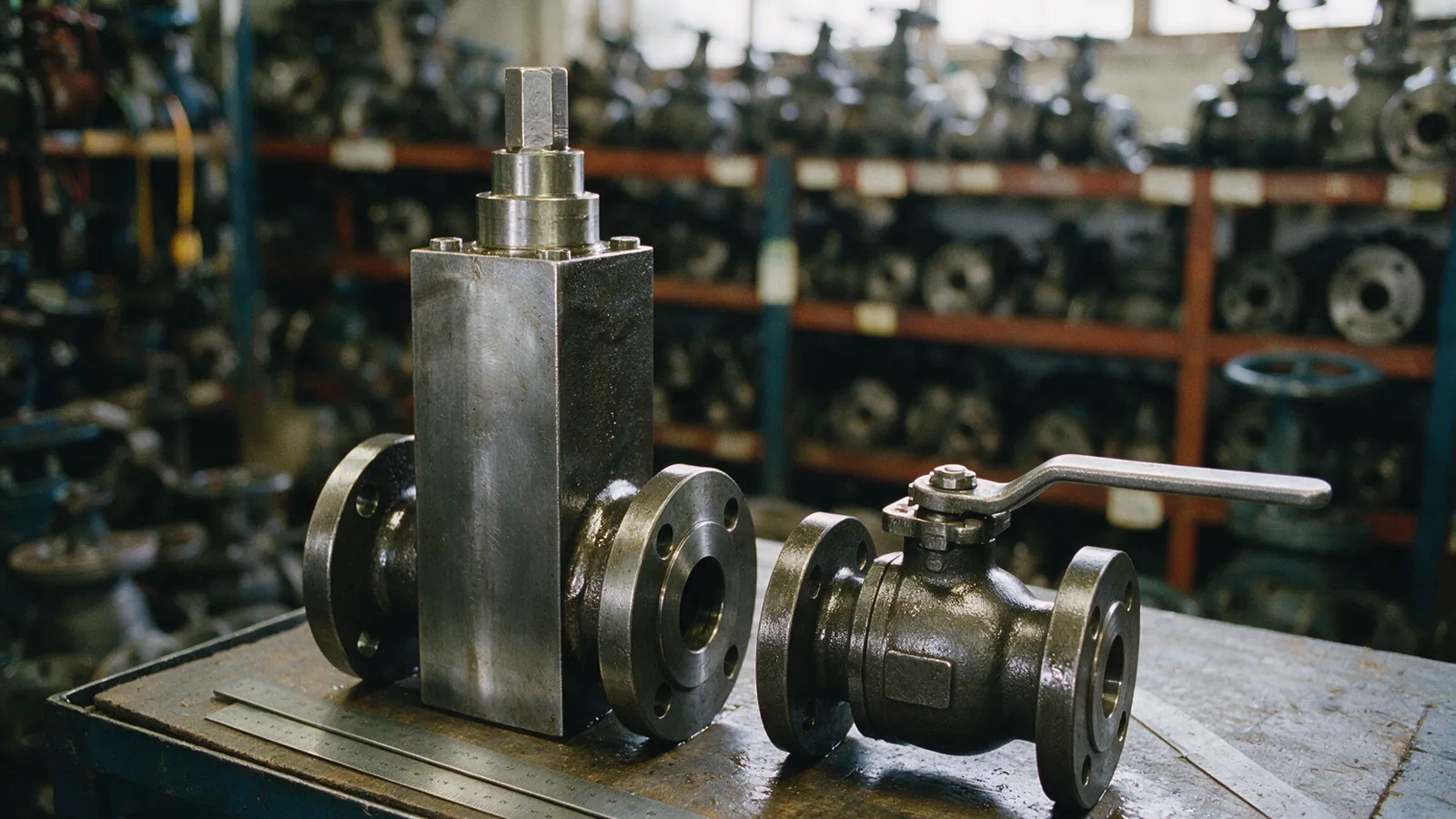
In this memo08 details
Plug valve or ball valve: which does the isolation duty need?
Neither standard ranks the two families, so the duty decides and the documents follow. NF Teguh's plug valve page sets out the split we work to, and its ball valve page the other side of it.
| On the line | What our product page for that family says |
|---|---|
| Clean fluids | The ball valve is lighter on torque and cheaper at size, and takes the duty |
| Dirty media, slurry, sludge, coking service, dirty crude | Plug territory by default: the plug wipes, and the bore is cavity-free |
| Service without breaking flanges | The plug lifts out through the top for inspection, lapping or sleeve renewal, and the body never leaves the line |
| Diverting flow | A three-way plug on a tank manifold replaces two valves and a tee, and cannot connect the wrong pair of lines |
| Fast or actuated cycling | The ball valve: "where a valve is cycled often, interlocked or actuated, the quarter-turn stroke is the point" |
| Throttling | Not the ball valve: sustained throttling "chews the seats at the part-open edge" |
| Hot, dirty or abrasive media | Ball valves move to metal seats; plug valves lean lubricated |
| Chemical and clean-process duty | A sleeved plug valve: a full-face PTFE-type sleeve, "no sealant, no service routine, low torque, excellent shutoff" |
| Tight shutoff on a clean line | The ball valve: resilient seats "wipe the ball as it turns, giving the drop-tight shutoff" |
Both pages are ours and already published, and none of those lines is in the standards. Send the line list and both families can be quoted together: WhatsApp +6012 944 3980 or contact us. The comparison next door, ball valve against butterfly valve, covers the other quarter-turn choice, and the rest of this memo is the paperwork the duty does not settle.
Which document covers a plug valve, and which covers a ball valve?
Each family is bought against its own API standard. The standards distributor Normservis lists API STD 599, Ninth Edition, issued 1 October 2025, as specifying "the requirements for quarter-turn metal plug valves ... for petroleum, petrochemical, and industrial applications", and API STD 608, Seventh Edition, issued 1 April 2025, as specifying "the requirements for metal ball valves suitable for petroleum, petrochemical, and industrial applications".
API 599's scope names ASME B16.34: it applies to "plug valve bodies conforming to ASME B16.34, which may have any combination of flanged, threaded, socket welding, or butt-welding ends". ASME's own catalogue page describes B16.34 as covering ratings, dimensions, tolerances, materials, examination, testing and marking for valves of steel, nickel-base alloys and other alloys, in the edition shown as B16.34 - 2025. The API 608 record names ASME B36.10 for sizing: its ball valves correspond "to the nominal pipe sizes in ASME B36.10". Which document a line ends up citing is the thread our guide to specifying industrial valves follows from line conditions to purchase order.
Name the edition as well as the number. The standards distributor DIN Media records API STD 599:2020-03, the eighth edition of March 2020, as withdrawn and replaced by API STD 599:2025-10. A line that says only "to API 599" leaves the edition to whoever quotes it.
Where do API 599 plug valves and API 608 ball valves each stop?
The two published scopes stop at different sizes. The plug valve standard states a larger band on flanged and butt-welding ends; the ball valve standard states a smaller start on socket-welding and threaded ends. A size near the end of either band is worth checking before the enquiry goes out.
| Stated in the scope | API STD 599, plug valves | API STD 608, ball valves |
|---|---|---|
| Flanged ends | DN 15 to DN 900 (NPS 1/2 to NPS 36) | DN 15 through DN 600 (NPS 1/2 through NPS 24) |
| Butt-welding ends | DN 15 to DN 900 (NPS 1/2 to NPS 36) | DN 15 through DN 600 (NPS 1/2 through NPS 24) |
| Socket-welding and threaded ends | DN 15 to DN 50 (NPS 1/2 to NPS 2) | DN 8 through DN 50 (NPS 1/4 through NPS 2) |
| Materials named | Steel, nickel base and other alloy with flanged or butt-welding ends; ductile iron with flanged ends | The record read states no material list |
| Ports or bores named | Two-way coaxial ports; tandem plug valves with two plugs in one body | Full bore and reduced bore |
| Stated exclusion | Three-way and four-way plug valves | None stated in the record read |
API 608 also states its own pressure classes: 150, 300 and 600 for flanged ends, and Classes 900, 1500 and 2500 for flanged ends "in sizes DN 15 through DN 50 (NPS 1/2 through NPS 2) only". So a flanged ball valve above DN 50 (NPS 2) in Class 900 or higher sits outside what API 608 states. This memo does not name the document that covers it; ask for it by name before the order.
The API 599 record read here states no class list at all.
What do the words "plug valve" on a line leave open?
Three of them sit inside API 599's own scope; a fourth, certification, sits outside it. The first is lubrication: the standard applies to "lubricated and non-lubricated plug valves that have two-way coaxial ports". Both are plug valves bought to the same document, so the line has to say which it wants.
The second is the port arrangement. API 599 states that "three-way and four-way plug valves do not fall under the scope of this standard", so a multi-port plug valve has to name the document it is bought to. The third is the tandem body: API 599 also applies to "tandem plug valves that have two independently operating plugs in a single body". Where the specification asks for double block and bleed, our memo on double block and bleed against double isolation and bleed covers what that wording means.
Then certification. API's own notice to its Subcommittee on Piping and Valves, dated 6 November 2017, says that effective 15 November 2017 API withdrew API Standard 599 from the Monogram Program, that "online applications for a 599 Monogram license will be disabled", and that organisations "may continue to manufacture products to the requirements of API Standard 599; however, those products are not eligible for monogramming". That notice pointed manufacturers to API Spec Q1 or ISO 9001 registration instead. On that notice, a line asking for a monogrammed plug valve is asking for something that is not issued; confirm the position with API before it goes into a specification.
What do the words "ball valve" on a line leave open?
The bore comes first. API 608 establishes requirements for bore sizes described as full bore and as reduced bore, so both are inside the standard and the order has to say which. Two valves can share the size, the class and the standard and still not be the same valve inside.
How the ball is carried is the next decision, covered in our memo on trunnion or floating ball valve mountings. The end is a third, and it moves the size band, as the table above shows. What each end type is, and which document describes it, is in our memo on valve end connections. Where the order calls for material certificates, our memo on EN 10204 3.1 and 3.2 certificates covers what those document types mean.
What should the enquiry say?
Six lines let a plug valve and a ball valve be quoted side by side. They are what a quotation needs before anything can be matched to the line, and they are the same six whichever family the duty points to. Send them with the line conditions and the comparison can be made on paper instead of at the flange face.
- Family, and the standard it is bought to, with the edition.
- Size and pressure class, stated together.
- End connection, and the standard for that end.
- For a plug valve: lubricated or non-lubricated, and the number of ports.
- For a ball valve: full bore or reduced bore.
- The test and certification documents the purchase order will call for: our memo on API 598 valve testing covers what a shell and seat test report shows.
NF Teguh is a Petronas registered vendor and an industrial valve supplier and stockist in Subang Jaya, supplying gate, globe, ball, plug, butterfly and check valves for power plant, petrochemical, oil and gas, oil terminal, offshore and natural gas work. Send the six lines by WhatsApp on +6012 944 3980, to sales@nf-teguh.com.my, or through contact us. The other memos are in insights.
Plug valve and ball valve questions buyers ask
These three come up once the isolation duty is settled and the enquiry is being written. Each is answered from the published records this memo reads.
Is a gray iron plug valve bought to API 599?
No. API 599's published scope names steel, nickel base and other alloy plug valves, and ductile iron plug valves with flanged ends. Gray iron is a different document: Nimonik lists MSS SP-78-2011, Gray Iron Plug Valves, Flanged and Threaded Ends, as the current revision at 13 pages, covering "gray iron plug valves with flanged or threaded ends".
The specification says lift plug valve. Is that a separate family?
No. API 599's published scope specifies requirements for quarter-turn metal plug valves "including the lift plug type", so a lift plug valve is bought against the same standard as any other plug valve in that scope. The material, the ends, the class and the port arrangement still have to be stated for it.
Will a ball valve drop into the length a plug valve left?
Treat it as its own question. Face-to-face length has a document of its own, and our memo on ASME B16.10 valve face-to-face dimensions covers it. Send the size, class and ends of the valve already fitted, and the replacement can be quoted.
Sources
Every quotation in this memo was read on 16 October 2026 from the publisher, distributor or NF Teguh page named beside it. Each of those pages was saved, so the wording can be checked again later.
- Normservis's records for API STD 599 and API STD 608: titles, editions, dates, scope text, size bands, class lists and bore sizes.
- DIN Media's record for API STD 599:2020-03: the eighth edition, withdrawn, replaced by API STD 599:2025-10.
- API's own notice of 6 November 2017, API Standard 599 withdrawal from the Monogram Program.
- ASME's own catalogue page for ASME B16.34, and Nimonik's record for MSS SP-78-2011, published by the Manufacturers Standardization Society.
- NF Teguh's own plug valve and ball valve pages, for the duty, seat and cycling lines quoted in DETAIL 01.
Fraction characters in a source are written here as 1/2 or 1/4. No value from any standard is reproduced, and both tables are our own wording. These designations are identifiers and publisher record facts only: no NF Teguh stock, capability or certification claim attaches to any of them.
Related memos
Standards named above are published reference data. Confirm against the current edition; your purchase order governs. Questions: the counter.