WCB, LCB and CF8M: what a valve body material code means
WCB, LCB and CF8M are grade designations from three different ASTM casting specifications. A216/A216M covers carbon steel castings for high-temperature service and lists WCA, WCB and WCC. A352/A352M covers ferritic and martensitic castings for low-temperature service, where LCB sits. CF8M is recorded as an austenitic grade of A351/A351M. The grade names the material, not the rating.
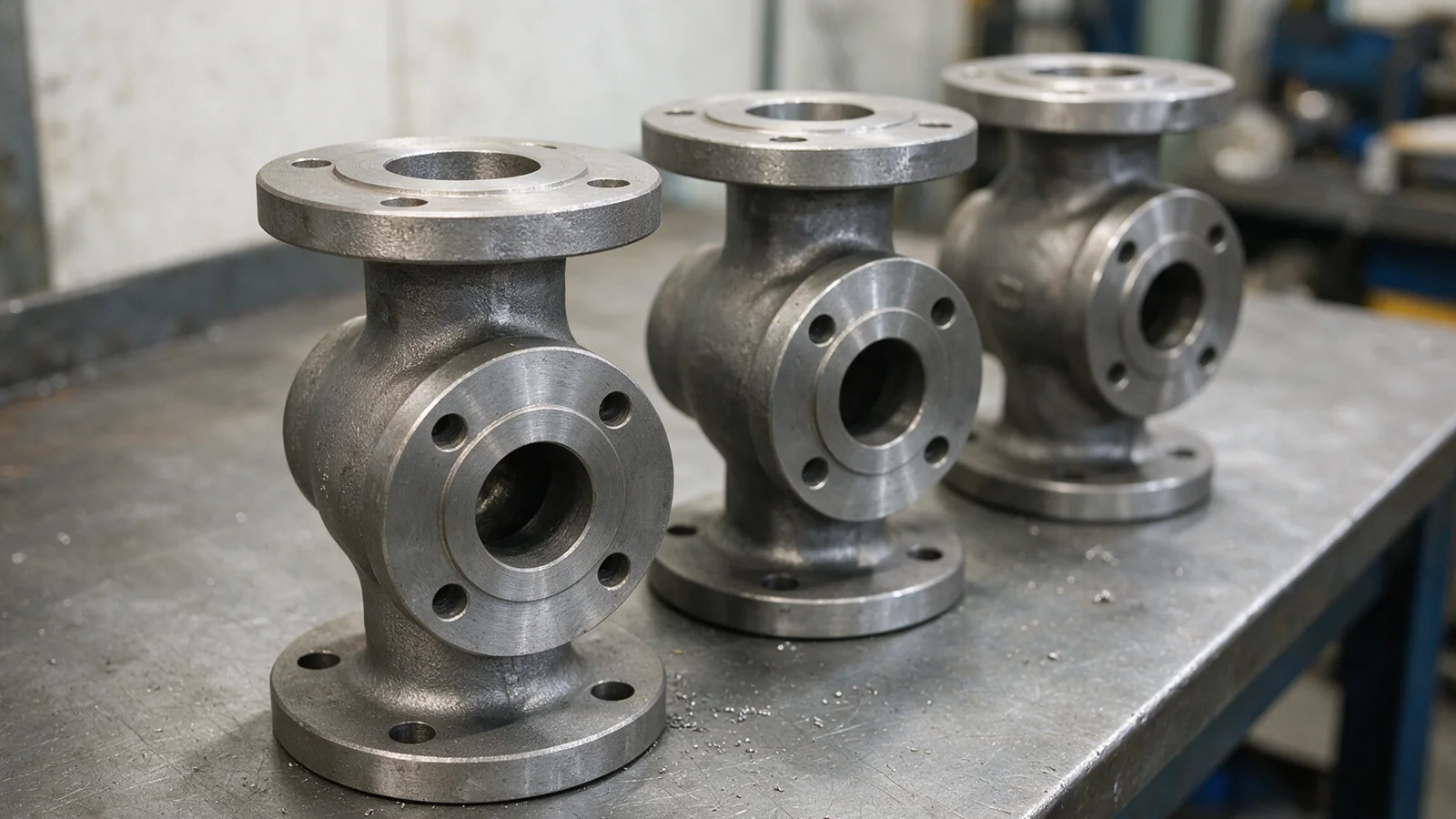
What does WCB mean on a valve body?
WCB is a cast carbon steel grade, specified in ASTM A216/A216M. That specification covers castings for valves and other pressure-containing parts in high-temperature service. Its published scope reads: "This specification covers carbon steel castings for valves, flanges, fittings, or other pressure-containing parts for high-temperature service and of quality suitable for assembly with other castings or wrought-steel parts by fusion welding."
ASTM A216/A216M names three grades of carbon steel. They are WCA, WCB and WCC. The record states that the choice between them "shall depend on the design and service conditions, mechanical properties, and the high temperature characteristics". WCB is therefore a selection inside a family.
So a body marked WCB is a carbon steel casting made to that specification. That is the whole of what the grade name proves. The pressure the valve may hold comes from somewhere else on the datasheet.
The specification's reach explains where the grade turns up. It is written for pressure-containing parts at high temperature, and for parts meant to be fusion welded to other steel. Gate valves, globe valves and check valves are all pressure-containing parts in that sense.
Which ASTM specification covers which valve body material?
The specifications route themselves, and ASTM A351/A351M says so in print. Its scope covers "austenitic steel castings for valves, flanges, fittings, and other pressure-containing parts". Its Note 1 then routes three other material families elsewhere: carbon steel castings to A216/A216M, low-alloy steel castings to A217/A217M, duplex stainless castings to A995/A995M.
That one note is the map. A buyer holding an unfamiliar code can place it by material family first, then look up the specification that owns it. A code quoted without its specification has lost the half of the information that routes it.
ASTM A352/A352M is the low-temperature document. It "covers steel castings for valves, flanges, fittings, and other pressure-containing parts intended primarily for low-temperature service", and its clause 1.2 records that "Several grades of ferritic steels and one grade of martensitic steel are covered". The grades it lists are LCA, LCB, LCC, LC1, LC2, LC2-1, LC3, LC4, LC9 and CA6NM.
| Grade | Specification it belongs to | What that specification is written for |
|---|---|---|
| WCB | ASTM A216/A216M | Carbon steel castings, high-temperature service, suitable for fusion welding |
| LCB | ASTM A352/A352M | Ferritic and martensitic castings, primarily low-temperature service |
| CF8M | ASTM A351/A351M | Austenitic castings for pressure-containing parts |
CF8M's place is recorded in a materials database rather than in the catalogue abstracts above. Total Materia files the grade as "ASTM A 351 Grade CF8M" against "A351/A351M: 2024 / Standard Specification for Castings, Austenitic, for Pressure-Containing Parts". Where a grade matters commercially, confirm it against the purchased edition's own grade table.
Write the specification and the grade together on the order line. Which document type the order asks for is a separate question, covered in EN 10204 3.1 against 3.2.
What is the difference between WCB, LCB and CF8M?
The difference is the service each parent specification was written for. ASTM A216/A216M is written for high-temperature service. ASTM A352/A352M is written primarily for low-temperature service. ASTM A351/A351M covers austenitic castings, and its own scope says its grades have "varying degrees of suitability for service at high temperatures or in corrosive environments". Three documents, three service cases.
Low temperature is where the specification does something visibly different. ASTM A352/A352M lists a figure against each grade under the column heading "Usual Minimum Testing Temperatures". Its clause 1.2 is careful about what that figure is: ordinarily, it says, the material is required to meet the specification's impact requirements at the temperature shown, and it points to a supplementary requirement for other impact test temperatures. Usual, and ordinarily. The figure is a default, with a supplementary requirement for anything else.
Two of those figures are quoted here. In the published list LCB sits at minus 50 degrees Fahrenheit, stated in metric as minus 46 degrees Celsius. LC9, at the cold end, sits at minus 320 degrees Fahrenheit, stated as minus 196 degrees Celsius. Those two are quoted as reference data points. The rest of the list is not reproduced here.
Austenitic grades are not shut out of cold service. ASTM A352/A352M's Note 1 records that certain austenitic grades furnished to A351/A351M have been found suitable for low-temperature service, and sets a condition on using them. They may be used when impact tested to A352/A352M, "with energy levels and temperatures of test mutually agreed upon between the purchaser and the manufacturer".
That phrase is a purchase order instruction sitting inside a materials standard. Nothing in the grade name settles it. Somebody has to write the energy levels and the test temperature down before the order is placed.
Does the material grade set the valve's pressure and temperature rating?
Not on its own, but it is half of the answer. The casting specification controls the casting. The valve standard sets the rating, and it sets it per material group. ASME's record for ASME B16.34, titled Valves: Flanged, Threaded, and Welding End (ASME styles that dash as a double hyphen), states that the standard covers "pressure-temperature ratings, dimensions, tolerances, materials, nondestructive examination requirements, testing, and marking" for the valves in its scope.
Class and body material are read together, not separately. As what Class 150, 300 and 600 actually mean sets out, the class alone is not the rating: the material group completes it, and the same class in a different body material lands on different numbers at the same heat. The pressure class reference shows how that reads in practice.
What the casting specification does not carry is the rating itself. ASTM A216/A216M's record lists chemical composition and tensile property requirements, naming tensile strength, yield strength, elongation and reduction of area. None of those is a pressure-temperature rating for a finished valve.
How does a buyer prove the body is the grade the order asked for?
Through the certificate and the marking, not through the grade name on the quotation. All three ASTM specifications require the steel to meet stated chemical composition and tensile property requirements. A document is what shows a buyer those requirements were met on the castings delivered.
The certificate type is a separate order line from the material grade. Which document type an order needs is covered in EN 10204 3.1 against 3.2. The grade belongs in the material line. The certificate type belongs in the documentation line.
Marking is the physical half of the same question. What a valve carries on its nameplate is covered in reading a valve nameplate. A buyer should be able to read the body material from the valve, then find the same designation on the paperwork.
When does a line need more than a grade name?
Whenever the service imposes a requirement the casting specification does not address. Sour service is the clearest case. The grade is part of that answer, but it is not the whole of it, because a separate document sets what counts as a compliant material in a compliant condition.
A material grade and a sour service requirement are two separate lines on an enquiry. What a sour service reference means is set out in NACE MR0175 and sour service. Naming CF8M or WCB does not answer it.
Low temperature is the second case. ASTM A352/A352M lists a usual minimum testing temperature per grade, with a supplementary requirement for other test temperatures. An austenitic body in cold service needs energy levels and test temperatures agreed between purchaser and manufacturer.
Fire exposure is the third. Whether a line needs a fire tested valve, and which test standard applies, is covered in API 607 against API 6FA. None of these three is settled by the body material alone.
What should an enquiry say about valve body material?
Five lines close the variables a grade name leaves open. An enquiry carrying all five lets a supplier quote against them, instead of coming back with questions. Each one removes something a quotation would otherwise have to assume.
- The specification and the grade together. Both belong on the material line, not one or the other.
- The valve standard and the class. The rating is read from the class and the material group together.
- The service temperature range, both ends. Low-temperature duty changes which specification the body belongs to.
- The certificate type wanted. State it as its own line, rather than leaving it to be assumed from the grade.
- Anything the service imposes beyond the casting. A sour service reference or a fire test requirement, with the edition.
NF Teguh is a Petronas registered vendor supplying gate, globe, ball, plug, butterfly and check valves from Subang Jaya, Selangor. Send an enquiry with those five lines in it. Where the material question sits inside a wider specification exercise, specifying industrial valves from line conditions to purchase order is the fuller sequence, and how ordering works covers what follows. The other memos are collected in insights.
What else do buyers ask about valve body material codes?
These are the questions left over once the grade and its specification are separated. Each is answered from the same published records used above. None of them is settled by the grade name alone.
Is WCB the same thing as A216?
No. ASTM A216/A216M is the specification. WCB is one of three grades its own scope names, alongside WCA and WCC. Naming the specification number and the grade together gives a purchase order both the document and the grade. Naming only one of the two leaves the other to be inferred by whoever reads it next.
What is the difference between WCA, WCB and WCC?
All three are carbon steel grades in the same specification, ASTM A216/A216M. Its record does not rank them. It states that the choice "shall depend on the design and service conditions, mechanical properties, and the high temperature characteristics". The values that separate them live in the standard's own chemistry and tensile tables, which this page does not reproduce. Read them from the purchased edition.
What if my code is not carbon steel and not austenitic?
ASTM A351/A351M's Note 1 names the two other routes: A217/A217M for low-alloy steel castings, A995/A995M for duplex stainless. So a code that belongs to neither A216/A216M nor A351/A351M usually belongs to one of those two. Confirm it against the purchased edition before it goes on an order.
Does changing the body grade change the valve's class?
Not the class itself, but it changes the rating that class gives you. ASME's record for ASME B16.34 states that the standard covers "pressure-temperature ratings" for "valves of steel, nickel-base alloys, and other alloys". Those ratings are indexed by material group, as this site's own ASME pressure class reference sets out, so the same class in a different body material lands on different numbers at the same temperature.
Can an austenitic body be used in cold service?
ASTM A352/A352M's Note 1 records that certain austenitic grades furnished to A351/A351M have been found suitable for low-temperature service. It attaches a condition: they may be used when impact tested to A352/A352M, with energy levels and test temperatures agreed between purchaser and manufacturer. That agreement belongs in the order, not in the grade name.
Where these figures come from
Read 7 October 2026. ASTM's own product pages refuse automated requests, so each ASTM record below is the publisher's catalogue entry as reproduced by the standards distributor Nimonik. ASTM A216/A216M, listing ASTM A216/A216M-26 as the current revision, issued April 2026, titled "Standard Specification for Steel Castings, Carbon, Suitable for Fusion Welding, for High-Temperature Service": for the scope sentence, the three grades, the selection wording and the property requirements. ASTM A351/A351M, listing ASTM A351/A351M-24e1, publish date 2024, titled "Standard Specification for Castings, Austenitic, for Pressure-Containing Parts": for the scope sentence, its Note 1 routing to A216/A216M, A217/A217M and A995/A995M, and the varying-suitability wording. ASTM A352/A352M, listing ASTM A352/A352M-21 as the current revision, issued March 2021, titled "Standard Specification for Steel Castings, Ferritic and Martensitic, for Pressure-Containing Parts, Suitable for Low-Temperature Service": for the scope sentence, clause 1.2, the "Usual Minimum Testing Temperatures" column heading, the two temperature pairs quoted and Note 1 on austenitic grades. For CF8M's membership of A351/A351M, the materials database Total Materia, which files the grade as "ASTM A 351 Grade CF8M" against "A351/A351M: 2024 / Standard Specification for Castings, Austenitic, for Pressure-Containing Parts". For the valve standard, ASME's own catalogue record for ASME B16.34, whose published title styles the dash between "Valves" and "Flanged" as a double hyphen. Where a quotation shows a degree symbol or a minus sign in the source, it is written here in words. No ASTM or ASME table of values is reproduced: the A352/A352M grade names are listed, two of its temperature pairs are quoted, and the comparison table on this page is our own wording. These designations are identifiers and publisher record facts only. No NF Teguh stock, capability, material range or certification claim attaches to any of them. Buy the current editions from ASTM and ASME for the requirements themselves, confirm every line against the valve maker's data sheet, and your purchase order governs.
Related memos
Standards named above are published reference data. Confirm against the current edition; your purchase order governs. Questions: the counter.