Valve end connections compared: flanged, butt weld, socket or threaded
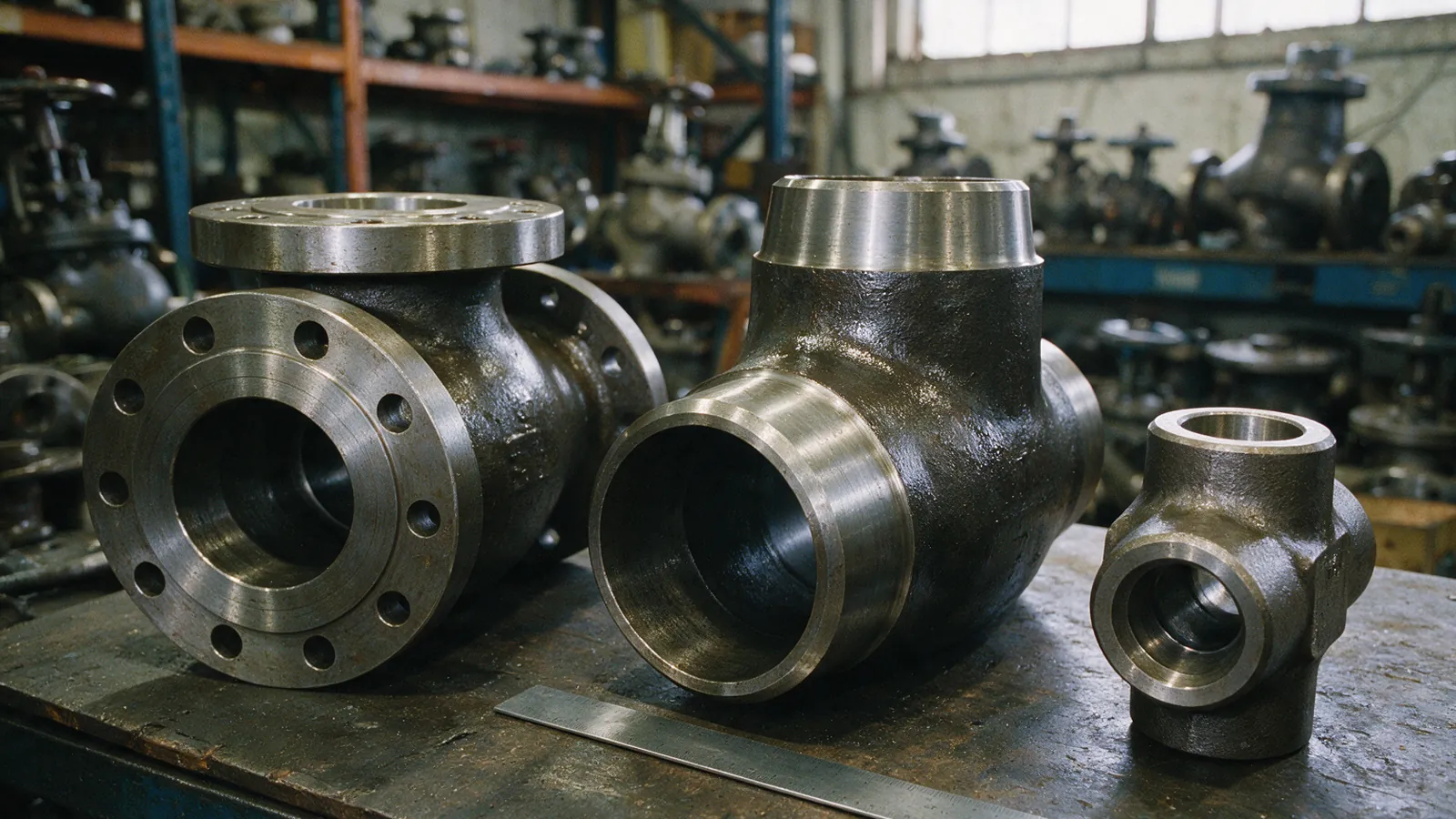
Choose the end by how the joint will be made and undone: a flanged end is bolted and comes apart in place, butt weld and socket weld ends are welded and have to be cut out, a threaded end unscrews with site tools. One standard, ASME B16.34, covers the valve whatever ends it has, while ASME B16.5, ASME B16.25 and ASME B16.11 describe the ends themselves. Naming the end settles the joint, not the rating, the material, the length or the test.
In this memo10 details
Which standard covers a valve, whatever ends it has?
One document covers all four ends. ASME's own catalogue page for B16.34, Valves Flanged, Threaded and Welding End, says the standard applies to new construction and that "it covers pressure-temperature ratings, dimensions, tolerances, materials, nondestructive examination requirements, testing, and marking for cast, forged, and fabricated flanged, threaded, and welding end and wafer or flangeless valves of steel, nickel-base alloys, and other alloys". The end connection is one of the things it covers, not a separate standard for the valve.
ASME writes on the same page that "wafer or flangeless valves, bolted or through-bolt types, that are installed between flanges or against a flange are treated as flanged-end valves", and that "alternative rules for NPS 2 1/2 and smaller valves are provided". So a wafer butterfly valve is not outside the flanged world, and small-bore valves are not simply the same rules scaled down.
What B16.34 does not do is describe how the end itself is made. That lives in a different document for each end type, and those are the documents a fabricator reads. The rest of this memo takes them one at a time.
ASME lists the current edition of B16.34 as B16.34 - 2025, and describes the standard as intended for "manufacturers, owners, employers, users and others concerned with the specification, buying, maintenance, training and safe use of valves with pressure equipment, plus all potential governing entities". It also says the standard is to be used in conjunction with equipment described in other volumes of the ASME B16 Series of Standards as well as with other ASME standards, such as the Boiler and Pressure Vessel Code and the B31 Piping Codes.
| End on the valve | Document that describes the end | What that document says it covers |
|---|---|---|
| Flanged | ASME B16.5 (and B16.47 above its size band) | Pipe flanges and flanged fittings, in the size range its own title states |
| Butt weld | ASME B16.25 | The preparation of buttwelding ends of piping components to be joined into a piping system by welding |
| Socket weld | ASME B16.11 | Ratings, dimensions, tolerances, marking and material requirements for socket-welding and threaded forged fittings |
| Threaded | ASME B16.11 | The same document, with its own class designations for threaded end fittings |
| Wafer or flangeless | ASME B16.34 | Treated as flanged-end valves when installed between flanges or against a flange |
Flanged ends: which flange standard a size falls under
Flanged is the end that needs two more answers before it is specified. ASME's catalogue lists B16.5, Pipe Flanges and Flanged Fittings: NPS 1/2 through NPS 24, at a B16.5 - 2025 edition. Above that band the document changes, and so do the questions that come with it.
Which standard, which series above NPS 24, and which facing are three separate decisions, and we have taken each of them apart already: ASME B16.5 against B16.47 covers the size split and the two series, and RF, FF and RTJ covers the face. A line that says only "flanged" has answered none of them.
A flanged valve also carries a face-to-face dimension that the end connection does not set. Our memo on ASME B16.10 valve face-to-face dimensions covers it.
Butt weld ends: what ASME B16.25 actually covers
B16.25 is a preparation standard, not a valve standard. ASME's own page for B16.25, Buttwelding Ends, says the standard "covers the preparation of buttwelding ends of piping components to be joined into a piping system by welding" and that "it includes requirements for welding bevels, for external and internal shaping of heavy-wall components, and for preparation of internal ends". It is read by whoever cuts and welds, and it is the reason a butt weld end on a valve is not simply a plain pipe end.
The scope goes further than the bevel. ASME lists the coverage as preparation for joints with "no backing rings; split or noncontinuous backing rings; solid or continuous backing rings; consumable insert rings; gas tungsten arc welding (GTAW) of the root pass". Those are five different preparations, and the valve end has to be prepared for the one the welding procedure actually uses.
That is the practical point for a buyer. A requisition that says "butt weld ends to ASME B16.25" has named the document. It has not said which of those joint preparations the site will weld, and on a heavy-wall line it has not said whether internal shaping is expected. Both are worth settling with the fabricator before the valve is made, because neither can be added afterwards without machining.
ASME lists the current edition as B16.25 - 2022.
Socket weld and threaded ends, and the class trap
Both small-bore ends sit in one document, and its classes are not valve classes. ASME's page for B16.11, Forged Fittings Socket Welding and Threaded, says the standard "covers ratings, dimensions, tolerances, marking and material requirements for socket-welding and threaded forged fittings", and that "these fittings are designated as Class 2000, 3000, and 6000 for threaded end fittings and Class 3000, 6000, and 9000 for socket-weld end fittings".
Those designations belong to fittings in B16.11. A valve's own pressure class comes from the valve standard, and ASME's description of B16.34 is explicit that pressure-temperature ratings are something B16.34 covers for the valve. A line that reads "Class 800 socket weld gate valve" is naming a valve class and an end type, and the two numbers people then quote at each other come from two different documents.
Socket weld or threaded, when one document covers both?
The document is the same; the joint and the class set are not. A threaded end is screwed together and can be unscrewed. A socket weld end is bored to take the pipe and then welded, so the joint is permanent until it is cut. ASME designates the two differently in the same sentence of B16.11 scope: Class 2000, 3000 and 6000 for threaded end fittings, Class 3000, 6000 and 9000 for socket-weld end fittings. Quoting a class without saying which end it belongs to leaves the line ambiguous, because 3000 and 6000 appear in both sets and 2000 and 9000 appear in only one.
Which one a line gets is a welding and maintenance decision rather than a standards one. If the position has to come apart for cleaning or instrument work, a threaded end can be undone with tools already on site. If it will not be opened again, a socket weld end removes the thread as a leak path and the welding procedure then governs the joint.
ASME lists the current edition as B16.11 - 2021.
When is each end chosen, and what changes with it?
The end is chosen by how the joint will be made and undone, then checked against the document that describes it. The table below sets the four ends side by side: what the published record says describes each one, how the joint is made, and what the requisition still has to carry because of that choice. The right-hand column is the one that costs money when it is left blank.
| End | How the joint is made and undone | Document describing the end | What the requisition must still carry |
|---|---|---|---|
| Flanged | Bolted through a gasket, and unbolted in place | ASME B16.5 in its own titled size band, and the flange standard that applies above it | The facing, the flange standard and series for the size, and the face-to-face dimension |
| Butt weld | Welded to the pipe end, and cut out to remove | ASME B16.25, which covers the preparation of buttwelding ends | The joint preparation the welding procedure uses, and whether internal shaping is required on heavy wall |
| Socket weld | Pipe entered into a bored socket and welded, and cut out to remove | ASME B16.11, which designates socket-weld end fittings Class 3000, 6000 and 9000 | Which class belongs to the end and which belongs to the valve, stated separately |
| Threaded | Screwed together, and unscrewed with site tools | ASME B16.11, which designates threaded end fittings Class 2000, 3000 and 6000 | The same class separation, stated once for the end and once for the valve |
| Wafer or flangeless | Clamped between two flanges, bolted or through-bolted | ASME B16.34, which treats it as a flanged-end valve when installed between flanges or against a flange | The flanges it sits between, their facing and the bolting, none of which the valve settles |
Two of those rows carry the same warning. A welded end is a decision about the next shutdown, not only about this purchase order, because the valve cannot be lifted out the way a bolted one can. Where a position is expected to be opened for maintenance, that is an argument for a flanged or threaded end before price is compared at all.
None of the four columns settles the rating, the material or the test. Those are set elsewhere, and the next section lists where.
What naming the end connection does not settle
An end connection fixes how the valve joins the line and almost nothing else. Five things a buyer usually assumes come with it are each set in a different place, and most of them have been the subject of their own memo on this site.
| Still open | Where it is set |
|---|---|
| Pressure and temperature rating | Covered by ASME B16.34 for the valve, per ASME's own description of its scope |
| Body and trim material | The material specification the valve standard and the purchase order name |
| Face-to-face dimension | The face-to-face dimension memo on this site |
| Shell and seat test acceptance | MSS SP-61 or the test document the purchase order names |
| Flange facing, where the end is flanged | The facing called out separately on the line |
On the last of those, the publisher record is specific about what the document is for. The catalogue record for MSS SP-61-2019, published by the Manufacturers Standardization Society and issued January 2019 at 14 pages, states that it "establishes requirements and acceptance criteria for shell and seat closure pressure testing of valves". A valve with the right end and no named test document has not been fully specified. Our memos on what a shell and seat test report shows and on EN 10204 certificates cover what then arrives with the valve.
Why the edition still belongs on the requisition
ASME currently lists these editions on its own catalogue pages: B16.5 - 2025, B16.11 - 2021, B16.25 - 2022 and B16.34 - 2025. Name the edition your specification means on the requisition, not just the standard number.
This is the same discipline the flange memos ask for, and the reason is identical: the designation is stable, the document behind it is not.
What an enquiry should say about the ends
Six lines close the end connection completely. Send them with the line conditions and a valve can be matched on paper rather than at the flange face.
- End type: flanged, butt weld, socket weld or threaded, and wafer or lug where the valve is flangeless.
- The standard and the edition for that end.
- For flanged ends, the facing, and the series where the size sits above the B16.5 band.
- For butt weld ends, the joint preparation the welding procedure uses, and whether internal shaping is required.
- The valve's own pressure class, stated separately from any fitting class.
- The test and certification documents the purchase order will call for.
NF Teguh is a Petronas registered vendor, an industrial valve supplier and stockist in Subang Jaya, carrying gate, globe, ball, plug, butterfly and check valves for power plant, petrochemical, oil and gas, oil terminal, offshore and natural gas work. Send the six lines above and the line conditions through contact us, by WhatsApp on +6012 944 3980 or to sales@nf-teguh.com.my, and the ends can be checked against the valve on paper.
How ordering works covers what happens after the enquiry, specifying industrial valves covers the whole line from conditions to purchase order, our products shows the valve families we hold, and the other memos are collected in insights.
What else do buyers ask about valve end connections?
These four come up once the end type itself is settled. Each is answered from the same published records used above, and none of them is settled by the words "to ASME" alone. Where a question turns on a value rather than on a record, the answer says so and sends you to the standard.
Is a wafer butterfly valve a flanged valve or not?
For the purposes of ASME B16.34 it is treated as one. ASME's own description of the standard says that wafer or flangeless valves, bolted or through-bolt types, that are installed between flanges or against a flange are treated as flanged-end valves. That settles which rules apply to the valve. It does not settle the bolting, the gasket or the facing of the flanges it sits between, which are still line decisions.
Our line says Class 3000 socket weld. Is that the valve's class?
Not on its own. Class 2000, 3000 and 6000 are the designations ASME states for threaded end fittings in B16.11, and Class 3000, 6000 and 9000 for socket-weld end fittings. A valve's pressure-temperature rating is something ASME describes B16.34 as covering for the valve itself. Ask which document the number came from before the order, because the two sets are not interchangeable.
The specification says butt weld to ASME B16.25. Is anything still missing?
Usually yes. ASME lists B16.25 coverage as preparation for joints with no backing rings, with split or noncontinuous backing rings, with solid or continuous backing rings, with consumable insert rings, and for gas tungsten arc welding of the root pass. The welding procedure decides which of those applies. On heavy-wall components the standard also covers external and internal shaping, so a heavy-wall line should say whether that is required.
Can we change a flanged valve for a butt weld one in the same position?
Not as a like-for-like swap. The joint is made differently, the length in the line is a different question again, and a welded valve cannot be removed the way a flanged one can. Send us the line conditions and the details of the valve already fitted, and the change can be checked on paper before anything is cut.
Where these figures come from
Read 14 October 2026. Every quotation above was taken from the publisher's own page and saved with this memo's working papers.
- ASME's own catalogue page for ASME B16.34: the scope description, the wafer and flangeless sentence, the alternative rules note, the intended-audience sentence, the B16 series sentence, and the B16.34 - 2025 edition shown.
- ASME's own catalogue page for ASME B16.11: the scope sentence, the class designations for threaded and socket-weld end fittings, and the B16.11 - 2021 edition shown.
- ASME's own catalogue page for ASME B16.25: the scope sentence, the welding bevel and shaping sentence, the five joint preparations listed, and the B16.25 - 2022 edition shown.
- ASME's own catalogue page for ASME B16.5: the published title with its NPS 1/2 through NPS 24 size band, and the B16.5 - 2025 edition shown.
- The standards distributor Nimonik's record for MSS SP-61-2019, published by the Manufacturers Standardization Society: the scope sentence, the January 2019 issue date and the page count.
Where a quotation shows a one-half fraction character in the source, it is written here as 1/2. No dimension, bolt count, bevel angle, rating, tolerance or test value from any standard is reproduced, and both tables in this memo are our own wording. These designations are identifiers and publisher record facts only. No NF Teguh stock, capability, material range or certification claim attaches to any of them. Buy the current editions from ASME and MSS for the requirements themselves, confirm every line against the maker's own drawing, and your purchase order governs.
Related memos
Standards named above are published reference data. Confirm against the current edition; your purchase order governs. Questions: the counter.