API 6D vs API 608: which ball valve standard your spec means
API 6D is the valve specification that grew out of pipeline service and covers axial, ball, check, gate and plug valves for the petroleum and natural gas industries. API 608 is a metal ball valve standard that adds requirements to valves already conforming to ASME B16.34 and points to the plant-side selection guide, API RP 615. The standard your specification names, with its edition, decides which one a ball valve is ordered to.
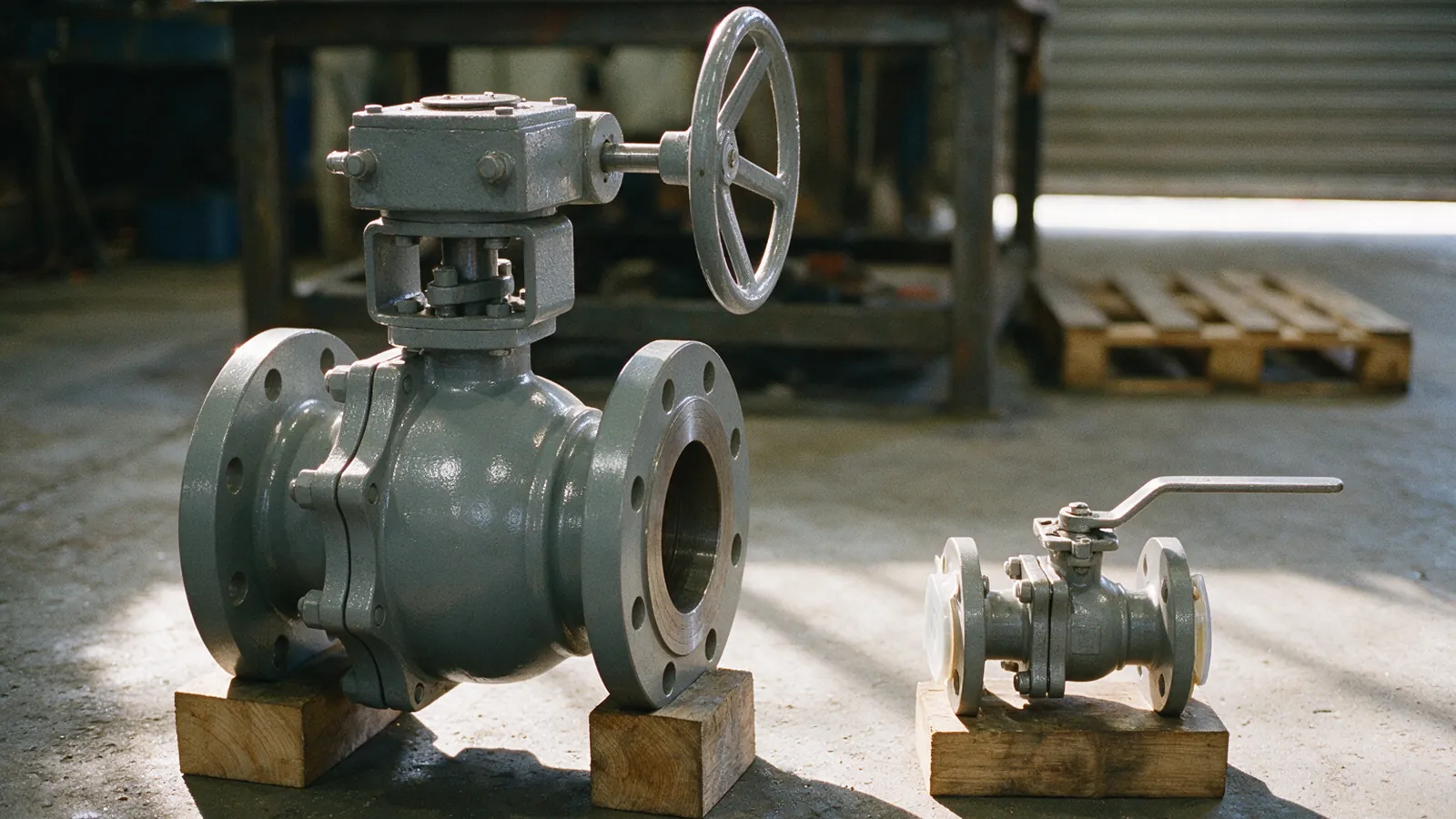
In this memo07 details
What does each standard cover?
API 6D is a specification for five valve types (axial, ball, check, gate and plug) in the petroleum and natural gas industries and hydrogen gas service, in ASME Class 150 to 2500. API 608 covers metal ball valves only, and it adds requirements to ball valves that already conform to ASME B16.34 (Standard Class). They are separate documents, not two grades of one.
The Standard Norge catalogue record for API 6D, 25th edition revised March 2025, lists its scope as the design, manufacturing, materials, welding, quality control, assembly, testing, marking, documentation and process controls of those five types. The record for API 608, seventh edition of April 2025, titles it for metal ball valves with flanged, threaded and welding ends, and covers floating and trunnion designs, full bore and reduced bore.
So a line that says "ball valve to API" has not yet said which document. Our memo on plug or ball valves looks at API 608 from the plug valve side. This memo is about the choice between the two ball valve documents, and our ball valve page covers the valves themselves.
| API 6D vs API 608 | API 6D (25th edition) | API 608 (7th edition) |
|---|---|---|
| Valve types | Axial, ball, check, gate, plug | Metal ball valves only |
| Stated service | Petroleum and natural gas industries, and hydrogen gas service | Petroleum, petrochemical and industrial applications |
| Relation to ASME B16.34 | None stated | Additional requirements on B16.34 Standard Class valves |
| Classes | ASME Class 150 to 2500 (Class 400 removed) | Flanged and butt-welding 150 to 600; higher classes only up to NPS 2 |
| Sizes and ends | None stated | Flanged and butt-welding NPS 1/2 to 24; socket-welding and threaded NPS 1/4 to 2 |
| Stated exclusion | None stated | Trunnion ball valves with double piston effect seats |
| Selection guide named | None stated | API RP 615 |
Pipeline or plant: where does each one belong?
API 6D began as a pipeline valve specification and has since widened to piping valves, while API 608 refers its users to API RP 615, the valve selection guide for refineries, petrochemical, chemical and LNG plants.
Ed Edgar of Cameron and Wojciech Zmudzinski of BP set out the history in Valve World Americas in 2022. API 6D started in 1936 as a document covering "wedge gate valves, plug valves, and swing check valves for pipeline service".
Its scope stayed on pipeline valves until the 2014 edition added piping valves, and the 25th edition renamed it simply "Specification for Valves". In their words, the new title recognises "that API 6D valves are not only used in the design and construction of pipelines but are in all aspects of the oil and gas industry, and more." A plant line can therefore name API 6D too.
The record for API RP 615, third edition 2022, describes it as valve selection guidance for "the hydrocarbon processing industry (HPI), which includes refineries, petrochemical, chemical, liquefied natural gas (LNG) plants", covering the API valve standards "for the downstream segment". On the pipeline side, the US Pipeline and Hazardous Materials Safety Administration published a direct final rule in July 2025 that moves its gas and hazardous liquid pipeline rules to the 25th edition of API 6D.
Where does API 608 stop, and what does that leave?
API 608 does not cover every ball valve. Its record caps flanged and butt-welding ends at DN 600 (NPS 24) and socket-welding and threaded ends at NPS 2. Above Class 600, flanged and butt-welding ends stop at NPS 2. Trunnion ball valves with double piston effect seats are outside its scope. A ball valve beyond any of those limits needs another document.
API 6D's record states ASME Class 150 to 2500 and names no size limit or seat exclusion, and it carries ball valves among its five types. So a line needing a large high-class ball valve, or a double piston effect seat, is one to check against API 6D. Seat and mounting arrangements are covered in our memos on trunnion or floating mounting and on double block and bleed, and class ratings in our ASME pressure class reference.
Not sure which document your line names? Send the line to the counter on WhatsApp.
What did the 25th edition of API 6D add?
The 25th edition of API 6D, published in November 2021, made the actuator and the pressure-boundary bolting part of what a conforming valve must meet. Actuators must conform to API 6DX, bolting to API 20E or 20F, and the base quality level lost its name. Edgar and Zmudzinski list the changes:
- An actuated valve conforms only if its actuator conforms to API 6DX, and a manual gearbox is now sized with a 1.5 safety factor.
- Pressure-boundary bolting has to come from suppliers that can ensure it conforms to API 20E (carbon steel) or API 20F (corrosion resistant).
- Quality Specification Levels changed: QSL-1 was dropped, so the base level no longer has a name, and QSL-3 and QSL-4 bring added requirements on castings, forgings and bolting.
- Annex K now holds the permissible deviations a purchaser specifies; a new Annex L lists supplemental options added on top of the main requirements.
- Repair and remanufacture moved into Annex A, replacing API 6DR.
Straight after their quality level point, the two authors warned in 2022 that "valves currently on a shelf at either the manufacturers or distributors will need to be carefully reviewed before they are deemed in full compliance with the new edition of API 6D." The edition belongs on the line, and so does the quality level if the specification asks for one.
What should a ball valve enquiry state?
A ball valve enquiry should name the governing standard and its edition, then size, class, ends, bore, mounting, operator and documents. Without the standard, two quotations for "a 6 inch Class 600 ball valve" can be for different documents, and only one may match the specification. NF Teguh Sdn Bhd is an industrial valve supplier and stockist in Subang Jaya.
- The standard and edition: API 6D 25th edition, or API 608 seventh edition, as your specification names it.
- Size, class and end connection, and full or reduced bore. Our memo on end connections covers the ends.
- Floating or trunnion mounting, and the seat arrangement if the duty needs one.
- For API 6D, any quality level and any Annex K or Annex L options your specification calls for.
- The operator, and for an actuated valve the actuator requirement. See our memo on valve operators.
- Any fire test the specification names, which is a separate document again: see our memo on API 607 and API 6FA.
- The documents you need with the valve, for example the EN 10204 certificate type.
Our guide to specifying industrial valves takes the same lines from line conditions to purchase order. The same reading applies to gate valves (API 600 or API 602) and globe valves (BS 1873 or API 623).
Send the line, the standard and the edition your specification names to the counter on +6012 944 3980, or email sales@nf-teguh.com.my.
What else do buyers ask about API 6D and API 608?
Buyers next ask whether one valve can meet both standards, whether API 6D is simply the stricter one, which a plant ball valve should name, and which editions are current. The short answers: only the maker can confirm both in writing, the two are different documents rather than grades, and the plant's own specification decides.
Can one ball valve conform to both API 6D and API 608?
Only the valve maker can say, and only in writing. The two are separate documents with separate scopes, so ask for each standard to be named on the quotation and on the documents that come with the valve, rather than assuming one implies the other.
Is API 6D simply the stricter standard?
Not as a rule. API 6D's scope runs from design and welding to testing and documentation for five valve types; API 608 adds requirements on top of ASME B16.34 for one valve type. They are different documents, not a ladder. If you want API 6D-style documents on a valve your specification puts under API 608, ask for them by name.
Which should a refinery or petrochemical plant ball valve name?
The plant's own piping specification decides. API 608 refers its users to API RP 615, the downstream selection guide, but the 25th edition of API 6D also reaches beyond pipelines, so read the valve line rather than the plant type.
Which editions are current?
On the records read for this memo on 21 October 2026: API 6D 25th edition (November 2021), record revised March 2025, and API 608 seventh edition (April 2025). Confirm against the publisher before the order, because a newer edition would replace either.
Sources
Read 21 October 2026.
- The Standard Norge catalogue record of API STD 608, seventh edition, published 3 April 2025: its scope abstract (title, valve type, applications, sizes, ends, classes, bore, designs, ASME B16.34, the double piston effect exclusion and API RP 615).
- The Standard Norge catalogue record of API SPEC 6D, 25th edition, revised March 2025: its scope abstract (valve types, industries, hydrogen gas service, Class 150 to 2500, Class 400 removed, Annex A replacing API 6DR).
- Valve World Americas, "What is New with API 6D?", 11 April 2022, by Ed Edgar (Cameron) and Wojciech Zmudzinski (BP Americas): the history of API 6D, the title change, the 6DX, bolting, QSL and annex changes, and the quotations above.
- The Standard Norge catalogue record of API RP 615, third edition, 17 August 2022: its scope abstract.
- US Federal Register, PHMSA direct final rule "Pipeline Safety: Standards Update - API Spec 6D", issued 26 June 2025: the move of 49 CFR 192.145(a) and 195.116(d) to the 25th edition.
- API, "API Specification 6D: 25th Edition": the publisher's own notice of the edition and its title.
No clause, table, test value or requirement text from API 6D, API 608, API RP 615 or ASME B16.34 is reproduced here; the scope details are taken from public catalogue records of each scope abstract and summarised. These designations are identifiers and record facts only, and no NF Teguh stock, capability or certification claim attaches to any of them. Confirm every line against the current edition. Your purchase order governs.
Related memos
Standards named above are published reference data. Confirm against the current edition; your purchase order governs. Questions: the counter.